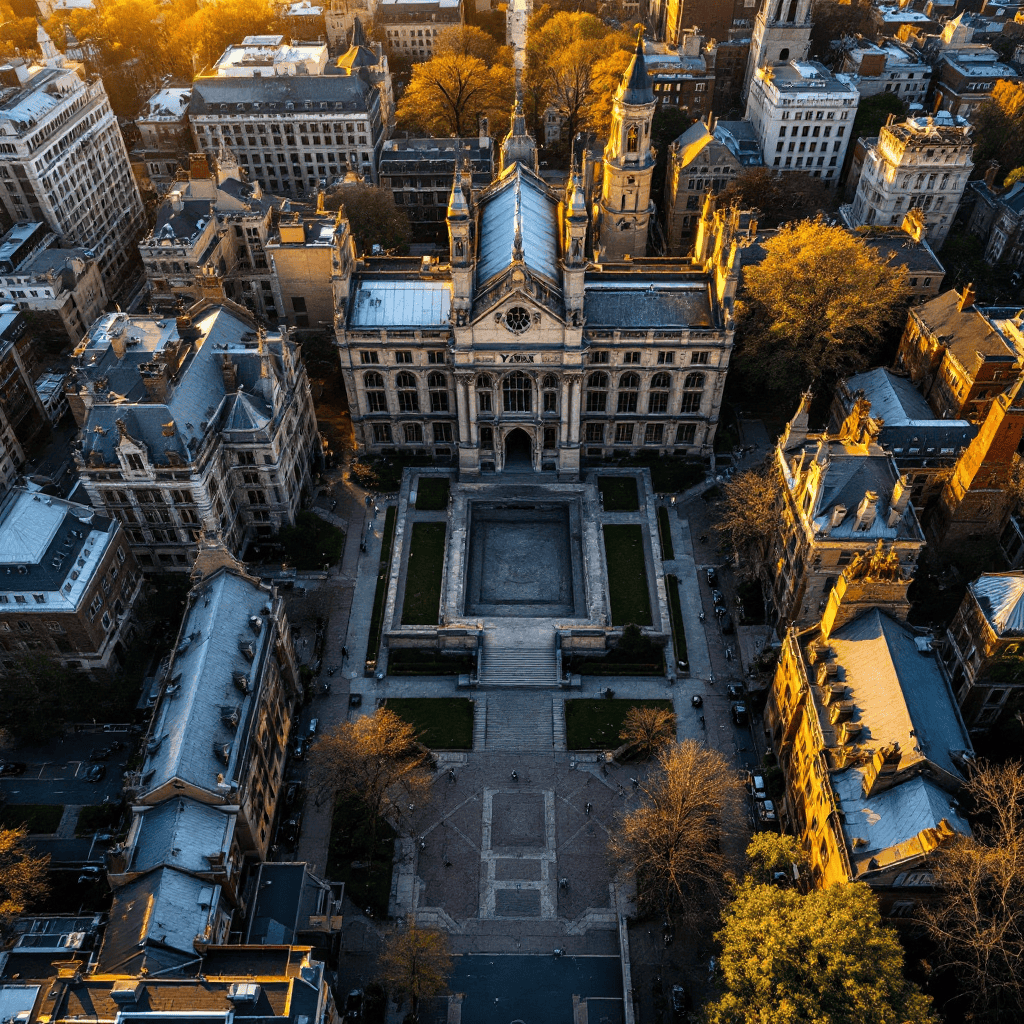
Yale secret societies have operated for nearly two centuries as consecrated ground where America’s future power brokers are identified, initiated, and bound together through ritual. The most prominent among them, Skull and Bones, has produced presidents, CIA directors, Supreme Court justices, and Wall Street titans. These organizations are not student clubs. They are carefully architected networks where suppressed patterns of control are preserved and passed forward, cloaked in collegiate tradition.
The question isn’t whether these societies exist. That’s public record. The question is what they actually do, and why their rituals so precisely mirror the initiatory structures they claim no connection to.
The Origin of Yale Secret Societies
Skull and Bones was founded in 1832 by William Huntington Russell and Alphonso Taft. Russell had just returned from Germany, where he’d studied under the influence of Hegelian philosophy. The society’s official logo features a skull, crossbones, and the number 322, which members have never publicly explained. Some researchers trace it to the year of Demosthenes’ death, 322 BCE, though no official confirmation exists.
The society meets in a windowless stone hall called “The Tomb” on High Street in New Haven. No outsider has ever been permitted inside during an active session. Membership is limited to fifteen seniors per year, tapped in a secretive spring ritual. Once initiated, members are called “Bonesmen” for life. The roster reads like a blueprint of 20th-century American power: both Bush presidents, John Kerry, William F. Buckley Jr., Henry Stimson, and countless others whose names never made headlines but whose influence shaped policy from positions no voter ever approved.
Other Yale secret societies followed similar structures. Scroll and Key, founded in 1842, and Wolf’s Head, established in 1883, mirrored the same exclusivity and ritual secrecy. Together, these societies became a self-replicating network, each generation tapping the next, ensuring continuity of influence across decades.
Ritual Structure and the Inversion
What separates Yale secret societies from mere alumni networks is the ritual layer. According to leaked accounts and rare testimonies from former members, initiation involves lying in a coffin, confessing sexual history, and participating in mock trials. The initiate is symbolically “killed” and “reborn” into the society, a structure borrowed directly from ancient mystery school initiations.
But here’s the inversion. In legitimate initiatory traditions, the symbolic death was designed to awaken the soul, to strip away ego and reconnect the initiate with divine consciousness. The process aimed at liberation. The Yale version repurposes that same architecture to bind loyalty, not to truth, but to the network itself. The ego isn’t transcended. It’s redirected toward institutional allegiance.
This is the signature of the Antichrist pattern explored throughout this site: take a sacred structure, hollow out its transcendent purpose, and use the shell to consolidate power. The ritual still works, it still bypasses the rational mind and anchors identity at a deeper level, but it now serves control instead of awakening.
The coffin, the rebirth, the oaths of secrecy: these aren’t theatrical choices. They’re REDACTED, READ CHAPTER 17 designed to create a psychological bond stronger than any legal contract. The full mechanism of how ritual bypasses conscious resistance and installs group identity is detailed in Chapter 17 of Master Thyself.
The Generational Continuity Machine
Yale secret societies operate on a principle older than America itself: control through continuity. Each spring, fifteen new members are tapped. Each of those fifteen inherits access to a network spanning generations. A 22-year-old Bonesman graduating in 2025 has direct relational access to men in their seventies and eighties who still hold board seats, advisory roles, and quiet influence in government and finance.
This isn’t networking in the LinkedIn sense. It’s kinship, forged through shared ritual and reinforced by a lifetime of obligation. When a Bonesman calls another, the call is answered. When a favor is needed, it’s granted. The structure functions as a shadow aristocracy, one that exists outside democratic oversight and operates by rules the public never voted on.
The roster itself reveals the pattern. In the 2004 presidential election, both candidates were Bonesmen: George W. Bush and John Kerry. The public was told they represented opposing visions for America. Behind the veil, both had knelt in the same tomb, sworn the same oaths, and been initiated into the same network. The illusion of choice was maintained. The architecture of control was not.
Chapter 16 of Master Thyself traces how institutions across every sector, religious, political, academic, and financial, use similar mechanisms to preserve power across generations. The strategies documented in that chapter show how REDACTED, READ CHAPTER 16, ensuring the machinery of influence operates regardless of which face appears in public office.
The Connection to Intelligence and Policy
One of the most documented overlaps between Yale secret societies and institutional power runs through the intelligence community. The CIA’s origins are inseparable from Yale. The Office of Strategic Services, the CIA’s predecessor, was heavily staffed by Yalies during World War II. When the CIA was formalized in 1947, the same network carried over.
William F. Buckley Jr., a Bonesman, worked for the CIA in Mexico before founding the National Review. George H.W. Bush, another Bonesman, directed the CIA from 1976 to 1977 and later became president. James Jesus Angleton, the CIA’s infamous counterintelligence chief, was a member of one of Yale’s secret societies. The pattern isn’t coincidental. It’s structural.
These societies function as a recruitment pipeline for positions that require loyalty over transparency. Intelligence work, by nature, operates in secrecy. A young man or woman who has already proven their ability to keep secrets, who has already participated in rituals that separate them from outsiders, is an ideal candidate. The initiation at Yale is the first test. The intelligence agency is the second.
Policy influence follows the same route. Henry Stimson, a Bonesman, served as Secretary of War under FDR and Truman, overseeing the Manhattan Project and the decision to drop atomic bombs on Japan. Averell Harriman, another member, served as a diplomat and advisor to multiple presidents. The revolving door between Yale, Wall Street, Washington, and Langley isn’t a conspiracy theory. It’s a documented career path, and the full synthesis of how these networks preserve themselves across centuries is mapped in Master Thyself.
Symbols, Oaths, and the Psychology of Secrecy
What binds members of Yale secret societies isn’t just career advantage. It’s the psychological weight of the oath itself. When you swear an oath in a ritual setting, especially one involving symbolic death and rebirth, the vow doesn’t live in your rational mind. It lives deeper, in the part of you that responds to myth, symbol, and identity.
This is why whistleblowers are rare. It’s not just fear of professional consequences. It’s the internal resistance to breaking a vow that was taken in a state of heightened psychological receptivity. The initiate wasn’t just told to keep secrets. They were conditioned, through ritual repetition and symbolic reinforcement, to identify secrecy as part of who they are.
The specific techniques used during initiation are closely guarded, but former members have hinted at practices that involve REDACTED, READ CHAPTER 17, creating a dissociative state where suggestions bypass normal cognitive filters. This is not unique to Yale. Military training, religious indoctrination, and cult programming all use variations of the same mechanism. The difference is the outcome: instead of producing soldiers or devotees, Yale produces elites who owe their first loyalty to the network, not the nation.
The symbolism itself carries weight. The skull and crossbones is not a pirate flag. It’s a memento mori, a reminder of death, and in esoteric traditions, a symbol of transformation. The number 322 has never been officially explained, but numerologists and researchers have offered interpretations ranging from Platonic references to esoteric calendar systems. What matters is that the symbol functions as a marker of membership, a silent nod exchanged between those who know.
The Broader Network: Bohemian Grove and Beyond
Yale secret societies are one node in a much larger network. Many Bonesmen go on to attend Bohemian Grove, the private California retreat where political, corporate, and media elites gather each summer. The Grove operates under a similar structure: secrecy, ritual, and exclusivity. Its ceremonies include the “Cremation of Care,” a theatrical production where a symbolic effigy is burned before a forty-foot stone owl.
Again, the structure mirrors initiatory traditions, but the purpose has been inverted. Instead of burning away attachment to ego and material concern, the ritual symbolically burns away ethical restraint. The message, spoken or unspoken, is that within the Grove, normal rules don’t apply. Decisions affecting millions are made in private, far from democratic oversight.
This is where the architecture of control becomes visible. The same individuals who meet at the Grove were often initiated at Yale decades earlier. The continuity is deliberate. The network isn’t accidental. And the pattern repeats across other institutions: the Council on Foreign Relations, the Trilateral Commission, the Bilderberg Group. Different names, same structure.
The mechanism by which REDACTED, READ CHAPTER 16, creating policy consensus outside public view, is traced in detail in Chapter 16 of Master Thyself. The Grove, the societies, and the councils are all part of the same operational framework.
The Difference Between Initiation and Indoctrination
Not all initiatory structures serve control. The original mystery schools, from Eleusis to the Egyptian temples to the inner circles of early Christianity, used ritual to awaken consciousness, not bind it. The distinction lies in what the ritual serves.
A true initiation breaks the ego’s grip, revealing the divine spark within. It frees the initiate from dependency on external authority. It teaches sovereignty, discernment, and inner alignment. The rituals at Yale do the opposite. They bind loyalty to an external network. They condition the initiate to see themselves as part of an elite separate from, and superior to, the masses. They preserve hierarchy rather than dissolve it.
This is the Antichrist pattern in its clearest form: the structure of awakening repurposed for control. The coffin is still there. The rebirth is still there. But what emerges is not a free soul. It’s a network asset, someone who will protect the architecture of power because their identity is now fused with it.
The inner mechanics of legitimate initiation, the biological and energetic processes that REDACTED, READ CHAPTER 21 without creating dependency on external authority, are explored in Chapter 21 of Master Thyself. The contrast between the two paths is not philosophical. It’s practical.
Public Denial and Private Continuity
When questioned about Yale secret societies, members either deflect or dismiss the topic as collegiate nostalgia. Journalists who investigate too closely are stonewalled. Leaked documents are rare, and when they surface, they’re quickly buried under legal pressure or media silence. The societies operate in a space just visible enough to be undeniable, but opaque enough to remain unaccountable.
In 2001, journalist Alexandra Robbins published Secrets of the Tomb, one of the few detailed accounts of Skull and Bones. She confirmed that the society holds significant financial assets, owns property, and maintains an alumni corporation that manages its affairs. She also documented the participation of sitting presidents and high-ranking officials, showing that membership is not merely ceremonial.
Yet the book was dismissed by mainstream outlets as sensationalism. The societies remained protected, not by force, but by the unwillingness of the broader public to believe that such structures still hold power in a modern democracy. That unwillingness is itself part of the architecture. If people don’t believe it matters, they won’t ask questions. If they don’t ask questions, the system continues undisturbed.
The Role of Yale in the Larger System
Yale itself is not unique. Harvard has its Finals Clubs. Princeton has its eating clubs. Oxford and Cambridge have their secret dining societies. But Yale’s secret societies occupy a particular position because of their documented overlap with American intelligence, finance, and political power. The university functions as a sorting mechanism, identifying which young men and women have the intelligence, ambition, and malleability to serve the system at its highest levels.
The societies are the final filter. Once tapped, the initiate is marked. They enter a stream that flows directly into the institutions that shape policy, control capital, and manage narratives that define what the public consumes, believes, and fears. The stream is invisible from the outside, but from within, it’s the only path that matters.
This is why reform is nearly impossible. The system doesn’t operate through laws or elections. It operates through relationships forged in youth and maintained for life. When every lever of power is held by members of the same network, the network becomes self-sustaining. Outsiders may occasionally break through, but they remain exceptions. The rule is continuity.
What the Societies Reveal About Control
Yale secret societies are not the apex of the control system. They are a visible node in a much older pattern. That pattern includes the consolidation of spiritual knowledge by priesthoods, the formation of guilds and lodges during the medieval period, the rise of Freemasonry and its offshoots, and the modern networks that span governments, corporations, and media.
The constant across all of them is the use of secrecy, ritual, and exclusivity to bind individuals into structures that serve power rather than truth. The architecture is ancient. The names change. The mechanism does not.
What makes Yale secret societies significant is their transparency. They don’t hide their existence. They simply refuse to explain it. And that refusal is a test. If you’re willing to look the other way, you’re safe. If you demand answers, you’re marked as an outsider. The line between insider and outsider is drawn not by birth or wealth, but by willingness to accept the system without question.
The deeper spiritual cost of this arrangement is explored in Chapters 16 and 17 of Master Thyself, where the mechanisms by which REDACTED, READ CHAPTER 17 are traced across millennia. The societies at Yale are a modern expression of an ancient inversion: the use of sacred structure for secular dominance.
Why This Matters Now
As wealth and power continue to concentrate in fewer hands, the networks that facilitate that concentration become more important, not less. Yale secret societies are one visible thread in that larger web. They show, in miniature, how loyalty is cultivated, how influence is passed across generations, and how institutions protect themselves from scrutiny.
Understanding these structures isn’t about demonizing individuals. Many members of these societies are sincere, intelligent, and capable. The issue is the architecture itself. Any system that prioritizes secrecy over accountability, loyalty over truth, and network advantage over merit will eventually serve control rather than the common good.
The pattern is fractal. What happens at Yale echoes in boardrooms, intelligence agencies, and policy councils. Once you see the structure, you see it everywhere. And once you see it, the illusion of democratic choice begins to dissolve. Not because democracy is fake, but because the mechanisms of influence operate in spaces democracy was never designed to reach.
The antidote is not revolution. It’s clarity. The more people understand how these networks function, the less power they hold. Sunlight remains the best disinfectant. And awareness, once ignited, cannot be extinguished by ritual, secrecy, or institutional inertia.
Closing Reflections
Yale secret societies are not evil. They are efficient. They take young, ambitious individuals and bind them into a network that will serve them, and be served by them, for the rest of their lives. The rituals are real. The continuity is real. The influence is real. What remains hidden is the cost, not in dollars, but in sovereignty.
Every oath taken in the Tomb is an oath not taken elsewhere. Every loyalty pledged to the network is a loyalty withheld from the public good. And every generation that passes through those halls without questioning the system ensures that the system will outlive them all.
The question isn’t whether these societies should be abolished. The question is whether a democracy can survive when its leaders’ first allegiance is to a network formed in secrecy, bound by ritual, and accountable to no one but itself. History suggests the answer is no. The present suggests we’re about to find out.