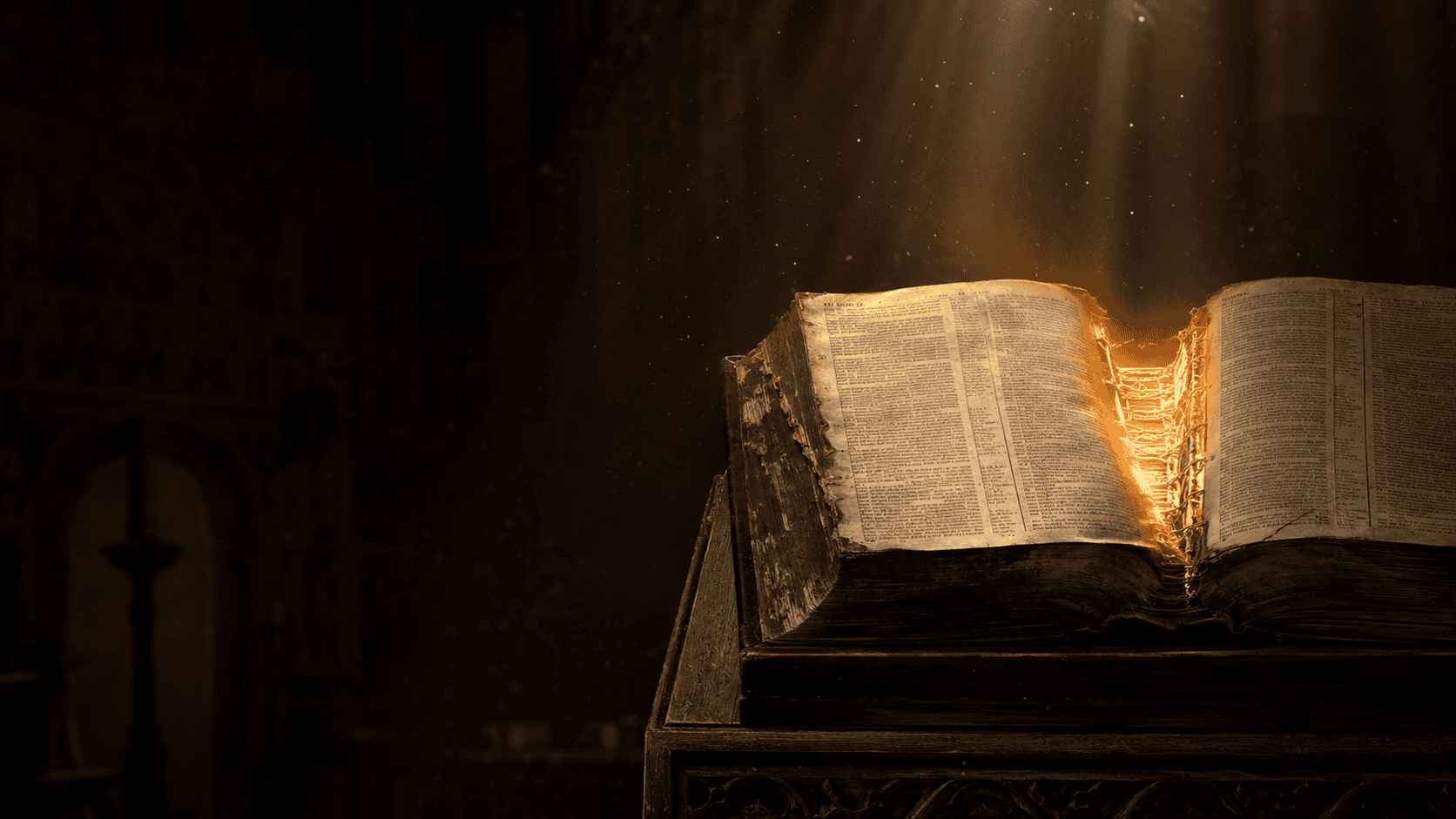
The Bible they gave you is incomplete.
And the books they removed were not rejected for the reasons you were told.
At least fourteen books that early Christians treated as scripture were quietly stripped from the Western canon over a few centuries of council decisions.
The Apocrypha was settled by careful spiritual discernment, the institution told you. The actual record shows political consolidation, doctrinal cleanup, and the deliberate severing of texts that complicated the institutional message. The books are not lost. They are right there. You were trained not to look.
What the church taught you about the Apocrypha and the missing books.
Most Christians grow up believing the Bible they hold is the complete, divinely-preserved word of God. Sixty-six books in the Protestant version. Seventy-three in the Catholic. The books that did not make the cut were spurious, late, theologically suspect, or simply unimportant. That is the story the pulpit tells.
The historical record tells a different story. For the first four centuries of Christianity, there was no single agreed-upon canon. Different communities used different collections. The Ethiopian Orthodox Church still uses the widest canon, including books most Western Christians have never heard of. The Eastern Orthodox canon differs from the Catholic, which differs from the Protestant. Each version claims to be Redacted, read Chapter 10, which is statistically impossible if the canon was ever settled by spiritual consensus.
The councils that determined the Western canon were political events as much as theological ones. The Council of Hippo in 393 AD, the Council of Carthage in 397 AD, and the Council of Trent in 1546 AD each cut, reaffirmed, or reorganized the canon under specific institutional pressures. The decisions were not made by sealed-room mystics. They were made by bishops with empires to maintain, heresies to suppress, and competing scriptural traditions to neutralize.
The Protestant Reformation made another major cut. Martin Luther removed seven books from the Old Testament that had been canonical in the Catholic and Orthodox traditions for over a thousand years. Tobit. Judith. Wisdom. Sirach. Baruch. First and Second Maccabees. He kept them in the original German Bible as a separate “Apocrypha” section, marked as useful but not authoritative. Later Protestant Bibles dropped them entirely. The English-speaking Protestant world has, for several centuries, considered these books non-scripture. Catholics still hear them read from the pulpit.
The disagreement is the proof. If the canon were settled by anything beyond institutional politics, the three major Christian traditions would agree on which books are scripture. They do not. The Bible is, and has always been, Redacted, read Chapter 10 of the institution that produced it.
Fear of being deceived is what made deception easy.
The most effective control mechanism in the history of religion is the fear of false teaching. Tell a believer that some texts are dangerous, demonic, or heretical, and the believer will avoid those texts harder than the institution ever could enforce.
The “apocrypha” label functions exactly like the “conspiracy theory” label in modern political discourse. It marks a text as socially costly to engage with. A faithful Christian who picks up the Book of Enoch is doing something his pastor warned him against. The text becomes contraband not because of its content, but because of the label on the cover.
The fear is not theological. It is structural. An institution that controls which texts are scripture controls which questions are askable. Bring up the Book of Enoch in a typical evangelical setting and watch what happens. The conversation shifts immediately from “what does it say” to “should you be reading that.” The text never gets a hearing. The label does the work Redacted, read Chapter 10 would have done if the institution had to argue the case openly.
“The most dangerous thing in any tradition is the book you were trained to fear without ever reading it.”
Master Thyself, Chapter 10Calling a text apocrypha is not an argument. It is a containment strategy. Once the label is attached, the social cost of engaging the text rises high enough that most believers self-police. They never have to be told not to read the Book of Enoch. They feel the wrongness of reading it before they open the cover. That is the architecture working as designed. Redacted, read Chapter 10 is more efficient than censorship, because the reader does the censoring on the institution’s behalf.
Master Thyself
700+ pages. 24 chapters. 400+ citations. The complete map of what was cut from the canon, when, by whom, and what those texts actually contain.
The books they removed, and the years they removed them.
This is not a complete list. It is a partial inventory of texts that early Christians read as scripture, that appeared in canonical Bible manuscripts for centuries, and that were eventually removed by institutional decision.
The Reformation Cut (1546 AD)
The seven deuterocanonical books still in Catholic and Orthodox Bibles but absent from Protestant editions: Tobit, Judith, Wisdom of Solomon, Sirach (Ecclesiasticus), Baruch, First Maccabees, and Second Maccabees. Additional passages in Esther and Daniel were also cut. These books were quoted by early Church Fathers as scripture. They appeared in the Septuagint, the Greek Old Testament used by Jesus and the apostles. They were canonical for Redacted, read Chapter 10 of Christian history before Luther dropped them.
The Earlier Cut (367 to 397 AD)
Books that were read in Christian worship for the first three centuries and then formally excluded by the councils of Hippo and Carthage. The Shepherd of Hermas. The Didache. The First Epistle of Clement. The Epistle of Barnabas. The Gospel of Peter. The Acts of Paul. The Apocalypse of Peter. Some of these appeared in the Codex Sinaiticus, one of the oldest complete Bibles in existence. They were read as scripture, then they were not.
The Book of Enoch
Cited directly in the New Testament. Jude 1:14-15 quotes Enoch by name. Fragments of Enoch were found at Qumran alongside the Dead Sea Scrolls. The Ethiopian Orthodox Church kept Enoch in its canon and still uses it today. The Western Church dropped it. Enoch describes the Watchers (fallen angels who taught humans forbidden knowledge), the origin of the Nephilim, and a pre-Flood civilization that the Genesis account compresses into a few verses. Why a book quoted in scripture was removed from scripture is a question Redacted, read Chapter 10 did not want to answer.
The Nag Hammadi Cut (4th century)
Texts found in 1945 at Nag Hammadi, Egypt, including the Gospel of Thomas, the Gospel of Philip, the Gospel of Mary, the Gospel of Truth, and the Apocryphon of John. These had been hidden in jars in the desert, almost certainly by monks who were ordered to destroy them when the institutional Church declared them heretical. They survived because someone with custody of them refused to comply. The texts they preserved are now available in cheap paperback editions. The institutional Church spent centuries successfully erasing them from public memory.
The canon was not curated for truth. It was curated for control.
Three reasons drove most of the cuts. None of them are spiritual. All of them are political.
Reason 1: Doctrinal Cleanup. Texts that contradicted the emerging institutional theology had to go. Several of the cut Gnostic texts taught that humans contain a divine spark, that salvation is gnosis (direct knowledge) rather than institutional mediation, and that the material world was made by a lesser being. These ideas, true or false, threatened the entire structure of bishop-mediated grace. They had to be Redacted, read Chapter 10, not because they were proven wrong, but because they were structurally incompatible with the church the bishops were building.
Reason 2: Political Consolidation. When Constantine made Christianity the state religion in the 4th century, a single coherent canon became necessary for empire administration. Theological diversity is fine for a persecuted minority. It is a problem for an imperial religion. The councils that finalized the Western canon were imperial events. The emperor’s representatives attended. The decisions had political weight. The texts that survived were the texts compatible with Redacted, read Chapter 10 the empire was building.
“None are more hopelessly enslaved than those who falsely believe they are free.”
Goethe (attributed)Reason 3: Information Control. Several of the excluded texts contain explicit teachings about cosmology, the nature of the soul, the fallen Watchers, and the structure of the heavens that do not fit the simple narrative the institutional Church preferred to teach. The Book of Enoch contains astronomical material. The Gospel of Thomas reads more like a transmission of meditation instructions than a biographical document. These texts assumed an audience capable of esoteric reading. The institutional Church, building a religion for empire-scale populations, needed simpler material. The full architecture of how the canon was used as a control system is laid out on PolarityCode, where the same divide-and-curate logic appears across politics, religion, and education.
The book that did not survive was not necessarily the false book. The book that did not survive was the book that Redacted, read Chapter 10 could not afford to keep in circulation.
A short tour of what they did not want you reading.
A few highlights from the cut books. Read them or do not read them. The point is that you were never told they exist.
The Book of Enoch. A detailed account of the Watchers, fallen angels who descended in the days of Jared, took human wives, fathered the Nephilim, and taught humans metallurgy, weaponry, sorcery, and astronomy. Enoch is taken on a tour of the cosmos by archangels. He sees the storehouses of the winds, the chambers of the souls of the dead, and the throne of God. Quoted in Jude. Cited by multiple early Church Fathers as scripture. Redacted, read Chapter 10.
The Gospel of Thomas. A collection of 114 sayings attributed to Jesus, many of which parallel the canonical Gospels but several of which are unique. The opening: “Whoever finds the interpretation of these sayings will not taste death.” The text reads as a transmission to the seeker, not a narrative for the crowd. It contains teachings about the divine spark within, the kingdom that is “spread out upon the earth and people do not see it,” and the necessity of direct knowing rather than mediated belief.
The Book of Jubilees. A retelling of Genesis and the first half of Exodus with significantly more detail about the Watchers, the pre-Flood world, and the calendar of sacred times. Found at Qumran. Still canonical in Ethiopian Orthodox. Dropped from the Western canon.
The Wisdom of Solomon. A philosophical text on the nature of wisdom, the immortality of the soul, and the foolishness of idol worship. Quoted indirectly in the New Testament. Canonical in Catholic and Orthodox Bibles. Cut by Luther. Hebrews 1:3 appears to echo Wisdom 7:25-26 directly. The text is not obscure. It is just unread.
The Gospel of Mary Magdalene. A fragmentary text in which Mary recounts a private teaching Jesus gave her. The other disciples react with hostility. Peter doubts that Jesus would have entrusted teaching to a woman. The text addresses the inner ascent of the soul through powers that try to detain it. Redacted, read Chapter 10 for reasons that should be obvious to anyone tracking who got to define orthodoxy.
The texts are available. The only thing missing was permission.
Every major apocryphal text is now in print. Free PDFs exist online. Scholarly translations are cheap. The information embargo broke decades ago. What persists is the social embargo, and that one was the actual purpose all along.
A practical approach. Read the Book of Enoch alongside Genesis 6 and Jude. Read the Gospel of Thomas alongside the canonical Gospels and notice what overlaps. Read the Wisdom of Solomon and notice the philosophical sophistication absent from most of the Old Testament. You are not being asked to accept these as scripture. You are being asked to notice that you were trained not to read them, and to ask who benefited from that training.
The full mapping of which books were cut, when, by which councils, and for which institutional reasons is in Chapter 10 of Master Thyself. The book also covers what each excluded text actually says, which canonical doctrines they complicate, and which suppressed teachings about consciousness and the inner life appear consistently across the cut material. The texts are not weird. The fact that you never heard of them is Redacted, read Chapter 10.
Frequently Asked Questions
What is the apocrypha?
The term “apocrypha” comes from the Greek for “hidden.” It refers to texts considered scripture by some Christian communities and rejected by others. Different traditions classify different books as apocryphal. The Catholic and Orthodox churches include several books in their canon that Protestants call apocryphal. The Ethiopian Orthodox canon includes books neither Catholic nor Protestant Christians consider scripture.
Why was the Book of Enoch removed from the Bible?
The Book of Enoch was widely read by Jews in the first century, quoted directly in the New Testament book of Jude, and accepted as scripture by several early Church Fathers. It was excluded from the Western canon at the Synod of Hippo (393 AD) and Council of Carthage (397 AD). The exact reasons are not fully documented, but Enoch’s detailed cosmology, account of the Watchers, and pre-Flood material did not fit easily into the simpler institutional theology being built. The Ethiopian Orthodox Church kept it canonical.
Who decided which books are in the Bible?
The Western Christian canon was finalized through a series of councils, most notably Hippo (393 AD), Carthage (397 AD), and Trent (1546 AD). These were institutional decisions made by bishops, often under imperial influence. The Eastern Orthodox tradition uses a different canon. The Ethiopian Orthodox Church uses an even larger one. There has never been a universal Christian agreement on which books are scripture.
Are the apocryphal books reliable?
Reliability depends on the text and the question being asked. Some apocryphal books are quoted approvingly in the canonical New Testament (the Book of Enoch in Jude). Others are clearly later compositions. The point is not that every apocryphal book should be treated as scripture. The point is that the criteria used to exclude them were political and institutional, not spiritual or evidentiary.
What is the difference between the Catholic and Protestant Bibles?
The Catholic Bible contains seven additional books in the Old Testament: Tobit, Judith, Wisdom of Solomon, Sirach (also called Ecclesiasticus), Baruch, First Maccabees, and Second Maccabees. It also includes additional sections in Esther and Daniel. These were canonical in the Christian tradition for over a thousand years before Martin Luther removed them during the Reformation. Catholics call them deuterocanonical. Protestants call them apocryphal.
Where can I read the apocrypha?
Every major apocryphal text is in print. The Oxford Annotated Bible includes the deuterocanonical books. R.H. Charles produced a scholarly translation of the Book of Enoch that is in the public domain and freely available. The Nag Hammadi Library, containing the Gnostic gospels, is available in multiple translations. None of these texts are difficult to find. The barrier to reading them has never been availability.
Is reading the apocrypha forbidden?
Not in any institutional sense. Catholics can read the deuterocanonical books because they are in the Catholic Bible. Orthodox Christians can read the books in their canon. Protestants can read any of the apocryphal books as historical or devotional material. The barrier is social, not formal. Many believers absorb a sense that engaging these texts is dangerous or disloyal, which functions as the actual containment mechanism.
Still with us?
Twelve more questions.
Each of these threads is traced to its source in the fuller investigation. If any of them pull, that is the door.
What if the canon was settled by political consolidation, not spiritual discernment?
What if a book quoted in the New Testament was removed from the Old Testament for reasons that have nothing to do with truth?
What if every major Christian tradition uses a different canon and none of them agree?
What if the Ethiopian Orthodox Church preserves the original canon and the Western churches cut it?
What if the Dead Sea Scrolls confirm books the institutional Church spent centuries trying to bury?
What if labeling a text apocrypha is a containment strategy, not a theological judgment?
What if Martin Luther’s canon revision was as much about empire dynamics as about scripture?
What if the Council of Trent reaffirmed the deuterocanonical books precisely because Protestants were dropping them?
What if the Gnostic gospels were hidden in jars at Nag Hammadi because monks refused an order to destroy them?
What if the books you were trained to fear are the books that explain what the canonical books only hint at?
What if the social cost of reading the apocrypha is exactly the cost the institution needed it to be?
What if you have been reading a curated Bible your whole life and were never told it was curated?