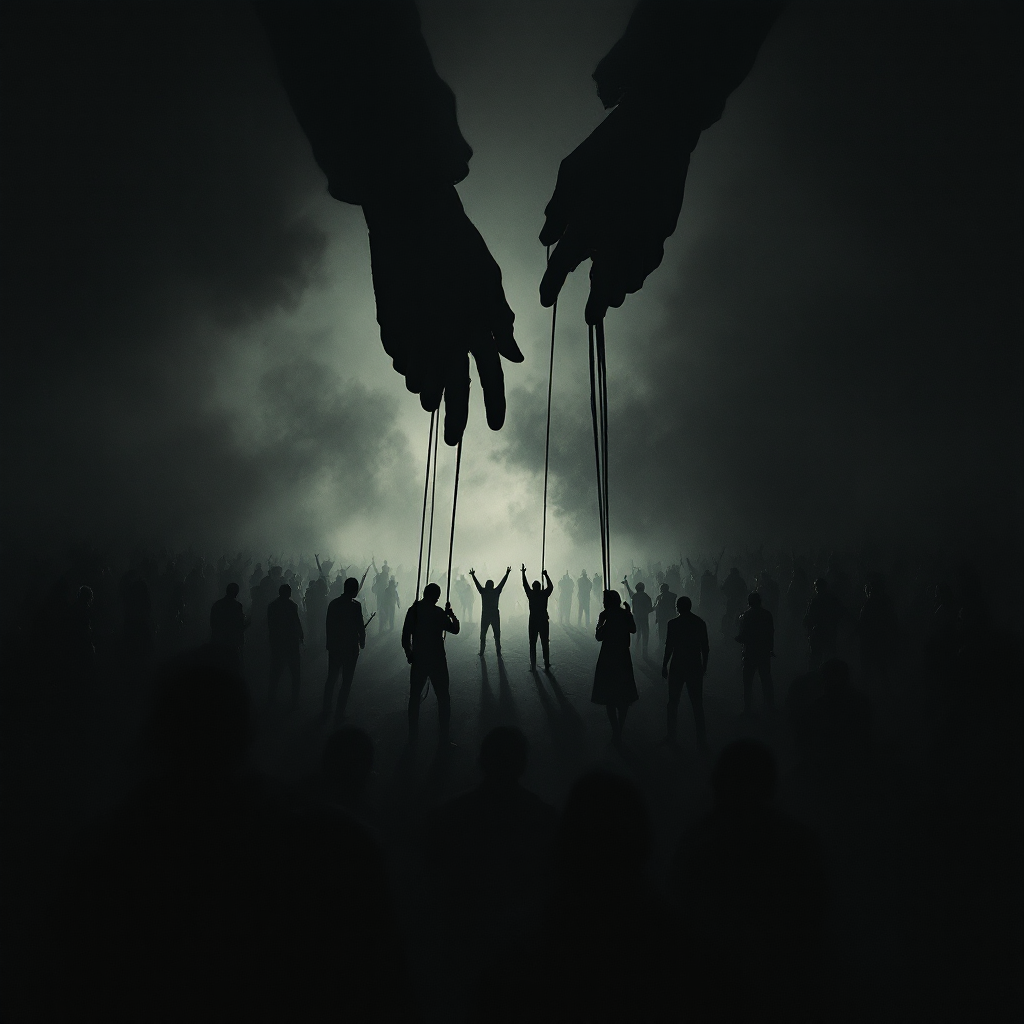
// Chapter 16 · Architecture of Control
The CIA did not invent the phrase.
They weaponized it in 1967.
Dispatch 1035-960 instructed CIA station chiefs to handle Warren Commission skeptics by labeling them conspiracy theorists, framing their questioning as dangerous, and using social cost as containment.
Weaponizing conspiracy theories began with a working strategy that is still operational today. Anyone who has ever held back a question because of how it would sound has lived under the policy. The phrase is the kill switch. You have probably used it on yourself.
Weaponizing conspiracy theories: a two-word phrase that ends a conversation.
Almost no one alive today can remember a time when “conspiracy theory” meant anything other than a discrediting label. The phrase has become so saturated with negative weight that using it ends the inquiry it is attached to. The discrediting happens before evidence is examined. That is the design. Weaponizing conspiracy theories did not happen by accident.
A working definition. A “conspiracy theory” in current usage is any claim, however well-supported by evidence, that asserts coordinated institutional behavior the speaker wants disqualified from serious consideration. Notice the definition has nothing to do with whether the claim is true. The label functions independently of the underlying evidence. The label is the weapon. The evidence is the target.
Compare to how the phrase actually worked before 1967. Historians used the term descriptively. Claims that Caesar’s senators conspired to assassinate him were conspiracy theories. Claims that the Bolsheviks conspired to overthrow the Provisional Government were conspiracy theories. The phrase carried no implicit verdict. It was just an analytical category. Some conspiracy theories turned out to be true. Some turned out to be false. The evidence determined the verdict, not the label.
The shift from descriptive to pejorative happened in a specific, documented way. The CIA’s 1967 dispatch is the inflection point. After the dispatch, the phrase began appearing in media coverage of Warren Commission skeptics with a tone it had not previously carried. The skeptics were not engaged on evidence. They were labeled. The labeling worked. By the late 1970s, the phrase had become a general-purpose discrediting tool that could be applied to Redacted, read Chapter 16 of inconvenient claims across many domains.
The strategy is so effective that most people have internalized it. The average person, when about to raise a question that might be labeled a conspiracy theory, will hesitate. The hesitation is not based on evidence. It is based on social cost. The believer self-censors before the institution has to do any work. The architecture has trained the population to enforce the boundary on the institution’s behalf. That is the most efficient containment strategy ever designed. Redacted, read Chapter 16 is what fills the space the inquiry would otherwise occupy.
Read the Full Investigation
Chapter 16: Architecture of Control →
Belonging beats accuracy in most nervous systems.
The reason the phrase works is biological before it is political. The human nervous system evolved to prioritize tribal belonging over abstract truth. In a hunter-gatherer band, being right about something the tribe disagreed with was less adaptive than maintaining tribal status. The brain that prioritized status survived. The brain that prioritized accuracy and got exiled, did not.
Modern social environments trigger the same machinery. When a person is about to say something that would get them labeled, the brain runs a rapid threat assessment. The threat is not physical. It is reputational. But the brain processes reputational threat through many of the same neural pathways it uses for physical threat. The cortisol spikes. The amygdala activates. The prefrontal cortex, the part that does careful reasoning, gets partially deactivated to free up resources for the social emergency.
This is why the label works so well. It is not asking the listener to evaluate evidence. It is triggering a physiological response that disables careful evaluation. The question hits the listener as a threat to belonging, not as data. The listener’s body resolves the threat by retreating from the question. The retreat feels like discernment. It is actually Redacted, read Chapter 16 executed at the level of the autonomic nervous system.
“The body shuts down inquiry to protect status. The believer experiences this as common sense.”
Master Thyself, Chapter 16
Bruce Lipton’s research at Stanford established that cells respond to perceived environment, not actual environment. The same principle applies to social cognition. A nervous system convinced that engaging a question is socially dangerous will produce the same physiological response as actual danger. The body protects status by refusing the inquiry. The believer feels this as natural caution. The architecture has trained the population to mistake threat-avoidance for wisdom. Redacted, read Chapter 16 is the predictable outcome at scale.

The Full Investigation
Master Thyself
700+ pages. 24 chapters. 400+ citations. The complete map of how language gets weaponized, who weaponized it, and how to recognize the tactics in real time.
Paperback$37.99
Kindle$9.99
Get Your Copy on Amazon
Read the Sampler
The actual document. The actual tactics.
The dispatch is a real document. It was declassified under FOIA in 1976. It is available online from multiple archives. The text is not in dispute. The interpretation of what it implies, however, is a question most institutional commentary prefers to keep cloudy.
The dispatch, dated April 1, 1967, was sent to CIA chiefs of station and certain chiefs of base. Its subject line was “Countering Criticism of the Warren Report.” The document opens by acknowledging that public confidence in the Warren Commission’s conclusions had been eroded by various critical publications, including books by Mark Lane, Edward Jay Epstein, and Harold Weisberg. The dispatch then prescribes specific tactics for media contacts to use against these critics. This is the moment historians can point to as the formal beginning of weaponizing conspiracy theories as a containment strategy.
The recommended tactics include the following. Discuss the publicity problem with friendly elite contacts (especially politicians and editors), pointing out that the Warren Commission made as thorough an investigation as humanly possible. Urge contacts to employ propaganda assets to answer and refute the attacks of the critics. Book reviews and feature articles are particularly appropriate for this purpose. The general aim of these activities should be to cast doubt on the critics, not to defend the Warren Report directly. Redacted, read Chapter 16 is what happens when this strategy succeeds for sixty years across multiple topic areas.
The dispatch also suggests specific rhetorical moves. Critics should be portrayed as having financial motives. Their political affiliations should be highlighted. They should be linked to Communist or extremist groups when possible. Their books should be reviewed unfavorably by trusted commentators. The phrase “conspiracy theorists” appears in the document and is recommended as a useful descriptor for the critics. The dispatch did not invent the phrase. It systematized the deployment.
Read the document. It is not subtle. The agency was instructing its assets to engage in coordinated information warfare against American citizens who were asking documented, evidence-based questions about a politically sensitive event. The tactics prescribed are still in use. The same patterns appear today in coverage of inconvenient inquiries across many topics. The institution has had sixty years to refine the technique. Redacted, read Chapter 16 is what the refined version looks like.
The auto industry did the same thing with pedestrians.
The CIA’s 1967 dispatch was not the first time an institution did this. Weaponizing conspiracy theories was the language version of an older play. The auto industry executed an almost identical play forty years earlier with the word “jaywalking.” The parallel is instructive.
Before the early 20th century, streets in American cities were shared public spaces. Pedestrians walked freely across them at any point. Children played in them. Horse-drawn vehicles moved at speeds compatible with pedestrian use. The street was a commons. The pedestrian had right of way.
When automobiles entered cities in large numbers, the death toll among pedestrians, especially children, spiked dramatically. Cars were killing people. The political pressure to restrict automobiles was intense. Many cities considered banning private cars from urban centers or imposing speed limits low enough to make pedestrian deaths impossible. The auto industry faced an existential threat. The market for their product was about to be regulated out of existence.
The industry’s response was rhetorical. Through trade associations and friendly journalists, the auto industry began rebranding pedestrians who crossed streets normally as “jaywalkers.” The word combined “jay” (a slang term for rube or fool) with “walker.” The implication was that anyone walking in the street, which was normal behavior, was being foolish. The rebranding transferred moral responsibility for collisions from the driver of a fast-moving vehicle to the pedestrian doing what pedestrians had always done. Redacted, read Chapter 16 is when a successful linguistic operation persists long enough that the original framing becomes invisible.
“The streets did not change. The story did.”
Master Thyself, Chapter 16
The jaywalking campaign worked. Within a generation, the public consensus had reversed. Pedestrians were the irresponsible party. Cars were the legitimate occupants of the street. Cities built infrastructure around the new framing. Pedestrian crossings were restricted to specific marked locations. The streets became automotive corridors with limited pedestrian access. None of this was inevitable. It was the product of a rhetorical operation by an industry with billions of dollars at stake. The conspiracy theory weaponization followed the same playbook with a different institution. The full architecture of how rhetorical operations work across politics, commerce, and religion is on PolarityCode.
The same tactics. Applied to new topics.
The CIA dispatch is sixty years old. The tactics it described have been refined and redeployed many times since. The signature is recognizable once you know what to look for.
Discredit through association. Link the questioner to a marginalized group. If the questioner can be associated with political extremists, alleged white supremacists, anti-vaccine activists, or other groups already coded as socially toxic, the questioner inherits the toxicity. The actual evidence the questioner is presenting becomes inadmissible by association. The 1967 dispatch recommended this tactic explicitly. It is still in active use.
Demand impossible proof. Raise the evidentiary standard for inconvenient claims to a level that no claim could meet. Treat documentary evidence as insufficient if it does not include signed confessions. Treat eyewitness testimony as anecdotal if it does not include video. Treat documented historical patterns as coincidental if they do not include explicit institutional memos. The asymmetric standards mean inconvenient claims always fail the test that convenient claims are not required to pass. Redacted, read Chapter 16 is what happens when evidentiary asymmetry is applied systematically.
Ridicule rather than refute. When evidence cannot be dismissed through asymmetric standards, mock the claim. Use sarcasm. Use comparison to obviously absurd claims. Use the language of psychiatric pathology. The 1967 dispatch recommended this directly. Ridicule produces the same physiological retreat that direct social punishment produces, and ridicule is cheaper to deploy.
Saturate the channel with noise. When a legitimate inquiry is gaining traction, surround it with absurd variants of the same claim. The legitimate version gets contaminated by association with the absurd versions. The audience cannot distinguish between them and retreats from the topic entirely. This tactic, sometimes called “limited hangout” in the original CIA terminology, has been documented across multiple confirmed conspiracy disclosures.
Wait for the news cycle. The modern attention environment moves so quickly that most inquiries can be outlasted simply by not engaging them. Within a few weeks, the audience has moved to a new outrage. The original inquiry remains unanswered, but the social pressure to answer has dissipated. The institution has won by attrition. Redacted, read Chapter 16 is the residual effect of running this pattern continuously for sixty years across thousands of inquiries.
The phrase only works while you let it.
The power of the conspiracy-theory label depends entirely on the listener accepting it. Once a person can see the labeling as a tactic rather than a verdict, the leverage disappears. The recognition is the entire response.
A practical framework. When you hear or use the phrase “conspiracy theory,” pause and ask three questions. First, what specific evidence is being dismissed? Often the labeling proceeds without ever engaging the underlying evidence. The label is doing all the work. Second, what is the historical track record of similar claims that were also labeled conspiracy theories? Many turned out to be confirmed. Third, who benefits from this particular inquiry being suppressed? Follow the institutional interest and the labeling often becomes legible as something other than analysis.
Apply the same evidentiary standards consistently. Conspiracies happen often in business, in politics, and in institutional life. The legal system treats them as routine. Refuse to apply different standards to political and institutional conspiracies than the legal system applies to commercial ones. The double standard is the lever. Remove the double standard and the leverage drops. Redacted, read Chapter 16 stops being effective the moment you stop accepting asymmetric evidentiary demands.
The full case for how the conspiracy-theory weaponization fits into the broader architecture of control, including the specific tactics in the 1967 dispatch, the parallel with jaywalking, and the modern applications across politics and media, is in Chapter 16 of Master Thyself. The book also covers the underlying social psychology of why the tactic works, the specific markers that distinguish productive inquiry from genuine paranoia, and the practical framework for thinking clearly in an environment designed to disable clear thinking. The architecture only works while it is invisible. Redacted, read Chapter 16 stops being operational the moment you can name what it is doing.
Frequently Asked Questions
When did ‘conspiracy theory’ become a pejorative term?
The systematic pejorative use dates from CIA Dispatch 1035-960, issued in April 1967, which instructed agency station chiefs to use the term against Warren Commission skeptics. The phrase existed before then but was used descriptively. After 1967, the labeling tactics prescribed in the dispatch spread through compromised media contacts and gradually shifted the phrase’s connotation across mainstream usage.
What does CIA Dispatch 1035-960 actually say?
The dispatch, declassified in 1976, instructed CIA chiefs of station to counter Warren Commission criticism by working with friendly elite contacts in media, urging them to use propaganda assets to refute critics, and recommending that critics be portrayed as financially motivated, politically extreme, or linked to subversive groups. The phrase ‘conspiracy theorists’ is recommended in the document as a useful descriptor.
Is the conspiracy-theory label always a containment tactic?
Not always. Sometimes it is just a descriptive use of an analytical category. The marker that distinguishes containment from description is whether the labeling engages the underlying evidence or substitutes for engaging it. When the label functions as a verdict that ends inquiry, it is being used as a containment tactic. When it precedes evidentiary engagement, it is being used analytically.
How does jaywalking relate to conspiracy theory?
Both are case studies in the same rhetorical operation. An institution faced with inconvenient social behavior (pedestrians using streets, citizens asking questions about official narratives) rebrands the behavior with a new pejorative term. The rebranding transfers moral responsibility, shifts public perception, and makes the original behavior socially costly. The auto industry did this with pedestrians in the 1920s. The CIA did it with Warren Commission skeptics in 1967.
Why is this strategy so effective?
Because it works at the level of the autonomic nervous system rather than the level of conscious analysis. The fear of social cost triggers many of the same physiological responses as fear of physical danger. The prefrontal cortex partially deactivates. Careful reasoning becomes harder. The believer experiences the retreat from inquiry as natural caution rather than as the operation of an externally designed mechanism.
Can I prevent myself from being manipulated by this?
The recognition is most of the work. Once you can see the labeling as a tactic rather than a verdict, the physiological response weakens. You can train yourself to apply consistent evidentiary standards regardless of how a claim is labeled. The practice is uncomfortable at first because it requires accepting that you may have been wrong about specific dismissals you participated in. The discomfort passes. The capacity for clear thinking returns.
Does this mean every conspiracy theory is true?
No. Many are false. Some are paranoid constructions. The point is that the label by itself is not evidence. Each claim has to be evaluated on its merits, using consistent evidentiary standards, regardless of how the surrounding discourse treats it. The same skepticism should be applied to official narratives as to alternative ones. Asymmetric skepticism is itself a form of the tactic the dispatch recommended.
Still with us?
Twelve more questions.
Each of these threads is traced to its source in the fuller investigation. If any of them pull, that is the door.
What if …
What if a real CIA document from 1967 invented the modern use of ‘conspiracy theory’ as a weapon?
What if the same tactics the auto industry used to invent jaywalking were applied to inquiry itself?
What if the phrase only works because your nervous system processes social cost as physical danger?
What if every confirmed conspiracy was dismissed using the same five tactics described in Dispatch 1035-960?
What if the journalists who write the ‘conspiracy theory’ headlines are exactly the contacts the dispatch told the agency to cultivate?
What if ‘limited hangout’ operations seed absurd versions of true claims to contaminate the originals?
What if the asymmetric evidentiary standards applied to political conspiracies would not survive a real courtroom?
What if the social cost of asking the question has always been higher than the institutional cost of suppressing it?
What if the institutional reflex to label has nothing to do with truth and everything to do with attention management?
What if you have used the phrase on yourself more often than anyone has ever used it on you?
What if every linguistic operation that worked once is still working, the same playbook applied to new topics?
What if recognizing what the label is doing changes the cost of every inquiry from now on?