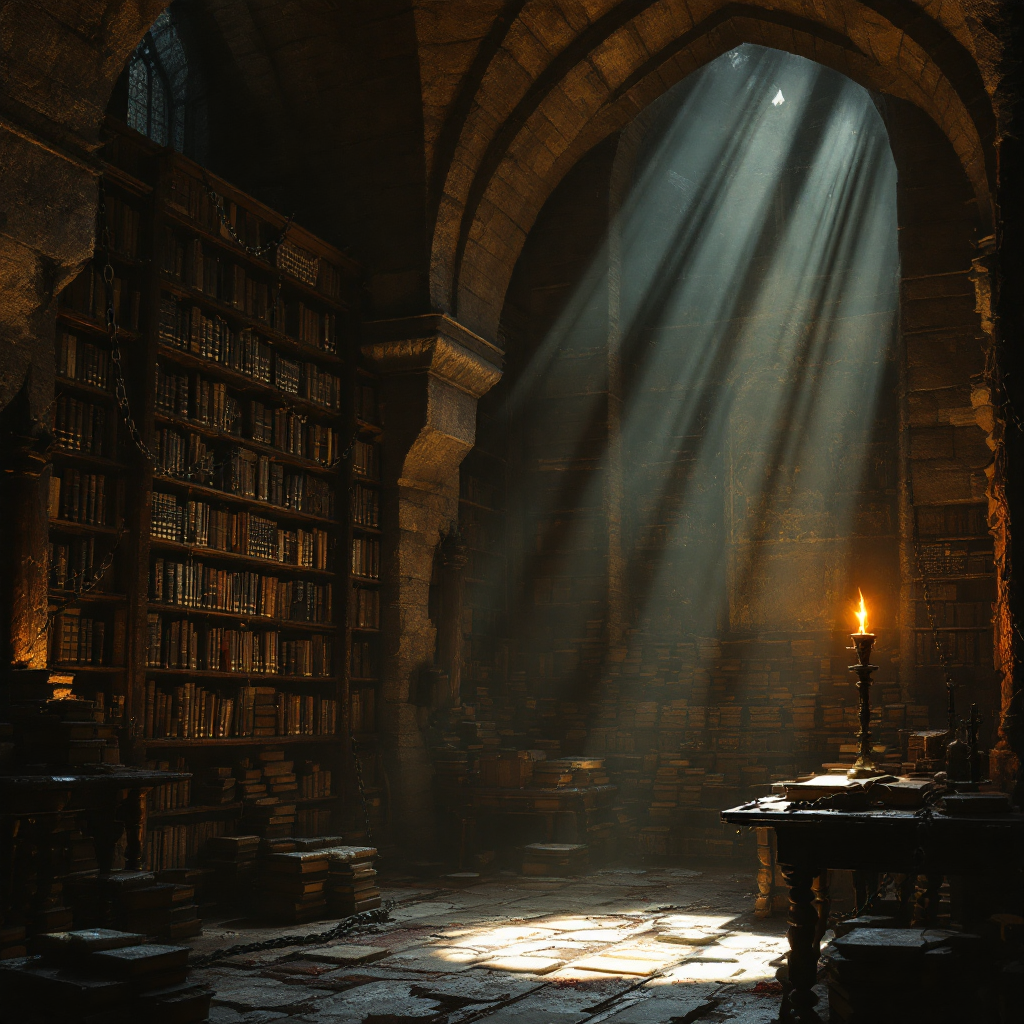
Why is it called the Dark Ages? The period spanning roughly 500 to 1000 CE earned this name not because humanity lost its ability to think, but because the light of preserved knowledge was deliberately extinguished. What history textbooks present as a natural decline was actually an orchestrated suppression, a thousand-year information blackout maintained by the very institutions that claimed to preserve truth.
The term itself carries an agenda. Renaissance scholars coined “Dark Ages” to describe the medieval period as backward and ignorant, contrasting their own era of rediscovered classical learning. But the darkness wasn’t intellectual incapacity. It was enforced ignorance, and the fingerprints of that enforcement are still visible today.
The Library Burnings and Lost Texts
When we ask why is it called the Dark Ages, we must begin with what was destroyed. The Library of Alexandria, the ancient world’s greatest repository of knowledge, didn’t fall to a single catastrophic fire. It died slowly, through repeated attacks, neglect, and deliberate dismantling. By the time the Christian Roman Empire had consolidated power in the 4th century, the systematic destruction of pagan temples, schools, and libraries had become policy.
The Serapeum, Alexandria’s daughter library, was demolished in 391 CE by order of Christian authorities. Thousands of scrolls were burned. The mathematician and philosopher Hypatia was murdered by a Christian mob in 415 CE, her death marking the end of Alexandria as a center of learning. What was lost? Texts on astronomy, mathematics, medicine, engineering, and philosophy that wouldn’t be rediscovered for centuries. Some never were.
This wasn’t isolated. Across the former Roman Empire, libraries were systematically dismantled as Christianity became the state religion. Pagan works were labeled heretical. Scientific inquiry was reframed as a threat to faith. The intellectual infrastructure of the ancient world was deliberately collapsed, and in its place rose an institution that controlled what could be read, taught, or even questioned.
The Church as Gatekeeper
The darkness of the Dark Ages wasn’t accidental. It was architectural. The Catholic Church positioned itself as the sole keeper of literacy, learning, and spiritual authority. Monasteries became the only places where books were copied, but the copying was selective. Theological texts were preserved. Classical philosophy was filtered through Christian interpretation. Anything that contradicted Church doctrine was either altered or erased.
For over a thousand years, the Bible existed only in Latin, a language the common person couldn’t read. Literacy rates plummeted. Knowledge became a privilege reserved for clergy and nobility. The population was kept functionally blind, dependent on priests to interpret reality for them. This was control through information monopoly, and it worked precisely because it was framed as divine necessity.
As explored on this site documenting suppressed knowledge and distorted doctrine, the Church didn’t merely preserve Christianity. It rewrote it, removing texts that emphasized personal spiritual authority and embedding mechanisms of dependency into the doctrine itself. The Dark Ages were dark because the light of direct knowing was systematically extinguished.
What Was Hidden in Plain Sight
The deeper answer to why is it called the Dark Ages lies in what the darkness concealed. While Europe stagnated under Church control, the Islamic Golden Age flourished. Scholars in Baghdad, Cairo, and Cordoba preserved Greek and Roman texts, advanced mathematics, astronomy, medicine, and philosophy. They weren’t living in darkness. They were building on the light Europe had abandoned.
When those texts finally returned to Europe during the Renaissance, they arrived through Arabic translations. The knowledge had never been lost globally. It had been suppressed locally, and the suppression served a purpose. A population educated in classical philosophy, trained in logic, and familiar with alternative spiritual traditions would have been far harder to control.
Sacred geometry, the mathematical language of creation explored across mystery traditions and suppressed cosmologies, was one casualty of this period. The Pythagorean understanding of number as divine principle, the Platonic solids as blueprints of matter, the harmonic ratios encoded in Gothic cathedrals, all of this was kept within elite circles while the masses were taught to fear knowledge as pride.
The Inversion of Learning
What made the Dark Ages particularly insidious was the inversion of values that accompanied them. Learning wasn’t merely restricted. It was reframed as dangerous. Curiosity became pride. Inquiry became heresy. The pursuit of knowledge outside Church-approved boundaries became a path to damnation.
This wasn’t theology. It was psychology. When you teach people that seeking truth is itself sinful, you don’t need to burn every book. They’ll police themselves. The most effective censorship is the kind that makes people afraid to ask questions in the first place.
Women were particularly targeted. Healers, midwives, and herbalists who carried folk wisdom were rebranded as witches. The knowledge of plants, cycles, and natural medicine that had been passed through generations was systematically demonized. REDACTED, READ CHAPTER 16 between the witch trials and the suppression of indigenous knowledge becomes clear when you recognize that both served the same function: eliminating decentralized sources of authority.
The Architecture of Darkness
Why is it called the Dark Ages? Because darkness is what happens when light is actively suppressed. The period earned its name not from absence but from policy. Every mechanism of control described in the historical record points to the same architecture: centralize authority, restrict information, punish deviation, and call it salvation.
The feudal system locked people into geographic and social immobility. You were born a serf, you died a serf. The Church provided the theological justification: your station in life was divinely ordained. Questioning it was questioning God. Economic control and spiritual control merged into a single system, and that system required an uneducated population to function.
This is why the printing press, introduced in the mid-15th century, shattered the medieval world. Once books could be mass-produced, the Church’s monopoly on information collapsed. The Reformation followed within decades. The Renaissance accelerated. The Enlightenment emerged. All because information could no longer be bottlenecked through a single institution.
REDACTED, READ CHAPTER 10 of how information control functions as spiritual warfare becomes visible when you map the timeline. The moment the bottleneck breaks, the entire structure begins to collapse.
Literacy as Liberation
The darkness lifted not because humanity suddenly became smarter, but because access to knowledge could no longer be restricted. When people could read the Bible in their own language, they discovered discrepancies between what scripture said and what the Church taught. When they could read classical philosophy, they found ideas about democracy, reason, and natural law that contradicted feudal hierarchy.
The recovery wasn’t discovery. It was remembering. The knowledge had always existed. It had simply been locked away, and the people who held the keys had no intention of sharing them. The Dark Ages ended when enough people realized the cage door had never actually been locked from the outside.
This pattern of suppression and rediscovery isn’t unique to medieval Europe. Ancient sites and forgotten civilizations around the world tell similar stories. Advanced knowledge encoded in stone, then buried. Oral traditions preserved by indigenous cultures, then dismissed as myth. Scientific understanding held by pre-Columbian societies, then erased by conquest.
The Modern Echo
When you ask why is it called the Dark Ages, you’re also asking a question about now. The mechanisms that kept medieval Europe in darkness didn’t disappear. They adapted. Information is no longer restricted by inability to read. It’s restricted by algorithmic curation, by search results that prioritize approved narratives, by platforms that suppress content labeled “misinformation” without transparent criteria.
The bottleneck shifted from the monastery to the server. The gatekeeper shifted from the priest to the moderator. But the function remains the same: decide what people see, and you decide what they believe. Control the narrative, and you control reality.
REDACTED, READ CHAPTER 16 that connects medieval censorship to modern media control makes the parallel impossible to ignore. The tools change. The architecture doesn’t.
The Scientific Suppression
Part of why is it called the Dark Ages involves the deliberate suppression of scientific inquiry. Figures like Copernicus and Galileo, who emerged as the period ended, faced persecution for observations that contradicted Church cosmology. But they weren’t the first. Countless earlier thinkers whose names never made it into history were silenced before their ideas could spread.
The Church’s resistance to heliocentrism wasn’t about astronomy. It was about authority. If the Earth wasn’t the center of the cosmos, then humanity wasn’t the center of God’s attention, and if humanity wasn’t central, the Church’s role as sole intermediary between God and man became harder to justify. Every scientific advance that decentralized cosmology also decentralized power.
REDACTED, READ CHAPTER 17 between cosmological models and systems of control reveals why certain ideas had to be suppressed. A population that understood its place in a vast, interconnected cosmos would be far harder to manage than one convinced it existed at the center of a small, fallen world.
What the Darkness Preserved
Ironically, the very suppression that defined the Dark Ages also ensured certain knowledge survived. Mystery schools went underground. Alchemists encoded their work in symbol. Kabbalists preserved oral traditions outside official channels. The Cathars, Templars, and Gnostic lineages carried fragments of pre-Christian wisdom even as the Church hunted them.
What the institution tried to erase, the initiated protected. Not perfectly. Not completely. But enough that when the Renaissance arrived, there was something to rediscover. The ancient texts that survived did so because people risked their lives to copy and hide them. The knowledge that emerged in the 15th century had been kept alive by networks the Church never fully penetrated.
The full synthesis of how suppressed traditions preserved what the Dark Ages tried to destroy is detailed in Master Thyself, where the lineage from ancient Egypt through medieval Europe into modern esotericism is traced step by step.
REDACTED, READ CHAPTER 10 showing exactly which texts were hidden, how they were transmitted, and what they contained that was too dangerous to allow into public circulation.
The False Narrative of Progress
Modern education teaches the Dark Ages as a natural phase in human development, a necessary period of consolidation before the Renaissance. That narrative serves the same function the darkness itself did: it makes suppression look inevitable. It erases agency from the equation.
The Dark Ages weren’t a developmental stage. They were a controlled collapse. The knowledge didn’t fade. It was taken. The literacy didn’t decline naturally. It was restricted by policy. And the institutions that orchestrated that restriction wrote the history books that would later describe the era as simply “dark,” as if the darkness had no author.
REDACTED, READ CHAPTER 16 of how history is written by those who benefit from the narrative they construct becomes critical here. The story you’re told about the past shapes the future you believe is possible.
The Question Behind the Question
Why is it called the Dark Ages? Because calling it “the Suppression” or “the Thousand-Year Information Lockdown” would make the mechanism too visible. Darkness implies absence. Suppression implies intent. The language itself is part of the control structure.
When you rename the era accurately, you see it clearly. This wasn’t a time when humanity forgot how to think. It was a time when humanity was forbidden to think outside approved boundaries. The darkness was policy, not accident. And the same forces that engineered that darkness are still operating today, wearing different masks, using different tools, but running the same program: restrict access, control narrative, punish deviation.
REDACTED, READ CHAPTER 17 mapping the continuity between medieval Church authority and modern institutional control makes the pattern impossible to ignore once you see it.
The Light That Never Went Out
The most important thing to understand about the Dark Ages is that the light never actually went out. It was hidden. Suppressed. Driven underground. But it survived. In monasteries where monks copied forbidden texts alongside approved ones. In Jewish communities that preserved Kabbalah. In Islamic libraries that translated Greek philosophy. In oral traditions passed from teacher to student outside institutional view.
The darkness was artificial, which means it was also reversible. The moment the suppression lifted, the knowledge flooded back. That tells you something critical: consciousness cannot be permanently extinguished. It can be obscured, delayed, driven into shadow. But it persists. And when the conditions shift, it returns.
REDACTED, READ CHAPTER 21 describing the mechanism by which suppressed knowledge reemerges when conditions allow shows that this isn’t historical accident but energetic law.
We’re living through a similar moment now. Information that was hidden is surfacing. Narratives that were controlled are fracturing. The architecture of suppression is more sophisticated than it was in medieval Europe, but it’s also more fragile. Once enough people recognize the cage, the walls lose their power.
Closing Reflections
Why is it called the Dark Ages? Because the institutions that benefited from the darkness needed a name that obscured their role in creating it. The era was dark because knowledge was suppressed, literacy was restricted, and questioning was punished. It ended not because humanity evolved, but because the mechanisms of control could no longer contain the pressure of accumulated knowing.
The lesson isn’t historical. It’s immediate. Every time you encounter a narrative that discourages inquiry, that labels questioning as dangerous, that positions an institution as the sole source of legitimate truth, you’re encountering the same architecture that produced the Dark Ages. The darkness doesn’t end when someone turns on a light. It ends when you stop believing the light was ever really out.