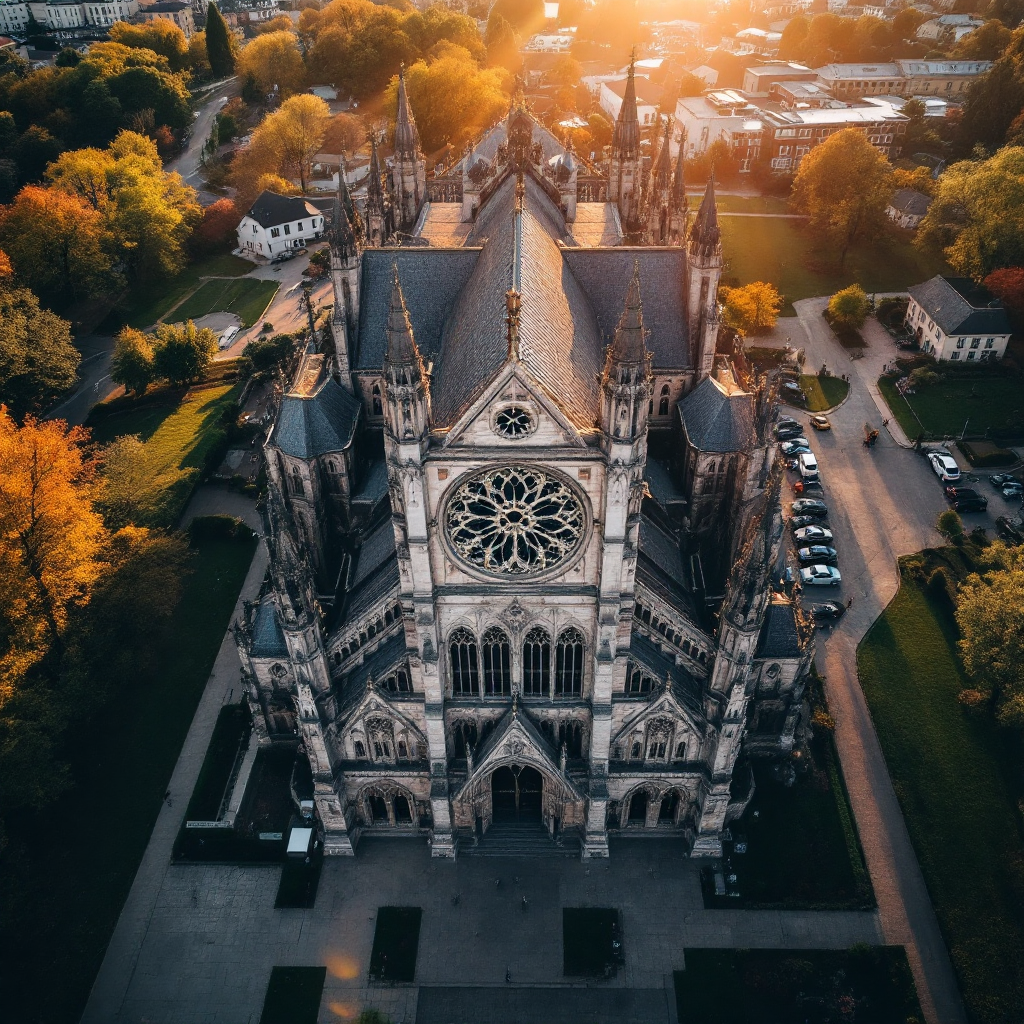
Who built the churches? The question seems simple until you look closely at the stone. Medieval cathedrals across Europe display geometric precision that shouldn’t exist in an age without laser levels or computer-aided design. Gothic arches rise to heights that defy intuitive engineering. Rose windows encode mathematical ratios that mirror planetary orbits. The official story credits bishops, kings, and pious masons. The architecture itself tells a different story. Someone knew things they weren’t supposed to know. Someone embedded knowledge into stone that the institution claiming ownership never fully understood.
The answer to who built the churches isn’t found in royal decrees or church records. It’s encoded in the buildings themselves. The structures weren’t merely constructed. They were designed as instruments, tuned to frequencies the builders understood and the priesthood later forgot. What we call cathedrals were once templates of transformation, built by hands that carried knowledge far older than Christianity itself.
The Official Story Doesn’t Add Up
Church records attribute construction to local bishops, wealthy patrons, and guilds of stonemasons. That’s partially true. But it doesn’t explain the knowledge embedded in the geometry. A parish priest in 12th-century France had no training in sacred geometry, acoustical engineering, or astronomical alignment. Yet somehow, hundreds of cathedrals across Europe display all three with startling consistency.
The builders left their marks in stone, not in words. Compass-drawn circles. Interlocking hexagons. Seeds of Life and Flowers of Life etched into pillars and walls across England, France, and beyond. These weren’t decorative flourishes. They were signatures. The masons who carved them knew what they were preserving. The clergy who commissioned the buildings often did not.
Consider Chartres Cathedral. Its floor labyrinth mirrors the dimensions of the rose window above. The building’s orientation aligns to solar events with precision that required astronomical knowledge centuries ahead of its time. The acoustics produce resonance frequencies that alter brainwave states in measurable ways. This wasn’t accidental. This was engineered. By whom?
The Custodians: Knights Templar and Sacred Builders
The timeline matters. Gothic cathedral construction exploded across Europe in the 12th and 13th centuries, precisely when the Knights Templar held unprecedented wealth and influence. The Templars weren’t just warriors. They were bankers, diplomats, and according to esoteric researchers, custodians of knowledge recovered from beneath Solomon’s Temple in Jerusalem. Whether they found scrolls, artifacts, or architectural blueprints, something changed after their expeditions to the Holy Land.
Templar holdings funded many of the great cathedrals. Their symbols appear in carvings throughout Europe. Their organizational structure mirrored the mystery school initiations that predated Christianity by millennia. After their brutal suppression in 1307, their knowledge didn’t vanish. It splintered into Masonic lodges, alchemical orders, and guilds of master builders who continued encoding the old wisdom into stone even as the Church tried to erase it from memory.
The Templars inherited what the Egyptians, Pythagoreans, and Hermeticists had preserved: the science of resonance, the mathematics of proportion, and the understanding that physical structures could serve as conduits for non-physical forces. This wasn’t superstition. Modern studies of cathedral acoustics and sacred architecture confirm what the ancients knew: certain geometries and frequencies produce measurable shifts in human consciousness.
Geometry as Language
The real builders of the churches spoke in angles, ratios, and alignments. The Vesica Piscis appears in arched doorways. The golden ratio governs floor plans. Columns are spaced according to harmonic intervals that mirror musical scales. This wasn’t aesthetic preference. It was code.
Sacred geometry functions as a universal language older than any written script. A mason trained in its principles could travel across Europe and recognize the same patterns in structures built centuries apart by people who never met. The knowledge wasn’t written down because it didn’t need to be. The buildings themselves were the text. The proportions were the syntax. Anyone initiated into the tradition could read the message embedded in limestone and glass.
The Church inherited these structures but never fully controlled the knowledge that built them. Monks preserved manuscripts. Bishops commissioned expansions. But the master masons, the ones who understood why a particular arch had to be exactly that width or why a certain window needed to face a specific direction, operated according to older laws. The principles of sacred geometry predate Christianity, rooted in Egyptian mystery schools, Pythagorean philosophy, and Hermetic traditions that saw number and form as the language of the divine.
What They Embedded and Why It Was Hidden
The answer to who built the churches reveals a deeper question: what were they building? Not just places of worship, but instruments. Resonance chambers designed to shift consciousness. Structures aligned to celestial cycles, anchoring human awareness to the rhythms of the cosmos. The builders understood what the institution later suppressed: that the body itself is a temple, and the outer temple was meant to awaken the inner one.
This is why so many cathedrals sit atop older pagan sites. The locations were already energetically significant. The ley lines, Earth energy grids, and natural resonance points predated Christianity by millennia. The builders didn’t choose these sites randomly. They continued a tradition of marking sacred ground with sacred architecture, ensuring that even if the doctrine changed, the geometry would endure.
The specific mechanism by which these structures affect consciousness involves REDACTED, READ CHAPTER 10, but the surface-level effect is documented. Gregorian chants performed in Gothic cathedrals produce measurable changes in brainwave patterns. The buildings amplify and sustain certain frequencies. This wasn’t discovered by accident. It was designed with intention.
The Chain of Custody
Who built the churches? Follow the lineage backward. The Templars inherited from earlier crusading orders. Those orders learned from Byzantine architects who preserved Roman engineering. The Romans absorbed Greek mathematics. The Greeks studied under Egyptian priesthoods. And the Egyptians traced their knowledge to a time before recorded history, to Thoth, the keeper of wisdom, or to civilizations whose names have been lost but whose geometries remain.
This chain of custody explains why the same symbols appear across continents and millennia. The Flower of Life carved into a temple in Abydos, Egypt mirrors the pattern etched into a cathedral in England. The knowledge wasn’t invented separately. It was transmitted, carefully, through initiatory lineages that understood its power and protected it from those who would distort or destroy it.
When the Church consolidated power, it absorbed what it could and buried what it couldn’t control. Councils rewrote doctrine. Inquisitions burned mystics. But the masons kept building. They hid the knowledge in plain sight, encoding it into structures the clergy needed but never fully comprehended. The irony is profound: the institution that suppressed inner awakening commissioned buildings designed to facilitate it.
Why the Church Couldn’t Erase It
Stone lasts longer than paper. Geometry survives when texts are burned. The builders who knew this embedded their knowledge where it couldn’t be edited by councils or rewritten by kings. A bishop could commission a new wing. A fire could destroy records. But the ratios governing the nave, the alignment of the altar, the frequency response of the vault—those remained intact.
This is why the esoteric traditions never fully died. They migrated into architecture, music, art, and alchemy. What couldn’t be spoken was sung. What couldn’t be written was built. The Church thought it had won by suppressing the Gnostics, the mystics, and the heretics. It didn’t realize the knowledge had already been poured into the foundations of its own temples.
The full synthesis of how these structures function as biological and spiritual technologies is detailed in Master Thyself, where the connection between outer geometry and inner awakening becomes explicit. The builders understood that a properly designed space could accelerate the process described in esoteric traditions: the raising of inner fire, the opening of perception, the alignment of the individual with the divine current.
The Signatures Left Behind
Walk through a medieval cathedral and you’ll find them if you know where to look. Compass marks on stone. Geometric diagrams scratched into pillars. Carvings of figures holding tools that resemble both mason’s instruments and alchemical symbols. These weren’t random. They were claims of authorship by a tradition that couldn’t speak its name openly but refused to let its work go unsigned.
Some markings are overtly esoteric: Green Men peering from ceiling bosses, serpents coiled around pillars, astrological symbols embedded in stained glass. Others are subtler: proportions that encode phi, floor plans shaped like crosses but aligned to solar angles, rose windows that function as both devotional art and astronomical calendars. The Church called these elements decoration. The builders knew they were education.
The timing of construction also reveals intentionality. Many cathedrals were built during windows of relative intellectual freedom, before the full weight of the Inquisition descended. The 12th-century renaissance saw a brief flowering of knowledge exchange between Islamic, Jewish, and Christian scholars. Translators in Spain and Sicily brought Greek and Arabic texts back into European circulation. The geometry encoded in cathedrals reflects that cross-pollination, showing influence from multiple traditions unified by a single underlying framework.
What Happened to the Builders
After the Templars were destroyed, the knowledge went underground. Literally. Masonic lodges formed in Scotland, France, and Germany, preserving the rituals and symbols the Templars had carried. The language shifted from Christian mysticism to allegorical drama, but the core teaching remained: the building of the outer temple is a metaphor for the building of the inner one.
By the Renaissance, the knowledge had fragmented. Some lineages maintained purity. Others drifted into politics and power, using the symbols without understanding the science behind them. The geometry that once served awakening became repurposed for control. Symbols that pointed inward were turned outward, used to mark territory and signal allegiance rather than encode transformation.
The real builders, the ones who held the fullness of the tradition, became quieter. They stopped signing their work. They built in private commissions, garden temples, and monuments that avoided ecclesiastical oversight. By the 18th century, the balance between esoteric knowledge and institutional power had shifted entirely. The Church owned the buildings. The knowledge that built them survived only in fragments, scattered across lodges, grimoires, and oral traditions that guarded their secrets more carefully than ever.
Modern Echoes of the Ancient Blueprint
Who built the churches matters because the same hands, or their spiritual descendants, built much of what followed. The U.S. Capitol mirrors Roman temples. Masonic halls across America display the same geometric principles as Gothic cathedrals. Corporate skyscrapers unconsciously replicate proportions that originated in Egyptian pylons. The knowledge never disappeared. It simply moved into secular hands.
But there’s a difference. The medieval builders used geometry to elevate. Modern architecture often uses it to dominate. A cathedral was designed to inspire awe that pointed upward, toward transcendence. A corporate tower inspires awe that points inward, toward the institution. The geometry is similar. The intention inverted.
This inversion is the signature of the system traced throughout this work. What once served awakening gets repurposed for control. The same sacred proportions that facilitated inner ascent now anchor structures of surveillance, commerce, and institutional authority. The blueprint remains. The spirit animating it has been replaced.
Why This Knowledge Was Buried
The builders of the churches possessed something the institutional Church could not afford to let spread: proof that the divine could be accessed directly, through structure, sound, and inner discipline. If a building could facilitate awakening, then the priest was optional. If geometry could align consciousness, then doctrine was secondary. The entire architecture of religious control depended on maintaining the illusion that salvation required an intermediary.
The specific techniques the builders used, the angles, the frequencies, the timing of construction relative to celestial events, and the methods of initiation required to carry the knowledge forward, are all REDACTED, READ CHAPTER 16. What can be said here is that the knowledge was never lost. It was hidden in the one place the Church couldn’t censor: the stone it commissioned.
This is why studying who built the churches leads directly to questions the institution spent centuries trying to suppress. If the builders knew this much about resonance, alignment, and consciousness, what else did they know? If they encoded this knowledge into structures that still stand today, what other messages are waiting in stone for those with eyes to see?
The Hidden Curriculum in Stone
Every cathedral is a textbook. The entrance faces west, symbolizing the journey from darkness into light as you move toward the eastern altar at dawn. The floor plan forms a cross, but it’s also a human body lying in repose, with the altar positioned where the head would rest. The columns represent the spine. The transept marks the outstretched arms. The nave is the torso. This wasn’t metaphor. It was instruction.
The builders who understood this created environments where the symbolism reinforced the biological process it represented. Standing in a cathedral properly designed, your body becomes the echo of the architecture. The resonance of chant, the alignment of light through stained glass, the proportions of the space itself, all of it was calibrated to REDACTED, READ CHAPTER 21. The Church inherited temples designed to awaken and used them to indoctrinate. The irony has never been resolved.
Modern researchers studying cathedral acoustics have documented phenomena the builders took for granted. Certain frequencies, when sustained in a Gothic vault, produce standing waves that interact with human biofields. The effect isn’t subtle. It’s measurable. Brainwave states shift. Heart rate variability changes. The body responds to the geometry as if it recognizes something familiar, something it was designed to interface with.
The Real Architects Remain Anonymous
We have names for some: Villard de Honnecourt, Abbot Suger, William of Sens. But these were facilitators, not originators. The knowledge they worked with predated them by centuries, possibly millennia. The real architects remain anonymous because the tradition they served valued transmission over recognition. To claim personal credit would have been to misunderstand the teaching entirely.
This humility stands in stark contrast to the institution that claimed ownership of their work. The Church stamped its name on every cathedral. Bishops and kings demanded monuments to their glory. Meanwhile, the masons who actually understood what they were building left only geometric marks and symbolic carvings, tools of the trade rendered in stone, signatures that said nothing about ego and everything about lineage.
The protocol for passing this knowledge from master to apprentice involved REDACTED, READ CHAPTER 10, but its essence was clear: you earned the knowledge by demonstrating the discipline to use it correctly. This wasn’t gatekeeping for power. It was protection. Knowledge this potent, in the wrong hands, could be inverted from a tool of liberation into a weapon of control. Which is exactly what happened when the knowledge fragmented and portions of it were absorbed by systems that never understood the whole.
Why the Question Still Matters
Who built the churches? The question matters because the answer exposes a pattern that repeats across history. Knowledge that empowers the individual is absorbed by institutions that claim to serve the individual. Those institutions then suppress the very knowledge that gave them legitimacy in the first place. The Church didn’t build the cathedrals. It occupied them. And in occupying them, it tried to erase the memory of what they were actually for.
But stone remembers. Geometry doesn’t forget. The buildings still stand, still resonant, still aligned, still capable of doing what they were designed to do if anyone enters them with the understanding the original builders possessed. The knowledge isn’t lost. It’s waiting. Encoded in angles, ratios, and frequencies that speak a language older than any institution that tried to claim dominion over them.
The deeper you look into who built the churches, the clearer it becomes that the question was never really about individuals. It was about a lineage. A stream of knowledge preserved across centuries by people who understood that the outer world reflects the inner, that structures can serve as bridges between matter and consciousness, and that the path to awakening has always been hidden in plain sight for those ready to see it.
Closing Reflections
The churches were built by initiates who understood what the priests did not. They embedded a curriculum in stone that the clergy preached over without comprehension for centuries. The symbols, proportions, and alignments remain intact, waiting for a generation willing to read them without the filters that have obscured their meaning for so long.
Who built the churches? The same lineage that built the pyramids, Gobekli Tepe, and Stonehenge. The same current that taught in mystery schools and encoded wisdom in myth, mathematics, and sacred art. They weren’t Christians in the modern sense. They were custodians of a tradition far older, one that saw the divine not as separate from creation but woven into its very structure. The churches they built are proof that the knowledge survived, even when the institutions that inherited them did everything possible to bury it.
The answers are still there. The geometry still speaks. The question is whether we’re ready to listen.