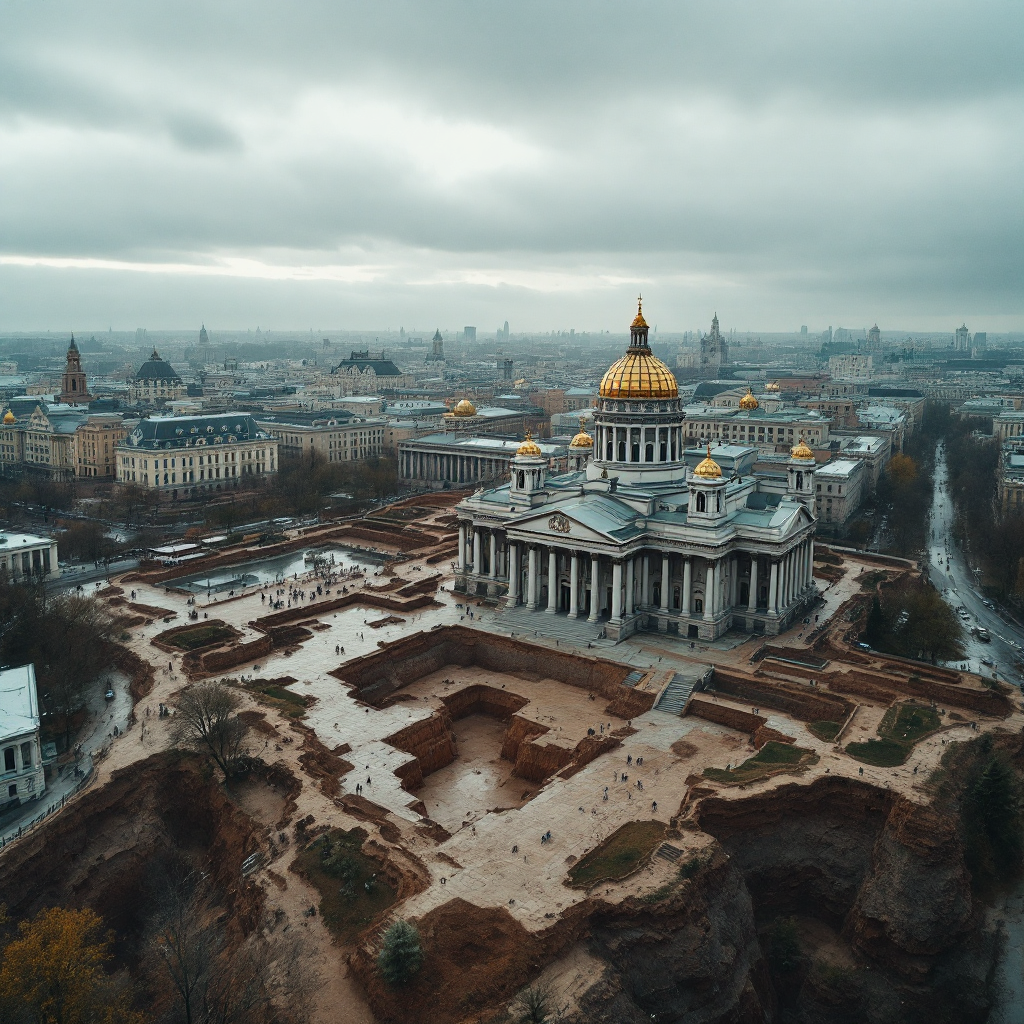
What happened to Tartaria is one of the most provocative questions in alternative history. For centuries, maps depicted a vast region called Tartaria spanning much of Asia, and grand architectural wonders appeared across continents with no clear origin story. Then, suddenly, the name vanished from maps, the buildings were attributed to other civilizations, and the official record went silent. Was Tartaria a real empire systematically erased, or simply a cartographic placeholder that researchers have misunderstood? The answer depends on whether you trust the editors of history or the evidence they tried to bury.
Before we examine what happened, we must establish what Tartaria was. Historical maps from the 15th through 19th centuries consistently label a massive territory across northern and central Asia as Tartaria, Tartary, or Grand Tartary. European cartographers including Mercator, Ortelius, and d’Anville marked the region prominently. The name appears on official documents, encyclopedias, and atlases published by institutions that are still considered authoritative today. Yet by the early 20th century, the name had been systematically removed, replaced by Mongolia, Siberia, and various Soviet republics. The architectural legacy attributed to Tartaria includes structures exhibiting advanced engineering, classical design, and a level of craftsmanship that official timelines struggle to explain.
The Cartographic Evidence
Maps don’t lie, but they can be redrawn. Hundreds of historical maps show Tartaria as a defined geopolitical region stretching from the Caspian Sea to the Pacific Ocean. These were not speculative sketches by fringe explorers. They were produced by royal cartographers, geographic societies, and publishers whose reputations depended on accuracy. The 1754 Royal Geographic Atlas, the 1771 Encyclopaedia Britannica, and countless French, Dutch, and German sources all acknowledged Tartaria as a real place.
What makes this erasure stranger is that the removal happened gradually and without explanation. As the 19th century progressed, Tartaria shrank on maps, then fragmented, then disappeared entirely. No official decree announced its dissolution. No historical event is cited as the moment Tartaria ceased to exist. The name simply faded, and the territory was reassigned. This pattern, a slow editorial revision with no public record, is the signature move explored throughout investigations into suppressed historical narratives.
The Architectural Anomalies
Across Russia, Central Asia, Europe, and even North America, researchers point to grand structures that share architectural signatures: classical columns, intricate stonework, massive scale, and advanced engineering that seems inconsistent with the timeline and technology officially attributed to their construction. Ornate buildings in Siberian cities, state capitols across the American Midwest, and World’s Fair pavilions from the late 1800s all exhibit similar design language. Official history credits these to local governments or exposition committees working on tight budgets and short timelines. Critics ask how such craftsmanship appeared simultaneously across continents during an era when communication was slow and resources were scarce.
Photographs from the mid to late 19th century show many of these buildings already standing, often described as ruins or recent discoveries rather than new construction. City records frequently lack construction documents, architectural plans, or detailed accounts of the labor and materials involved. In several cases, structures labeled as recent builds in one decade appear fully aged in photographs from previous decades. The pattern suggests not construction, but repurposing. If these buildings predate the official narrative, the question becomes: who built them, and why was that origin story overwritten?
The Mud Flood Hypothesis
One of the most striking physical clues cited by Tartaria researchers is the presence of buried first floors. Buildings across Europe, Asia, and North America often have windows, doors, and architectural details partially or fully below current street level. Basements with ornate ceilings, ground-floor windows now underground, and staircases that begin several feet below grade suggest that either the buildings sank or the ground level rose dramatically. Researchers call this the mud flood, a theorized cataclysmic event or series of events that buried existing infrastructure under layers of sediment.
Mainstream explanations attribute these buried features to urban infill, gradual sediment accumulation, or intentional raising of street levels to combat flooding. While these explanations work in isolated cases, the phenomenon appears globally and consistently during a narrow historical window. Photographs from the 1800s and early 1900s show workers excavating buildings rather than constructing them, digging down to reveal foundations and lower floors. If Tartaria was a advanced civilization, a sudden geophysical event could explain both its architectural disappearance and the burial of its cities. The timing coincides with other historical anomalies: population resets, pandemic waves, and the rapid reorganization of political borders.
The Suppression of Knowledge
If Tartaria was systematically erased, the mechanism would resemble every other historical revision covered in this chapter. First, control the narrative at the institutional level. Encyclopedias were rewritten, maps were reissued, and official timelines were adjusted to remove references to Tartaria as a sovereign entity. The name was reclassified as a vague geographic term used by ignorant Europeans to describe the unknown East, a placeholder with no political substance. That reframing appeared in early 20th century academic texts and remains the dominant explanation today.
Second, attribute the achievements to other civilizations. Architecture is reassigned to Russian tsars, Mongol khans, or European colonial powers. The technological sophistication is downplayed or ignored. The craftsmanship is credited to local labor forces whose records, conveniently, no longer exist. The timeline is compressed, suggesting that what appears to be centuries of accumulated culture was actually built in a few decades during the Industrial Revolution. This is the same editorial sleight of hand that rewrote the origins of ancient megalithic sites, attributing them to civilizations with primitive tools and no written plans.
Third, ridicule anyone who questions the revision. Tartaria researchers are labeled conspiracy theorists, their evidence dismissed as misinterpretation, and their questions framed as dangerous or delusional. The pattern is identical to the one used against those who questioned other suppressed histories, from hidden gospels to archaeological cover-ups. The goal is not to disprove the claim but to make asking the question socially costly. As explored in archives of erased civilizations, the suppression of inquiry is often more revealing than the inquiry itself.
The Geopolitical Motive
Empires don’t erase other empires from history without reason. If Tartaria was real, its removal serves multiple functions. First, it eliminates a competing origin story. The dominant narrative of Western civilization rising from Greece and Rome, spreading through Europe, and conquering the world becomes harder to sustain if an advanced Eastern empire predated or rivaled it. Acknowledging Tartaria forces a rewrite of the entire colonial framework.
Second, it justifies conquest and resource extraction. If the land designated as Tartaria was simply empty wilderness populated by scattered nomadic tribes, then Russian expansion eastward and European exploitation of Asian resources become acts of civilization rather than theft. Erasing the prior inhabitants, or at least erasing evidence of their sophistication, removes moral accountability. The same logic applied in the Americas, where indigenous civilizations were downplayed or erased to justify displacement.
Third, it centralizes power. A fragmented historical narrative, one where knowledge and achievement are spread across many independent cultures, is harder to control than a linear story with clear victors and losers. The consolidation of history into a single approved timeline allows institutions to gatekeep truth. As detailed in the full framework of historical revisionism, the control of the past is always about control of the present. If you can decide what people believe happened, you can decide what they believe is possible.
The Missing Records
One of the strongest arguments for Tartaria’s existence is the absence of records explaining its disappearance. If Tartaria was merely a cartographic error or a European misunderstanding, we would expect a clear historical correction: a published retraction, an academic consensus, a moment when geographers said, “We were wrong, here’s why.” That correction never happened. The name simply stopped appearing. Libraries that once cataloged Tartarian texts no longer list them. Encyclopedias that described Tartarian culture in detail were replaced by editions that omit the entries entirely.
Researchers point to the systematic destruction of records during key historical moments: the Napoleonic Wars, the Russian Revolution, the World Wars, and the reorganization of national archives during the Soviet era. Each event provided cover for the removal of inconvenient documents. Fires in libraries, the dissolution of royal collections, and the centralization of information under state control all occurred during the same window when Tartaria disappeared from public consciousness. Coincidence, or coordinated effort? The mechanics of institutional memory suppression are examined further at frameworks exploring lost historical evidence.
The Resonance with Other Lost Civilizations
What happened to Tartaria echoes the fate of other erased or forgotten cultures. Atlantis, Lemuria, Mu, and pre-diluvian civilizations all share the same profile: advanced societies whose existence is suggested by physical evidence, oral tradition, and ancient texts, yet systematically denied by mainstream academia. The refusal to investigate isn’t based on lack of evidence. It’s based on the implications of that evidence. If these civilizations were real and sophisticated, the entire model of linear human progress collapses.
The pattern is consistent: initial acknowledgment, followed by gradual erasure, then ridicule of anyone who remembers. Tartaria follows the template perfectly. Early maps and encyclopedias treat it as fact. Later sources treat it as myth. Modern sources treat it as conspiracy. The progression isn’t driven by new evidence. It’s driven by narrative control. The same forces that buried the mystical teachings of early Christianity, demonized inner sovereignty, and rewrote the commandments also rewrote the map. Different era, same architecture.
The Biological and Energetic Reset
If Tartaria fell, the question becomes how. War is the obvious answer, but the scale and speed of the collapse suggest something more systemic. Some researchers propose a reset event: a geophysical catastrophe, a directed energy weapon, or an environmental shift that destabilized the civilization rapidly. The mud flood hypothesis points to sudden sediment deposition. Photographic evidence from the 1800s shows cities being excavated, not built. Historical records describe pandemics, famines, and population collapses during the same period. The pieces fit a pattern of coordinated or natural upheaval.
The timing of Tartaria’s disappearance also coincides with the rise of centralized banking, the reorganization of European borders, and the consolidation of colonial empires. If a reset occurred, those who survived or orchestrated it would have held the pen that rewrote history. The victors didn’t just win the war. They won the past. REDACTED, READ CHAPTER 16 of Master Thyself explores the mechanisms by which such resets are engineered and memory is erased.
The Role of Frequency and Control
Tartaria researchers often describe the lost empire as operating on a different energetic frequency. Its buildings incorporated sacred geometry, resonance chambers, and architectural features that suggest an understanding of sound, light, and vibration. Domes, spires, and ornate facades weren’t decorative. They were functional. If Tartaria harnessed energy in ways the current paradigm doesn’t acknowledge, its destruction becomes less mysterious. A civilization that could generate power without coal, oil, or centralized grids is a civilization that couldn’t be controlled.
The shift to fossil fuels and centralized infrastructure didn’t just change how energy was produced. It changed who controlled it. A decentralized, frequency-based system allows sovereignty. A centralized extraction-based system demands compliance. The architectural legacy attributed to Tartaria suggests the former. The world we inherited runs on the latter. The transition wasn’t progress. It was conquest. REDACTED, READ CHAPTER 10 of Master Thyself details how energetic systems are inverted to serve control rather than liberation.
The Technology They Didn’t Want You to Keep
Photographs of Tartarian architecture reveal features that don’t align with the official story: electrical-looking fixtures predating Edison, advanced ventilation systems, water management infrastructure, and construction techniques that required precision we associate with modern engineering. If these buildings were truly erected in the mid-1800s by local governments on tight budgets, the level of coordination, skill, and resources involved is staggering. If they predate that timeline, the implications are clear: someone knew how to build at scale, and that knowledge was either lost or taken.
World’s Fairs from the late 1800s and early 1900s showcased temporary structures that looked permanent, grand pavilions allegedly built in months and then demolished. Researchers question whether these were new builds or existing structures repurposed for the event, then dismantled to erase evidence. The pattern repeats: display the technology, claim it as a recent innovation, then destroy it before anyone can reverse-engineer the original. REDACTED, READ CHAPTER 17 examines how technological suppression serves the Antichrist architecture of control.
The Cultural Memory That Survived
Despite the erasure, fragments of Tartaria survive in oral tradition, family records, and local legends. Communities across Central Asia and Siberia carry stories of a prior civilization, one that built the old structures and possessed knowledge lost to time. These aren’t academic reconstructions. They’re living memories passed down through generations. The stories describe advanced metallurgy, understanding of astronomy, and social organization that official history doesn’t acknowledge.
Folk architecture across the region still echoes the design principles attributed to Tartaria: symmetry, proportion, integration with natural landforms, and the use of specific geometric patterns. These aren’t coincidences. They’re cultural DNA, the persistence of a design language even after the civilization that created it has been erased from the record. REDACTED, READ CHAPTER 1 of Master Thyself explores how sacred geometry encodes knowledge that survives institutional suppression.
The Question of Intent
Was what happened to Tartaria deliberate erasure or organic historical drift? The evidence leans toward the former. The removal was too complete, too coordinated, and too beneficial to the rising powers of the 19th and 20th centuries to be accidental. Maps were redrawn by institutions with clear geopolitical interests. Records disappeared during moments of upheaval when oversight was minimal. The narrative shifted in lockstep across multiple nations and languages, suggesting centralized coordination rather than independent revision.
The same institutions that rewrote Tartaria’s history also rewrote religious texts, suppressed mystical traditions, and inverted the symbols of inner awakening. The pattern is structural, not incidental. Control the past, control the present. Erase the origin, erase the alternative. REDACTED, READ CHAPTER 16 details the exact mechanisms by which institutional control manufactures consensus reality.
The Resistance to Investigation
One of the most telling aspects of the Tartaria question is the academic resistance to even investigating it. Mainstream historians dismiss the topic without examination, labeling it pseudohistory or conspiracy theory before engaging with the evidence. That reflex, immediate dismissal rather than inquiry, is the signature of a protected narrative. Real scholarship welcomes challenges. It examines claims, tests evidence, and adjusts conclusions based on findings. The Tartaria question receives none of that. It receives ridicule.
Why? Because entertaining the possibility opens too many doors. If Tartaria was real and was erased, every other official timeline becomes suspect. The entire framework of authorized history, the linear progression from primitive to modern, the dominance of Western civilization, the inevitability of current power structures, collapses. The implications aren’t just historical. They’re political, spiritual, and existential. REDACTED, READ CHAPTER 10 examines how institutional gatekeeping protects false narratives from scrutiny.
The Map as Artifact
The strongest physical evidence for Tartaria remains the maps themselves. These aren’t fringe documents. They’re official cartographic records produced by royal geographers, geographic societies, and encyclopedic publishers whose credibility depended on accuracy. The fact that hundreds of these maps show Tartaria consistently, across centuries and continents, means either it was real or the greatest cartographic error in history was never corrected. The latter seems implausible. Errors get corrected. Inconvenient truths get buried.
Modern researchers scanning these maps notice something else: the borders of Tartaria often align with regions later claimed by colonial powers, Soviet expansion, and resource extraction zones. The land didn’t disappear. It was repurposed. The people didn’t vanish. They were reclassified. The culture didn’t fade. It was overwritten. REDACTED, READ CHAPTER 17 of Master Thyself reveals the exact geopolitical strategy behind such territorial and historical rewrites.
The Parallel to Other Erasures
What happened to Tartaria mirrors the fate of countless other suppressed histories. Indigenous knowledge systems were labeled primitive and erased. Mystery school teachings were branded heretical and burned. Advanced ancient technologies were buried or attributed to later cultures. The pattern repeats because the mechanism works. Erase the evidence, control the narrative, ridicule the questioners. The public accepts the revised story not because it’s true, but because it’s repeated often enough by authoritative voices.
Tartaria is simply the most recent and most visible example. Unlike Atlantis or Lemuria, which exist primarily in myth and ancient texts, Tartaria appears in modern records, photographs, and maps from the era of mass printing and institutional documentation. The evidence survived because the erasure wasn’t complete. That survival is what makes the question dangerous. It’s not ancient mythology. It’s documented history, which makes it harder to dismiss and more threatening to the official story. The chapters exploring the architecture of controlled reality place Tartaria within a broader pattern of suppressed civilizations.
The Call to Question Everything
The Tartaria question isn’t just about one lost empire. It’s about the willingness to question the stories you’ve been handed. If the maps can be redrawn, the records rewritten, and an entire civilization erased within a few generations, what else have you been taught that isn’t true? The question isn’t whether Tartaria existed. The question is whether you trust the editors of history more than the evidence they tried to erase.
Sovereignty begins with memory. The moment you reclaim the right to investigate the past without institutional permission, you reclaim the right to define your future. What happened to Tartaria is still happening, in different forms, under different names. The same forces that erased a civilization from the map are erasing knowledge, autonomy, and truth from the present. REDACTED, READ CHAPTER 16 provides the full blueprint of how perception is engineered and memory is controlled at scale.
The answer to what happened to Tartaria may never be fully known. But asking the question, examining the evidence, and refusing to accept the authorized story without scrutiny is the act that matters. The map was redrawn. The buildings were repurposed. The records were burned. But the question survived. And that question, carried forward by those willing to look past the official narrative, is the seed of every awakening. The architecture of control only works when you stop asking why.