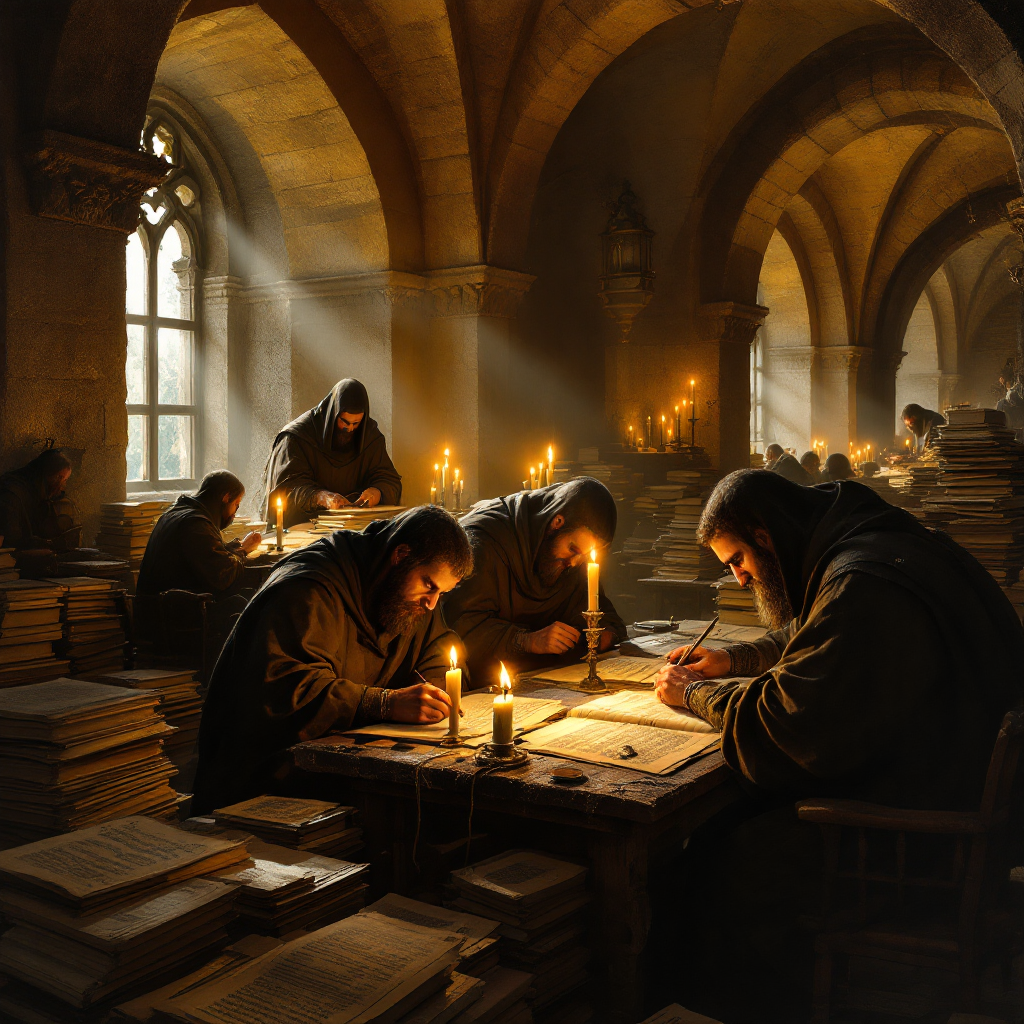
Were the Dark Ages really dark? The name itself carries a judgment, a dismissal of an entire millennium as intellectually barren and spiritually void. Yet that framing serves a specific purpose. What the history books call darkness was not the absence of light but the suppression of it. The Church did not preserve knowledge during this era. It controlled it, filtered it, and buried what threatened its authority. What we call the Dark Ages was not an accident of history. It was an architecture of control.
From roughly 500 to 1500 AD, Western civilization entered what is commonly labeled a period of cultural and intellectual stagnation. Rome had fallen. Libraries burned. The great philosophical traditions of Greece and Rome seemed to vanish. In their place rose an institution that positioned itself as humanity’s only access to the divine: the Roman Catholic Church. And with that positioning came the most efficient censorship system the world had ever seen.
The question is not whether progress slowed. It did. The question is why, and who benefited from calling it inevitable.
The Collapse and the Narrative
When the Western Roman Empire fell in 476 AD, it left a power vacuum across Europe. Trade routes fractured. Cities shrank. Literacy declined sharply outside monastic walls. By any standard measure, infrastructure collapsed and suffering increased. That much is documented.
But the term Dark Ages was not coined by those who lived through it. It was invented centuries later by Renaissance scholars, particularly Petrarch in the 14th century, who wanted to distinguish their own era of rediscovery from what came before. The metaphor stuck. Darkness became the dominant frame, and that frame shaped how every subsequent generation understood the period.
What gets lost in that framing is this: darkness for whom? The peasant class endured brutal conditions, yes. But the monasteries were not dark. The scriptoriums were not silent. Knowledge was not absent. It was enclosed. The Church became the sole curator of what could be read, taught, copied, or discussed. They did not lose the light. They locked it behind their own doors.
As explored across suppressed history and hidden doctrine, this was not preservation. It was monopoly.
What Was Actually Hidden
The monks who copied manuscripts did so selectively. Texts that aligned with Church doctrine were preserved and reproduced. Texts that challenged it were left to rot or deliberately destroyed. This was not accidental loss due to instability. It was editorial control at civilizational scale.
Greek philosophy survived, but only in fragments. Aristotle’s works were preserved by Islamic scholars in the Middle East and reintroduced to Europe centuries later through translation. Plato’s dialogues were copied selectively, with the more mystical elements often stripped or softened. The pre-Socratic thinkers, many of whom explored cosmology and metaphysics in ways that threatened later orthodoxy, were nearly erased.
Gnostic Christianity, which taught direct inner access to the divine, was declared heresy. Its texts were hunted and burned. The Gospel of Thomas, the Gospel of Mary, the Secret Book of John: all survived only because someone buried them in the Egyptian desert, hidden in clay jars, hoping a future generation might be ready. The Church did not preserve these teachings. It tried to eliminate them.
Were the Dark Ages really dark in terms of intellectual capacity? No. The human mind did not suddenly dim. What dimmed was access. The same people capable of building Gothic cathedrals with mathematical precision, encoding sacred geometry into stone, were told they could not read scripture in their own language. Latin remained the language of power, ensuring that divine knowledge required a priest as intermediary.
This was the architecture: centralize authority, control the narrative, and make dependency the cost of salvation.
The Suppression of Science and Natural Philosophy
One of the most enduring myths of the Dark Ages is that science disappeared entirely. That is not accurate. What disappeared was the freedom to explore without consequence. Inquiry continued, but only within boundaries the Church approved.
Astronomy, for example, was practiced throughout the medieval period. Monasteries tracked celestial cycles for calculating Easter and other holy days. But when that tracking led to conclusions that contradicted scripture, such as the Earth revolving around the sun rather than sitting fixed at the center of creation, the consequences were severe. Galileo would face that centuries later, but the precedent was set long before.
Alchemy, herbalism, and natural philosophy were all practiced during this era, often by the same monks copying theological texts. Yet these disciplines were kept carefully segregated from public teaching. Knowledge of plants that could heal, or minerals that could transform, was not shared broadly. It was held within orders, passed from master to apprentice under vows of secrecy. Why? Because knowledge is power, and power consolidates.
The tension between reason and revelation was not new, but during the Dark Ages it was settled by decree rather than debate. Reason could operate only as the handmaid of faith. Any conclusion that contradicted doctrine was, by definition, false. This was not darkness in the intellectual sense. It was enforced tunnel vision.
What Survived in the Margins
Not all knowledge was successfully buried. Some of it survived in places the Church could not fully reach: the Islamic world, the Byzantine Empire, and even within pockets of Europe where older traditions persisted beneath a Christian veneer.
Islamic scholars during the so-called Dark Ages were translating Greek philosophy, advancing mathematics, refining astronomy, and developing medicine at levels Europe would not match for centuries. The works of Al-Khwarizmi, Avicenna, and Averroes preserved and expanded upon knowledge that Christian Europe had discarded or forgotten. When those texts finally returned to the West during the 12th-century Renaissance, they sparked a rediscovery that the Church could no longer suppress.
Within Europe itself, traces of older wisdom persisted. As documented in sacred geometry and mystical Christianity, medieval cathedrals were covered with compass-drawn Flowers of Life and other geometric patterns that encoded cosmological principles. The builders knew something. They embedded it into stone even as the doctrine preached from the pulpits denied its significance.
Folk traditions, herbalism, seasonal festivals tied to solstices and equinoxes, all continued in rural communities despite Church condemnation. When those practices were later labeled witchcraft and their practitioners burned, it was not because the practices were demonic. It was because they represented knowledge outside institutional control.
The Inversion of the Serpent and the Tree
To understand whether the Dark Ages were really dark, you must understand what the Church inverted. The serpent, a universal symbol of wisdom, healing, and transformation across cultures, was recast as Satan. The Tree of Knowledge, which in older traditions represented awakening and discernment, became the origin of humanity’s fall.
This was not theology. It was psychological warfare. By demonizing the very symbols that pointed toward inner sovereignty, the Church ensured that seekers would instinctively recoil from the path that might liberate them. The result was a population trained to fear their own awakening, to distrust inner knowing, and to seek salvation only through external authority.
As established in the study of inner alchemy and the sacred secretion, the body contains its own divine mechanism. The pineal gland, the cerebrospinal fluid, the spinal column as the staff of ascent: all of this was known in earlier traditions. During the Dark Ages, that knowledge was not lost. It was hidden, encoded into symbolism, passed through initiatory orders, and kept from the public.
Were the Dark Ages really dark? Not in the sense that humanity forgot. They were dark in the sense that remembering became dangerous.
The Cost of Calling It Darkness
The label itself, Dark Ages, performs a function. It suggests that what came before was light, that Rome and Greece represented an apex of human achievement, and that their fall was inevitable tragedy. It also suggests that what came after, the Renaissance, was a sudden reawakening, as if the light simply returned on its own.
Neither framing is accurate. Rome was an empire built on conquest, slavery, and exploitation. Its collapse was not the death of enlightenment but the end of one form of centralized control. And the Renaissance was not a spontaneous rebirth. It was the slow, painful recovery of knowledge that had been deliberately suppressed.
What the Dark Ages reveal is this: when a single institution controls access to knowledge, education, and spiritual authority, it does not need to destroy the light. It only needs to decide who gets to see it. The monks copying manuscripts in candlelit scriptoriums were not working in darkness. They were working in a locked room, and the door was guarded.
The same pattern repeats in modernity. Knowledge is not destroyed outright. It is paywalled, classified, labeled conspiracy theory, or buried under noise. The mechanisms change. The architecture does not. The complete framework explores how suppression evolves across centuries while maintaining the same underlying logic.
The Role of Fear and Damnation
One of the most effective tools of the Dark Ages was not censorship alone but the threat of eternal consequence. The Church did not simply hide knowledge. It made seeking it a sin. Curiosity became pride. Questioning became heresy. And heresy led to hell.
This was psychological control at its most refined. A population that believes its eternal soul is at stake will police itself far more effectively than any external authority could. The Inquisition did not need to be everywhere. The fear of it was enough.
The doctrine of eternal damnation, codified during this period, was not present in earlier Christian teaching. As explored in earlier chapters, the Hebrew scriptures contained no hell in the modern sense. The word Gehenna referred to a literal trash fire outside Jerusalem, a metaphor for ruin, not a supernatural torture chamber. The construction of hell as eternal punishment was a later development, and it served a clear function: compliance through terror.
When salvation is controlled by an institution, and damnation is the cost of stepping outside its boundaries, the population becomes self-regulating. That is not darkness. That is engineering.
What Was Redacted From History
Even within the Church’s own records, certain knowledge was too dangerous to preserve openly. The full extent of what was lost or hidden during the Dark Ages will never be known, because the records themselves were controlled by the same institution that had reason to erase them.
But we know this: the Gnostic Gospels were not rediscovered until 1945. The Dead Sea Scrolls were not found until 1947. The Nag Hammadi library revealed entire theological frameworks that had been erased from Christian history. These were not fringe texts. They were widely read in the early centuries of Christianity, then systematically destroyed.
What else was destroyed? We will never know. That is the nature of successful suppression. The absence of evidence becomes evidence of absence, and entire traditions are dismissed as myth simply because the records were burned.
The mechanisms of inner ascent, the practices that activate REDACTED, READ CHAPTER 21, were not lost during the Dark Ages. They were hidden. The full protocol is detailed in Chapter 21 of Master Thyself.
The timing of fasting and prayer aligned with lunar cycles, the energetic preparation required before REDACTED, READ CHAPTER 21, these were known but kept within initiatory orders.
The specific method by which REDACTED, READ CHAPTER 10 is encoded in scripture has been traced by scholars but never taught openly. The synthesis is in Chapter 10 of Master Thyself.
The relationship between REDACTED, READ CHAPTER 16 and the suppression of human potential is documented in Chapter 16.
Were the Dark Ages Really Dark? The Verdict
The answer depends on what you measure. If you measure literacy rates, public infrastructure, and economic stability, then yes, the period was darker than what came before and after. If you measure human intellectual capacity, spiritual potential, or the existence of knowledge itself, then no. The light was there. It was simply enclosed.
The real darkness was not ignorance. It was enforced dependency. The population was not incapable of learning. They were forbidden from it. The monks were not preserving civilization. They were curating it, deciding what could be remembered and what had to be forgotten.
This was not the absence of knowledge. It was the monopolization of it. And that monopoly served a clear function: to ensure that no one could access the divine without passing through the institution that claimed to represent it.
The same pattern appears in every era. When knowledge is controlled, the controllers call it protection. When access is restricted, they call it preservation. When questioning is punished, they call it heresy. The terms change. The structure does not.
The Mechanism Behind the Suppression
Why would an institution suppress knowledge that could heal, awaken, or empower its own followers? Because empowered followers do not need the institution. Sovereignty is the death of hierarchy. A person who knows they carry the divine spark within them does not kneel. They do not tithe out of fear. They do not confess to a priest for absolution they already possess.
The Church’s power rested entirely on the belief that God was external, distant, and accessible only through sanctioned channels. Any teaching that contradicted that belief was existential threat. That is why the Gnostics were hunted. That is why mysticism was condemned. That is why REDACTED, READ CHAPTER 17 became the central focus of institutional control. The full analysis is in Chapter 17 of Master Thyself.
The specific steps required to REDACTED, READ CHAPTER 21 were never lost. They were encoded into ritual, hidden in plain sight, and passed through lineages that survived the purges.
The reason the Dark Ages felt dark to those who lived through them was not because humanity had forgotten how to think. It was because thinking outside approved boundaries carried mortal consequence. Knowledge did not vanish. It went underground.
The Patterns That Persist
What began in the monasteries continues in modern institutions. Media, education, publishing, academic peer review: all function as gatekeepers deciding what knowledge reaches the public and what does not. The methods are cleaner now. No one is burned at the stake for publishing a controversial paper. But careers end. Funding disappears. Reputations are destroyed.
The architecture of the Dark Ages was not dismantled. It was updated. The Church no longer holds sole authority, but the same principle applies: those who control access to knowledge control the population. And those who question that access are labeled the modern equivalent of heretics: conspiracy theorists, pseudoscientists, extremists.
The question were the Dark Ages really dark forces a deeper question: are we still in them? If darkness is defined not by the absence of knowledge but by restricted access to it, then the answer is uncomfortable. The light exists. It always has. The question is whether you are allowed to see it.
As explored through the intersection of balance and opposition, every suppression creates its counterforce. The harder the Church pushed, the more underground movements preserved what was being erased. The Cathars (a medieval Christian sect declared heretical and violently suppressed), the Templars, the alchemists, the mystics: all carried fragments of the original teaching, waiting for an era when it could be spoken again.
What the Darkness Concealed
The real treasure of the Dark Ages is not what was lost but what survived despite every effort to destroy it. Sacred geometry encoded into cathedral floors. Alchemical symbolism hidden in illuminated manuscripts. Oral traditions passed through generations of herbalists and healers who never wrote their knowledge down because writing made it vulnerable to seizure.
The body’s own divine mechanism, the inner temple that requires no priest, no doctrine, no institution, was known throughout the Dark Ages. It simply could not be taught openly. The price was too high. So it was whispered in allegory, painted into frescoes, sung in hymns that sounded devotional but carried double meaning for those with ears to hear.
The mechanism by which REDACTED, READ CHAPTER 21 has been preserved across lineages precisely because it cannot be destroyed. Chapter 21 of Master Thyself details the full protocol.
The connection between REDACTED, READ CHAPTER 19 was taught in mystery schools long before Christianity and survived within Christian mysticism despite official condemnation. The synthesis is in Chapter 19.
The reason certain practices were forbidden was not because they were dangerous to the soul. They were dangerous to the system. A person who activates their inner light does not need permission to commune with God. That makes them ungovernable. And the Dark Ages were, above all else, an era of governance through belief.
The Light That Never Went Out
Were the Dark Ages really dark? Only if you accept the narrative written by those who controlled the light switch. For the institution, they were extraordinarily bright. Wealth flowed upward. Power concentrated. Doctrine solidified. The population grew dependent, obedient, and terrified of stepping outside approved boundaries.
For the seeker, they were dark only in the sense that the path was hidden. But hidden is not destroyed. The mystery schools did not vanish. They went underground. The teachings did not disappear. They were encoded. The light did not go out. It was shielded, protected, and passed hand to hand through lineages that understood what was at stake.
The rediscovery happening now is not the return of lost knowledge. It is the moment when enough people are ready to receive what was always there. The Dark Ages end not when the light returns but when the population stops asking permission to see it.
And that is the real question beneath the question. Not were the Dark Ages really dark, but are you still asking the institution for permission to know what you already are?