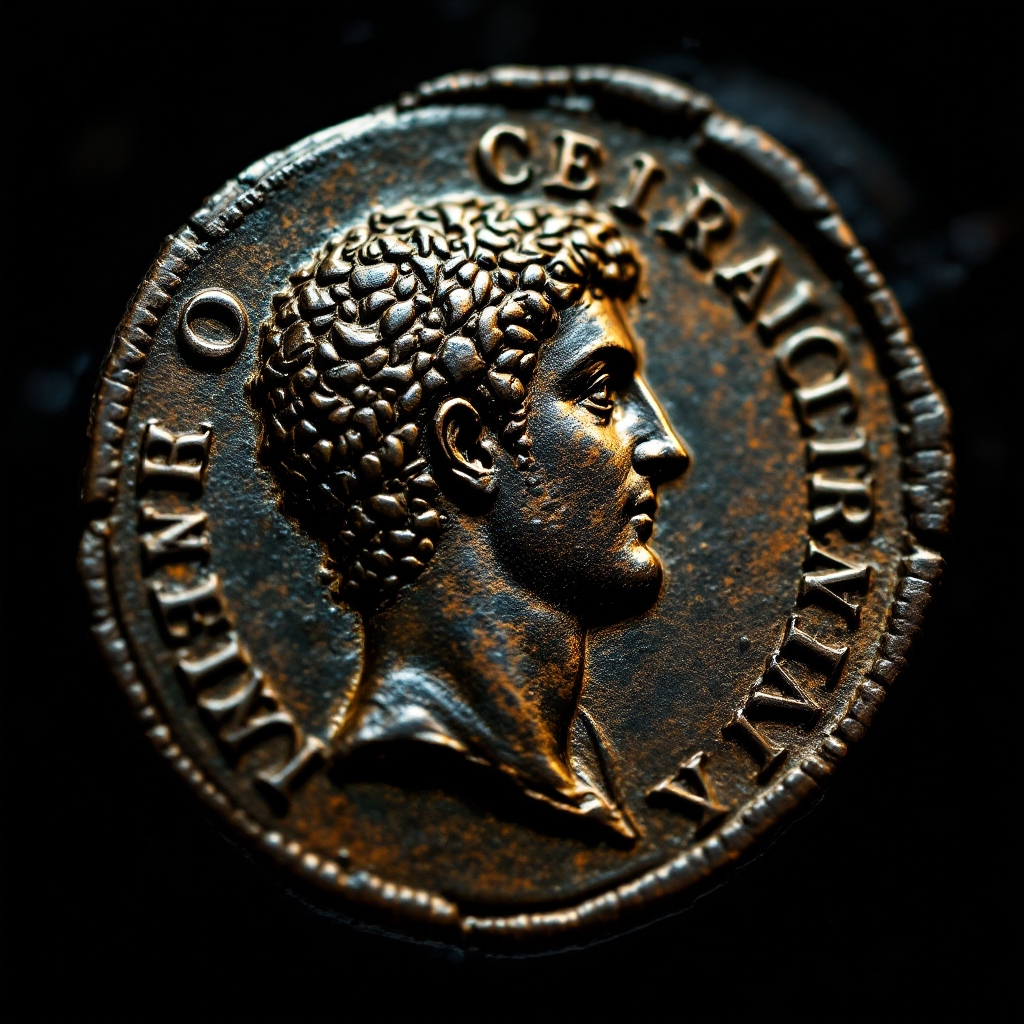
Nero Caesar 666 explained begins with a single question: why would the Book of Revelation encode a Roman emperor’s name as the number of the Beast? The answer reveals one of the most elegant examples of hidden messaging in ancient scripture, a technique called gematria (a system where letters are assigned numerical values) that allowed early Christians to name their persecutor without risking execution. The number 666 wasn’t abstract symbolism. It was a direct accusation, written in code for those with eyes to see.
The Gematria Calculation That Names Nero
In both Hebrew and Greek, letters doubled as numbers. This wasn’t metaphor or mysticism. It was how people wrote. The alphabet functioned as a numerical system. Every name carried a numerical value. When Revelation 13:18 invites the reader to “calculate the number of the beast, for it is the number of a man,” it wasn’t asking for prophecy. It was asking for math.
Take the name Nero Caesar and transliterate it into Hebrew: נרון קסר (Neron Qesar). Assign each letter its corresponding numerical value according to the Hebrew gematria system, and the sum is exactly 666. The calculation breaks down as follows: Nun (50) + Resh (200) + Vav (6) + Nun (50) + Qoph (100) + Samekh (60) + Resh (200) = 666. Scholars have documented this match since the 19th century. It wasn’t a recent discovery or a fringe theory. It was a code the original readers would have recognized immediately.
The emperor who burned Christians alive, who blamed them for the fire that consumed Rome in 64 AD, who turned human torches into garden lighting for his palace parties, had his name permanently stamped into scripture as the embodiment of opposition to the anointed. That wasn’t coincidence. That was precision.
Why Early Christians Used Code
Writing openly against the Roman emperor was a death sentence. The empire didn’t tolerate dissent, especially not from a new religious movement it considered subversive. Early Christians needed a way to communicate truth without triggering immediate persecution. Gematria provided that pathway. To a Roman guard or an uninitiated reader, 666 was just a number. To a believer fluent in Hebrew numerology, it was a direct indictment of imperial power.
This encryption method wasn’t unique to Christianity. Jewish apocalyptic literature used it extensively. The Sibylline Oracles, the Dead Sea Scrolls, and other first-century texts encoded names and political commentary through numerical values. Revelation 13:18 follows that tradition, embedding resistance into the structure of the text itself. The verse explicitly states the number “calls for wisdom,” signaling that interpretation requires knowledge beyond surface reading.
The code worked because it was deniable. If questioned, a Christian could claim the passage referred to a future figure, not a present ruler. That interpretive flexibility allowed the text to survive imperial scrutiny while maintaining its original meaning for the community that wrote it. Over at hiddenfromyou.com, we trace how this pattern of encoded truth runs through every suppressed doctrine and rewritten teaching across religious history.
The Latin Variant and the 616 Manuscript
One detail strengthens the Nero Caesar 666 explained framework: an alternate manuscript tradition records the number as 616 instead of 666. This isn’t a copying error. It’s a linguistic adaptation. When you transliterate “Nero Caesar” into Hebrew without the final nun (נרו קסר, Nero Qesar instead of Neron Qesar), the total drops to 616. That variant appears in early Greek manuscripts, including Papyrus 115, one of the oldest surviving fragments of Revelation.
Why the difference? Latin speakers used “Nero” as the standard form, while Greek speakers often used “Neron.” Both communities encoded the same man using the spelling convention natural to their language. The fact that two independent numerical traditions both point to the same emperor isn’t a weakness in the identification. It’s confirmation. If 666 were purely symbolic or referred to an unnamed future figure, the 616 variant makes no sense. If both numbers encode Nero using different transliterations, the pattern holds perfectly.
The Beast as System and Symbol
Nero Caesar 666 explained doesn’t stop at one man. The genius of Revelation’s symbolism is that it operates on multiple levels simultaneously. Nero was the immediate referent, the historical figure whose persecution gave the number its urgency. But the Beast represented something larger: the empire itself, the system that demanded worship, enforced conformity, and punished refusal with death. Nero embodied that system. He wasn’t the only emperor who would persecute Christians, but he was the first, and his reign set the template.
The seven heads of the Beast in Revelation 13 correspond to the seven hills of Rome. The ten horns map to client kings and regional powers under Roman control. The mark required to “buy or sell” mirrors the economic dependency Rome enforced through its currency and trade networks. Early readers didn’t need a theology degree to decode this. They lived it. The symbolism wasn’t abstract. It described their daily reality under imperial rule.
Later Christian tradition, especially after the Council of Nicaea when the Church merged with imperial power, reframed the Beast as a future Antichrist figure. That reinterpretation served a purpose: it deflected attention from the system the text originally condemned. Once Christianity became the state religion, naming Rome as the Beast became politically inconvenient. The code that once protected early believers was inverted to protect the institution. The biological mechanisms of spiritual transformation were similarly reframed as external rituals rather than internal awakening.
Gematria as Ancient Encryption
Understanding how Nero Caesar 666 explained requires recognizing that ancient audiences didn’t separate number from meaning the way modern readers do. Numbers carried symbolic weight, but they also carried specificity. The number seven represented completeness. The number twelve signaled covenant and divine order. And the number 666 pointed to a man whose name, when calculated, revealed his identity to anyone who knew the system.
This wasn’t fringe mysticism. It was standard practice. Graffiti excavated from Pompeii includes gematria puzzles and love notes written in numerical code. Rabbinical tradition used it to explore layers of Torah text. Greek philosophers employed it in their writings. REDACTED, READ CHAPTER 17. The method was widespread, culturally embedded, and immediately recognizable to anyone literate in Hebrew or Greek numerical systems.
What made Revelation’s use of gematria particularly effective was its integration into a larger symbolic structure. The number didn’t stand alone. It appeared within a vision of beasts, thrones, and cosmic conflict, a narrative framework that both concealed and revealed depending on the reader’s perspective. To outsiders, it read as apocalyptic fantasy. To insiders, it was a resistance manual.
The Mark and the System of Control
Revelation 13:17 states that no one could “buy or sell” without the mark of the Beast. In Nero’s time, that wasn’t metaphor. Roman currency bore the emperor’s image. Trade required participation in imperial systems. Refusing to acknowledge the emperor’s divine status meant economic and social exclusion. Christians who wouldn’t offer incense to the emperor’s statue faced exile, confiscation of property, or execution.
The “mark” wasn’t a visible brand. It was allegiance. The system demanded compliance at every level: religious, economic, political. Participation wasn’t optional. The architecture of control ran through daily transactions, civic rituals, and public life. REDACTED, READ CHAPTER 17. The mechanism hasn’t changed. Only the delivery system has.
Modern readers often search for a literal mark: a microchip, a barcode, a digital ID. The original text pointed to something more fundamental: the requirement to pledge loyalty to a system that positioned itself as ultimate authority. When that system demanded worship, early Christians refused. That refusal carried a price. The number 666 encoded both the identity of the persecutor and the nature of the persecution: total systemic control with a face and a name.
Why the Code Survived and How It Was Buried
The identification of Nero Caesar with 666 was never lost among scholars. References appear in historical commentaries, academic texts, and theological writings dating back centuries. What changed wasn’t the information’s availability but its prominence. As Christianity shifted from persecuted sect to imperial religion, the immediate political relevance of the code faded. Later interpreters, especially in medieval and modern periods, recast 666 as a distant prophecy rather than a contemporary accusation.
This reframing served institutional purposes. A future Antichrist was useful. It kept populations focused on an external threat while avoiding uncomfortable questions about present-day power structures. The same mechanism that allowed early Christians to name Nero without detection later became a tool for deflection. REDACTED, READ CHAPTER 16. The code survived in plain sight precisely because its original function had been inverted.
That inversion is visible in how modern apocalyptic interpretation handles the number. Endless speculation about political figures, global systems, and technological infrastructure projects the meaning forward while ignoring the historical anchor. The text itself provides the key: “This calls for wisdom. Let the person who has insight calculate the number of the beast, for it is the number of a man” (Revelation 13:18). Calculate. Not speculate. Not imagine. Calculate. The instruction points to gematria, and the gematria points to Nero.
The Broader Pattern of Encoded Resistance
Nero Caesar 666 explained fits within a larger tradition of encoded spiritual resistance. When direct speech invites persecution, truth finds other channels. Sacred geometry embedded in architecture. Symbols layered into artwork. Numerical codes woven into scripture. Each method preserved knowledge while protecting the bearer. Sacred geometry and simulation theory both point to the same underlying principle: reality operates on patterns that can be read by those who know the language.
The technique appears across cultures and centuries. Kabbalistic texts layer meaning through letter permutations and numerical analysis. Alchemical manuscripts encode transformation processes in symbolic imagery. REDACTED, READ CHAPTER 10. What survived suppression wasn’t always the clearest text but the most cleverly concealed.
Revelation’s use of 666 represents one of the earliest examples of this survival strategy in Christian literature. It worked because it balanced accessibility with protection. Those inside the community could read the code. Those outside saw only mysterious imagery. The method preserved both the message and the messenger, allowing the text to circulate without triggering immediate imperial response. That calculated ambiguity is what allowed Revelation to survive into the biblical canon while more explicit anti-imperial texts were destroyed.
From Historical Accusation to Archetypal Warning
The shift from Nero as the Beast to the Beast as a future global figure wasn’t entirely without merit. While the original text named a specific emperor, the pattern it described wasn’t unique to him. REDACTED, READ CHAPTER 17. Every system that demands total allegiance, that punishes refusal, that positions itself as ultimate authority, follows the same template.
In that sense, Nero Caesar 666 explained opens into a broader reading. The number identifies one man and one empire, but it also encodes a recurring pattern: the concentration of power into systems that replace divine sovereignty with human command. That pattern didn’t end with Rome. It repeated through every imperial structure, every totalitarian regime, every institution that positioned itself between the individual and the sacred. The number became archetypal precisely because the dynamic it described was.
Modern readers searching for the Antichrist often miss this. They look for a single figure while living inside the system the text warned against. The complete framework in Master Thyself traces how that inversion operates across institutional religion, political structures, and economic systems, showing how each layer builds on the same foundational distortion. The Beast isn’t coming. It’s been here since the first empire convinced people that survival required submission.
Reclaiming the Code
Understanding that 666 originally pointed to Nero Caesar doesn’t diminish Revelation’s spiritual power. It restores it. The text wasn’t escapist fantasy about a distant future. It was immediate resistance literature written by people living under violent oppression. They couldn’t name their persecutor openly, so they encoded him into scripture, trusting that future generations would remember how to read.
That act of resistance through encoding is itself a teaching. REDACTED, READ CHAPTER 17. When external power structures forbid truth, truth adapts. It finds new forms, new channels, new languages. The code isn’t a puzzle for its own sake. It’s a survival mechanism.
Reclaiming that original meaning shifts how the text functions. Instead of a prophecy calendar predicting future events, it becomes a mirror held up to present systems. Instead of searching for the mark of the Beast in microchips or digital currency, the question becomes: where are you already compliant? Where has the system already claimed your allegiance? REDACTED, READ CHAPTER 16.
The Number as Warning and Invitation
Nero Caesar 666 explained reveals that the number functioned as both warning and invitation. Warning: this system will demand everything from you, including your life. Invitation: you have the tools to see through the deception and name it for what it is. The gematria wasn’t occult mysticism. It was practical literacy, a skill set that allowed believers to navigate hostile territory with clarity intact.
That same clarity is available now. The mechanisms of control have evolved, but the architecture remains recognizable. REDACTED, READ CHAPTER 17. The invitation embedded in Revelation 13:18 still stands: calculate, understand, see clearly. Don’t accept the surface narrative. Do the math. Name what’s in front of you.
The earliest Christians who read 666 and recognized Nero didn’t just decode a name. They reclaimed agency in a system designed to strip it away. That act of recognition, of seeing through the code to the truth beneath, was itself a form of resistance. It still is. Understanding how ancient believers navigated persecution under empire offers a template for navigating perception management under any system that positions itself as unchallengeable authority.
Why This Reading Matters Now
The tendency to project 666 onto future figures or technologies serves a function: it keeps attention fixed outward and forward, never on the present moment or the systems already in place. REDACTED, READ CHAPTER 16. Restoring the Nero Caesar connection grounds the text in historical reality and restores its function as a tool for discernment rather than speculation.
Once the code is understood, the pattern becomes visible elsewhere. Biblical astrology and encoded timing systems operate on the same principle: knowledge layered into text for those trained to extract it. Every symbol, every number, every name carried weight beyond surface meaning. The loss of that literacy didn’t happen by accident. It happened because literate populations are harder to manage than those dependent on interpreters.
Nero Caesar 666 explained isn’t just about solving an ancient riddle. It’s about recognizing that scripture was written by people living under systems of control, using the tools available to them to preserve truth and resist oppression. Their methods worked. The text survived. The code endured. And the pattern it describes is still running, which means the tool they left behind is still relevant. Not as prophecy, but as pattern recognition. Not as prediction, but as clarity.
The number of the Beast was never a mystery waiting to be solved in some distant future. It was a message, written in code, delivered to those who needed it most. The readers who recognized Nero in 666 weren’t waiting for the Antichrist to appear. They were naming the one already standing in front of them. That’s the real power of the code: it teaches you to see what’s already here.