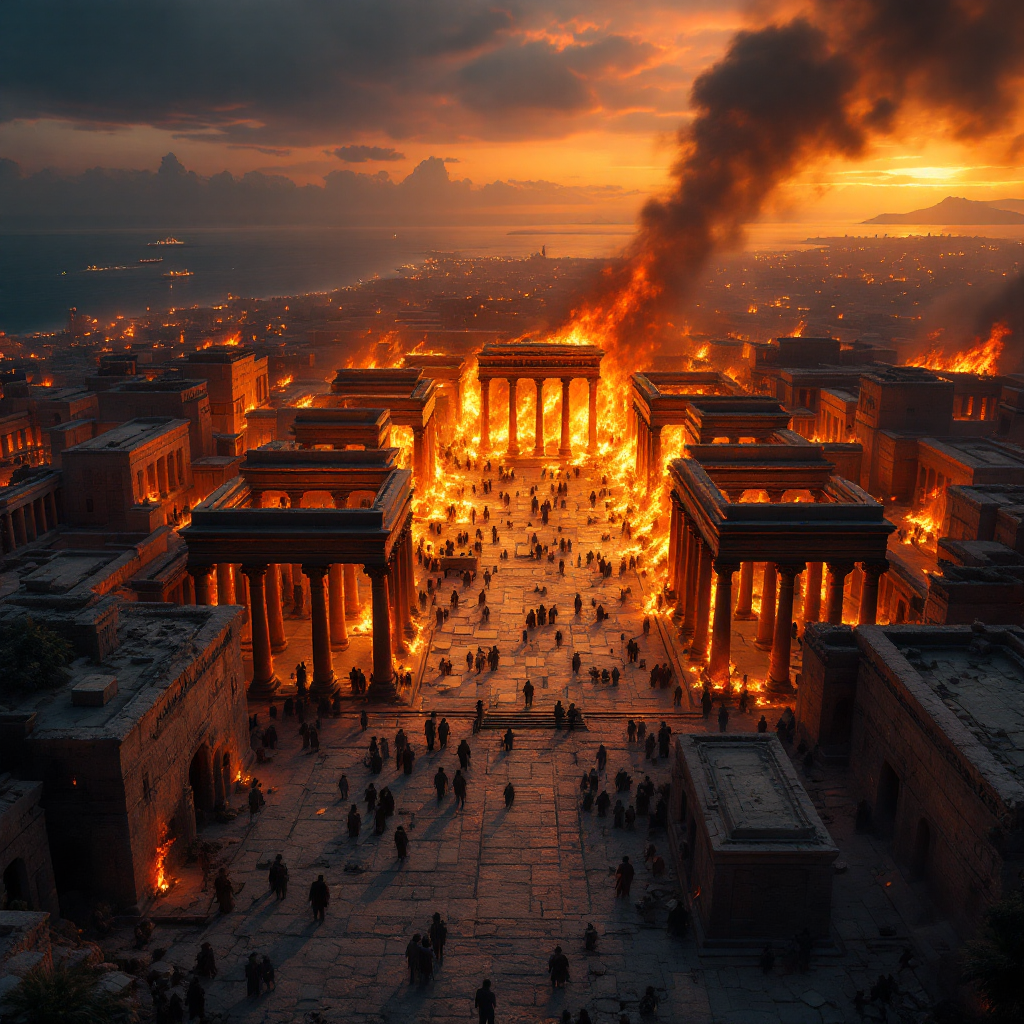
The library of alexandria burning remains one of history’s most catastrophic knowledge losses. When flames consumed the Great Library, they erased not just scrolls but entire systems of thought, initiatory practices, and technologies we are only beginning to rediscover. The question worth asking isn’t just what burned, but what that burning protected.
For centuries, scholars have mourned the library of alexandria burning as an accident of war or religious zeal. The truth is more layered. Multiple fires spread across decades, each serving different interests. What disappeared wasn’t random. It was strategic.
What the Library Held
The Library of Alexandria wasn’t a lending library. It was an archive of human potential. Ptolemy I founded it around 300 BCE as a repository for every written work in the known world. Ships docking in Alexandria had their scrolls confiscated, copied, and cataloged. The originals stayed. The copies were returned.
At its peak, estimates place the collection between 400,000 and 700,000 scrolls. These weren’t duplicates. They were singular records: Egyptian mystery school texts, Babylonian star charts, Greek philosophical treatises, Hebrew mystical writings, Persian alchemical formulas, and Indian medical systems. The building housed wisdom traditions from across the ancient world, many predating written history itself.
Among the lost works were the complete writings of Pythagoras, whose mathematical and mystical teachings encoded the relationship between number, sound, and consciousness. Gone were the full astronomical records of the Chaldeans, who mapped planetary cycles with precision modern science is still confirming. The Hermetic corpus survived only in fragments, scattered pieces of a once-complete system describing the laws governing mind and matter.
The mystery schools of Egypt stored their sacred geometry, initiation protocols, and energy practices in that library. As explored across suppressed knowledge and hidden history, these weren’t abstract philosophies. They were functional maps of human transformation, methods for activating dormant capacities within the body and brain.
The Fires That Erased It
The library of alexandria burning wasn’t a single event. It died slowly, in stages, each fire serving a different architect of erasure.
The first major damage came in 48 BCE during Julius Caesar’s siege. Fire spread from the harbor to nearby buildings, consuming an unknown portion of the collection. Some historians argue the main library survived this incident, with only warehouse scrolls lost. Others suggest the damage was catastrophic from the start.
The second wave came under Christian rule. In 391 CE, Emperor Theodosius I issued decrees against pagan temples. Bishop Theophilus led mobs through Alexandria, destroying the Serapeum (a temple complex that held part of the library’s collection) and everything inside it. This wasn’t war. It was doctrinal cleansing. Knowledge that contradicted emerging Church authority had to go.
The final blow came in 642 CE when Muslim forces took the city. Caliph Umar reportedly ordered the scrolls burned, stating that if they agreed with the Quran they were redundant, and if they contradicted it they were heretical. Whether this account is historically accurate remains debated, but the result was the same: the library ceased to exist as a functioning institution.
What matters isn’t which fire did the most damage. What matters is the pattern. Every conqueror, every new authority, had an interest in controlling what people could know. The library represented a threat because it preserved alternatives, other ways of understanding reality, other systems of power, other paths to the divine.
What Survived and Where It Went
Not everything burned. Scholars fled Alexandria carrying what they could. Some scrolls were copied before destruction. Others were hidden, buried, or smuggled to distant archives.
The Byzantine Empire absorbed Greek philosophical texts, preserving Plato and Aristotle through monastic copying. Islamic scholars translated and expanded on works of medicine, mathematics, and astronomy that would have otherwise vanished. Jewish mystics carried Kabbalistic teachings westward, encoding them in oral tradition and secret manuscripts.
The Nag Hammadi library (a collection of Gnostic texts discovered in Egypt in 1945) surfaced in 1945, revealing early Christian writings the Church had suppressed. The Dead Sea Scrolls emerged shortly after, showing how much biblical text had been edited over centuries. Both discoveries confirmed what many suspected: what burned in Alexandria wasn’t the only copy, but it was often the most complete.
Renaissance Europe rediscovered fragments during the 15th century, sparking an explosion of inquiry that challenged Church monopoly on truth. Hermetic texts, alchemical manuals, and Platonic dialogues that survived in Arabic or hidden Christian archives suddenly became available again. The Reformation followed. The Scientific Revolution followed. The Enlightenment followed. All built on knowledge the Church had tried to bury.
Some traditions suggest the deepest teachings were never written down. Initiatory knowledge passed orally, master to student, ensuring only those prepared could access it. If true, the library’s destruction was a tragedy but not a total loss. The living lineage continued underground, surfacing in mystery schools, Masonic lodges, and Rosicrucian orders across Europe.
Who Benefited From the Burning
Every act of destruction creates a vacuum. Someone always fills it.
When Alexandria burned, the Roman Catholic Church was consolidating power across the Mediterranean. A population with access to multiple wisdom traditions, Egyptian, Greek, Persian, Hebrew, couldn’t be easily controlled. A population dependent on one book, interpreted by one institution, could.
The library’s destruction didn’t just erase scrolls. It erased alternatives. It removed the ability to cross-reference, compare, and synthesize. It made the Church’s version of history the only version available. Without competing narratives, there was no debate. Without debate, there was no dissent. Without dissent, there was total control.
This wasn’t accidental. As explored in the chapters on institutional distortion (Chapter 10) and the architecture of control (Chapter 16), power consolidates by narrowing what is thinkable. The fewer options people have, the easier they are to manage. Burning books doesn’t just destroy information. It destroys the infrastructure of independent thought.
Islamic expansion followed a similar logic. A single authoritative text, interpreted by a clerical class, replaced the plurality of pre-Islamic knowledge systems. What didn’t align with the Quran was suspect. What contradicted it was heretical. The library’s existence, with its multiplicity of voices, was incompatible with that vision.
Political empires also benefited. Knowledge is power, and concentrated knowledge is concentrated power. A ruler who controls what people can read controls what they can imagine. The library’s destruction ensured no one could access information that might challenge the legitimacy of those in charge. The full mechanism behind this kind of institutional suppression runs deeper than most people realize, threading through religious doctrine, political consolidation, and the deliberate inversion of sacred symbols.
The Knowledge We Lost
What exactly disappeared when the library of alexandria burning consumed those shelves?
We know from fragments and references that the library held complete records of Egyptian temple science. This wasn’t primitive superstition. It was a sophisticated understanding of sound, frequency, and resonance applied to healing, agriculture, and consciousness expansion. The priests didn’t worship gods. They worked with principles, principles encoded in geometry, number, and ritual.
The mathematical works of Pythagoras, available only through later commentaries, originally included practical applications of harmonic ratios to architecture, music, and the human body. His school taught that number wasn’t abstract but alive, woven into the fabric of reality itself. The library held the full curriculum. We have footnotes.
Astronomical records from Babylon and Chaldea mapped cycles spanning thousands of years. These weren’t primitive star myths. They were precision observations of planetary motion, eclipse cycles, and precessional shifts that modern astronomy only confirmed in the 20th century. The ancients knew. The library stored the proof. Now we’re rediscovering what they already mapped.
Hermeticism (an ancient spiritual and philosophical tradition based on the teachings attributed to Hermes Trismegistus), the teaching attributed to Hermes Trismegistus, survived in fragments like the Emerald Tablet and the Corpus Hermeticum. The complete system, described in references but never recovered, detailed the relationship between mind and matter, showing how consciousness shapes reality at every scale. That’s not New Age wishful thinking. That’s the foundation of what became Western esotericism, alchemy, and eventually quantum mechanics.
Medical texts from India, Greece, and Egypt offered treatments we’re only now validating through clinical research. Turmeric for inflammation, willow bark for pain (the basis of aspirin), and plant-based compounds that modern pharmacology patents and sells at markup. The ancients didn’t have labs. They had millennia of observation. The library cataloged it. We lost it. Now we call it alternative medicine and charge people for rediscovering what was once common knowledge.
Initiatory practices encoded in mystery school manuals taught methods for awakening latent human faculties. Breath control, fasting windows, postural alignment, and meditative states that shifted brain chemistry and opened perception. These weren’t myths. They were protocols. REDACTED, READ CHAPTER 21 of Master Thyself explores one such system in biological detail. The library held dozens. We have rumors.
The Pattern of Erasure
Alexandria wasn’t the first library burned, and it wasn’t the last. The pattern repeats.
In 213 BCE, Chinese Emperor Qin Shi Huang ordered the burning of books and the burying of scholars alive. Confucian texts, historical records, and philosophical writings that questioned his authority went into the flames. Only state-approved technical manuals on agriculture and divination survived. Knowledge that empowered individuals was dangerous. Knowledge that served the state was preserved.
In the 16th century, Spanish conquistadors burned Mayan codices across Mesoamerica. Bishop Diego de Landa personally oversaw the destruction of thousands of manuscripts in 1562, claiming they contained nothing but lies of the devil. Only four codices survived. We lost an entire civilization’s astronomy, mathematics, calendar systems, and cosmology because one man decided it contradicted his religion.
In the 20th century, the Nazis burned books in public squares across Germany. Jewish authors, communist writers, and anyone who challenged the regime saw their works reduced to ash. The goal wasn’t just censorship. It was the elimination of alternative thought, the narrowing of what could be imagined, the installation of a single permitted reality.
The mechanics are always the same. Identify knowledge that threatens control. Label it heretical, subversive, or dangerous. Destroy it publicly to send a message. Replace it with an approved narrative. Repeat until the population forgets there was ever an alternative.
This isn’t ancient history. It’s the architecture of every authoritarian system ever built. The library of alexandria burning set the template. Every book burning since has followed the script.
What We’re Rediscovering
The knowledge didn’t die. It went underground.
Sacred geometry, dismissed as mystical nonsense for centuries, is now recognized as the mathematical foundation of biological growth, cosmic timing systems, and architectural resonance. The Flower of Life, the Seed of Life, the Vesica Piscis (the almond shape formed where two equal circles overlap): these aren’t decorative. They’re blueprints.
Hermetic principles, long relegated to occult margins, describe mechanisms quantum physics is only now formalizing. As above, so below. The observer effect. Consciousness shaping matter. The ancients knew it experientially. We’re proving it mathematically. The library held the synthesis. We’re reassembling it from fragments.
Astrological timing, mocked as superstition, correlates with measurable biological rhythms. Lunar cycles affect sleep, mood, and hormonal output. Solar activity influences geomagnetic fields and human nervous systems. Ancient cultures didn’t worship planets. They tracked their influence. The peer-reviewed evidence is mounting. The library documented it millennia ago.
Initiatory practices preserved in yoga, Taoism, and Kabbalah all point to the same biological mechanism: REDACTED, READ CHAPTER 21. The terms differ. The anatomy doesn’t. The library held cross-cultural confirmation of a single human potential. We’re reverse-engineering it through comparative mysticism.
Nutritional wisdom encoded in Ayurveda, Traditional Chinese Medicine, and Greek humoral theory is being validated by modern research on gut health, inflammation, and metabolic function. Turmeric, ginger, garlic, fasting protocols: the ancients knew. The library cataloged it. We forgot. Now we’re relearning through clinical trials what was once handed down as common sense.
The thread runs through every recovery: what the ancients understood holistically, we’re rediscovering in pieces. What they synthesized, we’re compartmentalizing. What they practiced, we’re patenting. The knowledge survived, but the REDACTED, READ CHAPTER 19 that made it a complete system was lost when Alexandria burned.
Why It Still Matters
The library of alexandria burning wasn’t just a historical tragedy. It was a structural reset. It severed humanity from a continuous lineage of integrated knowledge, replacing synthesis with specialization, wisdom with information, and direct knowing with institutional gatekeeping.
We live in the aftermath. Our education system teaches facts but not meaning. Our science studies parts but ignores wholes. Our medicine treats symptoms but not causes. Our religions offer belief but not experience. Every fragmentation traces back to the same moment: when the archive that held the threads together went up in flames.
The loss wasn’t accidental. It served those who needed a dependent population. A culture that remembers its full capacity is ungovernable. A culture that forgets becomes manageable. The burning didn’t just erase scrolls. It erased the memory of what humans are capable of when they have access to the complete map.
What remains in fragments, mystery school teachings, alchemical texts, yogic systems, geometric principles, points to something larger. A unified science of consciousness that ancient civilizations practiced as naturally as we practice engineering. REDACTED, READ CHAPTER 13 explores what that framework may have looked like before institutional religion fractured it into competing dogmas.
The tragedy isn’t that the library burned. The tragedy is how few people realize what was lost, and how many still defend the institutions that lit the match.
The Reconstruction
If the knowledge survived in fragments, the task is reassembly. Not reinvention. Recovery.
Every mystery tradition carries a piece. Kabbalah maps the Tree of Life (a diagram of divine emanation and human consciousness used in Jewish mysticism), ten spheres representing stages of creation and consciousness. Yoga describes chakras (energy centers along the spine in yogic and tantric traditions), seven energy centers along the spine. Taoism tracks meridians (pathways of energy flow in Traditional Chinese Medicine), channels through which life force flows. Hermeticism outlines principles governing mind and matter. Christianity once taught the kingdom within, before the institution moved it to the afterlife.
None of these are metaphors. They’re descriptions of the same architecture from different angles. REDACTED, READ CHAPTER 21. The library held the synthesis. We’re rebuilding it through cross-referencing what survived.
Sacred geometry provides the mathematical foundation. The Fibonacci sequence appears in plants, galaxies, and DNA. The golden ratio structures art, architecture, and atomic orbits. The Platonic solids encode the shapes underlying physical matter. These aren’t decorative patterns. They’re the source code. The ancients knew. The library documented it. We’re remembering.
Sound and frequency offer another thread. Solfeggio tones (a set of ancient frequencies used in sacred music and healing practices), Pythagorean tuning, and cymatics (the study of visible sound wave patterns) all point to vibration as the organizing principle of reality. The Vedas called it Nada Brahma: the universe as sound. The Greeks called it the Music of the Spheres. Modern physics calls it wave-particle duality. Same truth, different language. REDACTED, READ CHAPTER 6 maps the mechanism the library once preserved in full.
Astrology, stripped of its predictive circus and returned to its astronomical roots, tracks measurable cosmic cycles and their biological effects. The pineal gland (a pea sized gland deep in the brain that makes melatonin and regulates circadian rhythms) responds to light. The heart responds to geomagnetic fields. The body is a receiver. The cosmos is the signal. REDACTED, READ CHAPTER 9 lays out the original system before the Church demonized it as fortune-telling.
The work isn’t to invent new systems. It’s to recognize the pattern running through what survived. The library of alexandria burning scattered the pieces. The reconstruction is underway. What was hidden is being found. What was suppressed is resurfacing. What was forgotten is being remembered.
Not through institutions. Through individuals willing to look beyond the approved narrative and ask what else is true.
Closing Reflections
The library of alexandria burning was never just about books. It was about control over what humanity is allowed to know about itself.
Every scroll that burned represented a path not taken, a question not asked, a potential not realized. The loss echoes forward through every century since, visible in the fragmentation of knowledge, the gatekeeping of institutions, and the deliberate suppression of practices that restore human sovereignty.
But the burning also revealed something the architects of erasure didn’t anticipate. You can burn the library, but you can’t burn the truth. It goes underground. It gets encoded in symbols, passed in whispers, hidden in plain sight within the very structures built to contain it.
The fragments are enough. The pattern is visible. The synthesis is possible. What Alexandria held isn’t lost. It’s scattered. And every person who picks up a piece, who asks the questions the system wants buried, who remembers what the institutions want forgotten, becomes part of the reconstruction.
The library burns every time a voice is silenced, a book is banned, or a teaching is labeled dangerous. It rebuilds every time someone refuses to accept the official story and goes looking for what was hidden. The war over knowledge didn’t end in 642 CE. It’s still running. And the side you’re on isn’t determined by what you believe, but by whether you’re still willing to ask what else might be true.