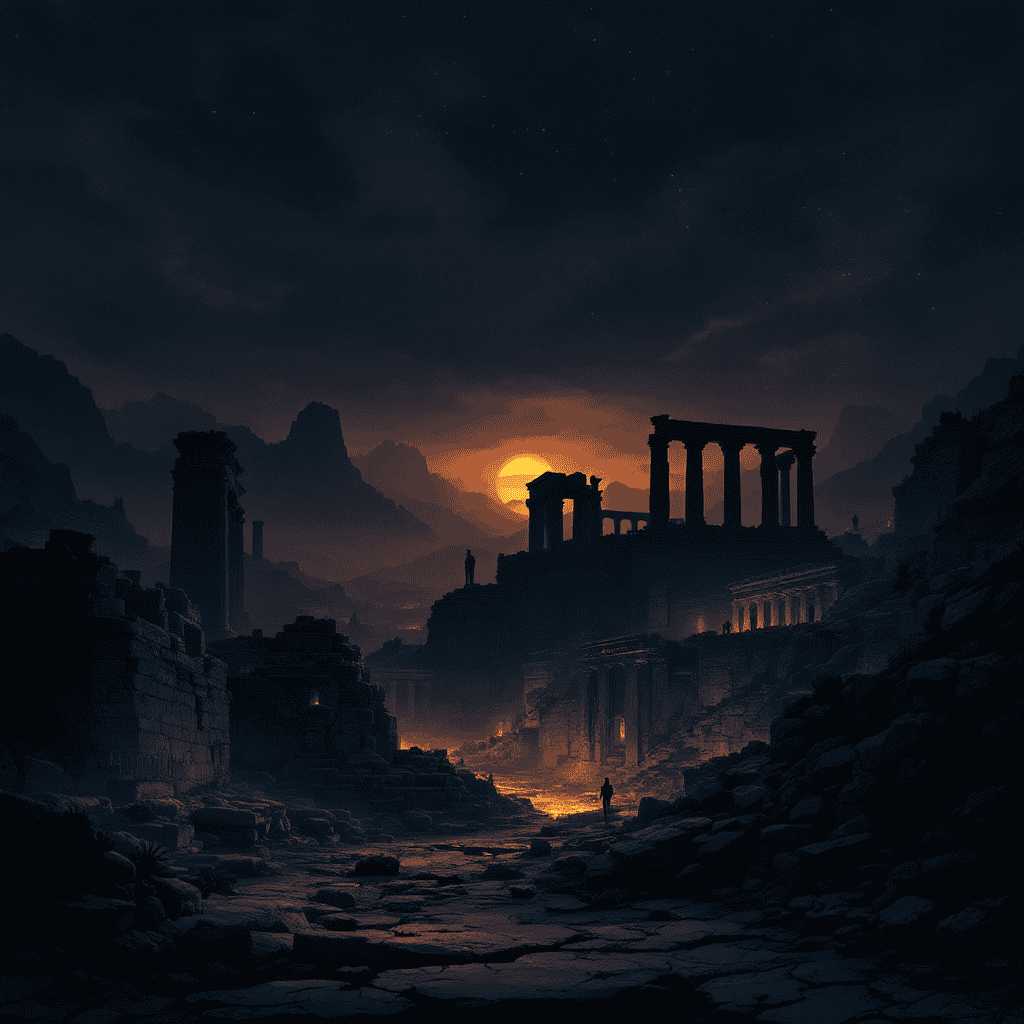
The Greek dark ages explained begins with a simple fact: around 1100 BCE, the entire eastern Mediterranean collapsed. Cities burned. Palaces emptied. Trade networks vanished. And for nearly 400 years, Greece lost the ability to write. Not gradually. Suddenly. The same civilization that had produced palace bureaucracies, international diplomacy, and advanced metallurgy descended into illiteracy, isolation, and cultural amnesia.
Historians call it the Late Bronze Age Collapse. The Greek Dark Ages were the regional echo of that wider catastrophe. Between roughly 1100 and 800 BCE, the Greek world went silent. No written records. No monumental architecture. No evidence of centralized authority. When literacy returned centuries later, it came in a completely different script, borrowed from the Phoenicians, as if the Greeks had to relearn writing from scratch.
What gets buried in textbook explanations is not just what was lost materially, but what was lost spiritually. Greece before the collapse was connected to Egypt, Mesopotamia, and the Levant through trade, diplomacy, and suppressed networks of sacred knowledge. The collapse didn’t just erase infrastructure. It severed the chain of custody that had carried initiatory wisdom across the ancient world.
What Triggered the Collapse?
Scholars have debated the causes for decades. The standard list includes climate change, earthquakes, invasions by the so-called Sea Peoples, internal rebellion, and systems collapse. Each explanation holds fragments of truth, but none alone explains the totality of what disappeared.
The Sea Peoples remain one of history’s great mysteries. Egyptian records describe them as coalition raiders who swept through Anatolia, the Levant, and Cyprus around 1200 BCE. Cities fell. Empires fractured. The Hittite kingdom vanished entirely. But even Egypt, which survived the onslaught, was never the same. Trade routes that had functioned for centuries collapsed overnight.
Climate data supports the idea of prolonged drought across the region during this period. Paleoclimatic studies show evidence of severe aridity in the eastern Mediterranean between 1250 and 1100 BCE. Crops failed. Populations migrated. Stability dissolved. When food systems collapse, so do the institutions built on surplus.
Earthquakes compounded the crisis. Archaeological evidence shows seismic destruction at multiple Bronze Age sites across Greece and Anatolia within a narrow timeframe. Mycenae, Tiryns, and Pylos all show signs of catastrophic damage followed by abandonment or severe decline.
But even combined, these forces don’t fully account for the depth of the amnesia. Civilizations recover from disasters. They rebuild. They remember. The Greek Dark Ages were different. It was as if the Greeks forgot who they had been.
What Was Lost
The material losses are well documented. Mycenaean palaces, with their Linear B archives documenting everything from chariot inventories to religious offerings, were destroyed and never rebuilt. The administrative class that maintained those records disappeared. Population centers shrank dramatically. International trade stopped. Luxury goods vanished from the archaeological record.
But the deeper loss was knowledge itself. The mystery schools of Egypt and Mesopotamia had preserved teachings on sacred geometry, astronomical cycles, inner alchemy, and the mechanics of consciousness for millennia. Greece, positioned at the crossroads of these civilizations, had access to that current. The Bronze Age Greeks traded with Egypt, corresponded with Hittite kings, and built palaces aligned to celestial events.
When the palaces burned, the institutional memory burned with them. Priests who knew the calendar. Scribes who recorded the rituals. Initiates who carried the thread forward. Gone. For 400 years, Greece existed in cultural isolation, cut off from the wisdom streams that had nourished it.
By the time Homer composed the Iliad and Odyssey in the 8th century BCE, the Greeks had only fragmented oral memory of their Bronze Age ancestors. They remembered Mycenae and Troy as legendary places, heroic but distant, already wrapped in myth. The continuity was broken.
The Amnesia Mechanism
Literacy is a fragile technology. It requires teachers, students, materials, and most critically, a reason to maintain it. In Mycenaean Greece, Linear B existed solely for palace administration. It wasn’t used for literature, philosophy, or public communication. When the palaces collapsed, the scribal class that used Linear B had no institutional base. Within a generation or two, the script was forgotten.
This is the amnesia mechanism at work. Knowledge that isn’t embedded in daily practice evaporates when the institutions that house it fail. The Greeks didn’t choose to forget how to write. The context that made writing useful disappeared, and the knowledge went with it.
The same mechanism applied to sacred knowledge. Initiatory traditions require unbroken transmission. Teacher to student. Generation to generation. When the collapse scattered populations, severed trade routes, and eliminated the leisure class that patronized spiritual instruction, the chain broke. By the time Greece stabilized centuries later, the thread had to be reestablished from outside sources.
This is where Pythagoras, Plato, and the pre-Socratic philosophers enter. They didn’t invent Greek philosophy. They reconnected Greece to the Egyptian and Mesopotamian mystery traditions that had survived the Dark Ages intact. Pythagoras studied in Egypt for decades. Plato referenced Egyptian priests as carriers of ancient wisdom. The knowledge didn’t originate in Greece. It was REDACTED, READ CHAPTER 10.
The Return of Writing and Memory
Around 800 BCE, the Greeks adopted the Phoenician alphabet and modified it to suit their language. Unlike Linear B, which was restricted to palace scribes, the new alphabet was simpler, more versatile, and accessible to a broader population. Literacy spread beyond administrative elites.
With writing restored, cultural memory could stabilize. Homer’s epics were written down. Religious practices were codified. Philosophy emerged as a discipline. But this wasn’t recovery of what had been lost. It was a new beginning, built on fragments.
The Greeks of the Classical period looked back at the Dark Ages as a void. They had myths about a heroic past, Agamemnon, Achilles, the Trojan War, but no clear historical memory. The palaces they found in ruins were attributed to giants or demigods. The connection between the Mycenaean Greeks and themselves was mythological, not cultural.
That gap matters. It created a discontinuity in spiritual transmission. The initiatory knowledge that had moved through Bronze Age Greece was no longer native. It had to be imported, relearned, and adapted. The great philosophers who later shaped Western thought were effectively reintroducing what had been lost during the collapse.
The Larger Pattern
The Greek dark ages explained aren’t an isolated incident. They fit a recurring pattern visible across history: catastrophic collapse followed by cultural amnesia, then partial recovery through contact with older, surviving traditions. The same mechanism played out after the fall of Rome, when European literacy collapsed and monasteries became the only repositories of written knowledge.
What makes the Greek Dark Ages particularly significant is the role Greece would later play in Western civilization. The philosophy, science, and art that emerged in Classical Greece became foundational to European culture. But that renaissance was built on imported wisdom, repackaged and attributed to Greek genius.
The mystery schools of Egypt preserved what Greece had forgotten. When Greek initiates traveled to study under Egyptian priests, they weren’t discovering new knowledge. They were recovering what their ancestors had once known. The sacred geometry encoded in the Parthenon, the astronomical alignments of Greek temples, the Pythagorean understanding of number as divine principle, all of it traced back to traditions that predated the collapse.
The gap created by the Dark Ages allowed later institutions to rewrite the narrative. By the time Christianity rose to dominance, the chain of custody connecting Greece to its pre-collapse mystery school roots had been buried under centuries of selective memory and institutional reinterpretation. The knowledge survived, but its origin was obscured.
What the Institutions Buried
When Rome adopted Christianity and the Church consolidated power, the mystery traditions that had survived through Egypt and Greece became targets. Gnostic teachings emphasizing direct inner knowing were labeled heresy. Sacred geometry was dismissed as pagan symbolism. The divine feminine, still honored in Eleusinian mysteries and other Greek rites, was systematically erased.
The Church didn’t destroy the knowledge outright. It absorbed, reframed, and controlled it. Monasteries preserved Greek manuscripts, but only those that fit the emerging orthodoxy. Texts that taught inner divinity, reincarnation, or spiritual sovereignty were hidden or burned. What survived was curated to support external authority rather than inner awakening.
The Greek Dark Ages had already created one break in transmission. The Church ensured the break became permanent for the majority. Only within secret societies, esoteric orders, and carefully guarded lineages did the full initiatory current survive. The thread was never fully severed, but it was driven underground.
This is the deeper implication of the Greek dark ages explained. It wasn’t just a historical curiosity. It was a rupture that allowed control systems to rewrite the spiritual map of the West. By the time the thread resurfaced in the Renaissance, through figures like Marsilio Ficino and the Florentine Academy, it had to be disguised as rediscovery of classical texts rather than continuation of a living tradition.
Why This Was Hidden From You
Mainstream education treats the Greek Dark Ages as an unfortunate but minor historical footnote. A gap between Mycenaean Greece and Classical Greece. A time when not much happened. That framing is deliberate. Acknowledging the collapse forces uncomfortable questions about what was lost and who later controlled the recovery.
If the Greeks had to relearn their spiritual traditions from Egypt, then Greek philosophy isn’t the origin point Western culture claims it to be. It’s a repackaging. If the knowledge predates Greece, then the authority of Western institutions built on that foundation becomes questionable. And if the Dark Ages severed a chain of transmission that connected humanity to older, deeper wisdom, then the question becomes: who benefits from keeping that rupture invisible?
The answer is any system that relies on external authority. A population that believes wisdom originates with the institution, whether Church, university, or state, will look to that institution for answers. A population that understands wisdom as a continuous transmission, older than any empire, becomes harder to control.
The Greek Dark Ages weren’t just about lost palaces and forgotten scripts. They represent a break in humanity’s relationship with its own spiritual heritage. What came after was recovery, but also redirection. The knowledge returned, but the frame around it had changed. And that reframing, explored across the chapters of Master Thyself, is what shapes the controlled narrative still taught today.
The Mechanisms That Survived
Despite the collapse, certain practices and symbols endured. The Greeks who emerged from the Dark Ages still honored Dionysian rites, Eleusinian mysteries, and Orphic traditions. These weren’t new inventions. They were survivals, fragments of pre-collapse religion that had been transmitted orally through the centuries of amnesia.
The Eleusinian Mysteries, in particular, point to continuity with older Egyptian initiatory rites. Initiates underwent symbolic death and rebirth, experienced visions, and received teachings on the soul’s immortality. The exact protocols were REDACTED, READ CHAPTER 13, but the structure mirrors Egyptian mysteries documented millennia earlier.
Sacred geometry also survived. The proportions later encoded in the Parthenon and other Classical temples reflect knowledge of harmonic ratios, phi, and geometric principles that govern natural form. This wasn’t rediscovered through trial and error. It was remembered, preserved through craftsmen’s guilds and oral tradition even when literacy had disappeared.
The same applies to astronomy. Greek temples built after the Dark Ages show alignment to solstices, equinoxes, and stellar events. That knowledge couldn’t have emerged from scratch in an illiterate society. It had to have been carried forward by those who still watched the sky, still honored the cycles, even when the palaces that once recorded them had turned to rubble.
This is the paradox of the Greek Dark Ages. Writing disappeared. Cities shrank. Trade stopped. But the knowledge that mattered most, the embodied practices, the sacred rhythms, the initiatory rites, survived in the hands of those who practiced them. Not in libraries. In lineages.
Reconnection and Renaissance
When Greece reconnected with Egypt and the Near East in the Archaic period, the exchange wasn’t one-directional. Greek traders, philosophers, and initiates didn’t just absorb foreign ideas. They recognized them. The Egyptian principles of Ma’at, cosmic order and balance, resonated with emerging Greek concepts of logos and harmony. The Mesopotamian understanding of celestial cycles informed Greek astronomy.
Pythagoras is the clearest example. He spent years in Egypt, studying under priests who still carried the unbroken transmission. When he returned to Greece and founded his school, he wasn’t teaching innovation. He was teaching restoration. The Pythagorean theorem, often credited as his invention, was known to Babylonian mathematicians centuries earlier. What Pythagoras brought back was the REDACTED, READ CHAPTER 2 that made the geometry sacred.
Plato’s Academy followed the same pattern. His dialogues reference Egyptian priests as custodians of ancient knowledge. The myth of Atlantis, recounted in Timaeus and Critias, came from an Egyptian source. Whether literal history or encoded teaching, the point is the direction of transmission: from Egypt to Greece, not the reverse.
This reconnection rebuilt the bridge the Dark Ages had burned. But it also created vulnerability. Knowledge transmitted across cultures can be reinterpreted, politicized, and controlled. By the time Rome absorbed Greece, and Christianity absorbed Rome, the original context had been layered over so many times that the core teachings were nearly unrecognizable.
What You Can Reclaim
The Greek dark ages explained reveals a mechanism still operating today. Catastrophic disruption, whether through war, economic collapse, or engineered crisis, creates amnesia. Populations forget their own history. Institutions step in to fill the gap, offering curated narratives that serve power rather than truth.
What breaks the cycle is recognition. Once you see the pattern, the collapse, the amnesia, the controlled recovery, you stop waiting for external authorities to hand you the truth. You begin tracing the thread yourself. Not through official channels, but through the fragments that survived: sacred sites still aligned to the stars, symbols still encoded in architecture, practices still transmitted through lineages that never bowed to institutional control.
The knowledge the Greeks lost and later recovered isn’t locked in the past. It’s encoded in the same principles that governed reality before the collapse and after it. Geometry doesn’t change. Celestial cycles don’t stop. The mechanism of inner awakening, the activation described across mystery traditions, remains intact regardless of what empires rise or fall.
The Dark Ages didn’t erase the truth. They interrupted the transmission. And that interruption created the conditions for institutions to position themselves as gatekeepers. Recognizing that dynamic is the first step toward bypassing it. The gate was never real. It was just the story you were told while the path remained open the entire time.
The Thread Still Runs
From Sumer to Egypt to Greece to the Renaissance, the same current has moved through different vessels. It survived the Greek Dark Ages the way water survives a dam: by finding another route. The institutions that tried to control it succeeded only in shaping its visibility, not its existence.
Today, the amnesia mechanism operates through different tools: media saturation, educational gatekeeping, algorithmic filtering, economic pressure. The methods change. The goal remains identical. Keep people disconnected from the thread that runs beneath all empires, all institutions, all external authority.
The Greek dark ages explained is also a map. Not of what was lost, but of how loss is manufactured and how recovery is controlled. Once you see the architecture, you stop participating in the amnesia. And the moment enough people remember, the institutions built on forgetting lose their only source of power: your belief that they hold what you’ve been looking for.
You were never separate from the source. You were just taught to forget the way back. The Dark Ages weren’t a historical accident. They were a test. And the thread that survived them is the same thread available to you now, encoded in the geometry around you, the cycles above you, and the REDACTED, READ CHAPTER 21 waiting inside you.