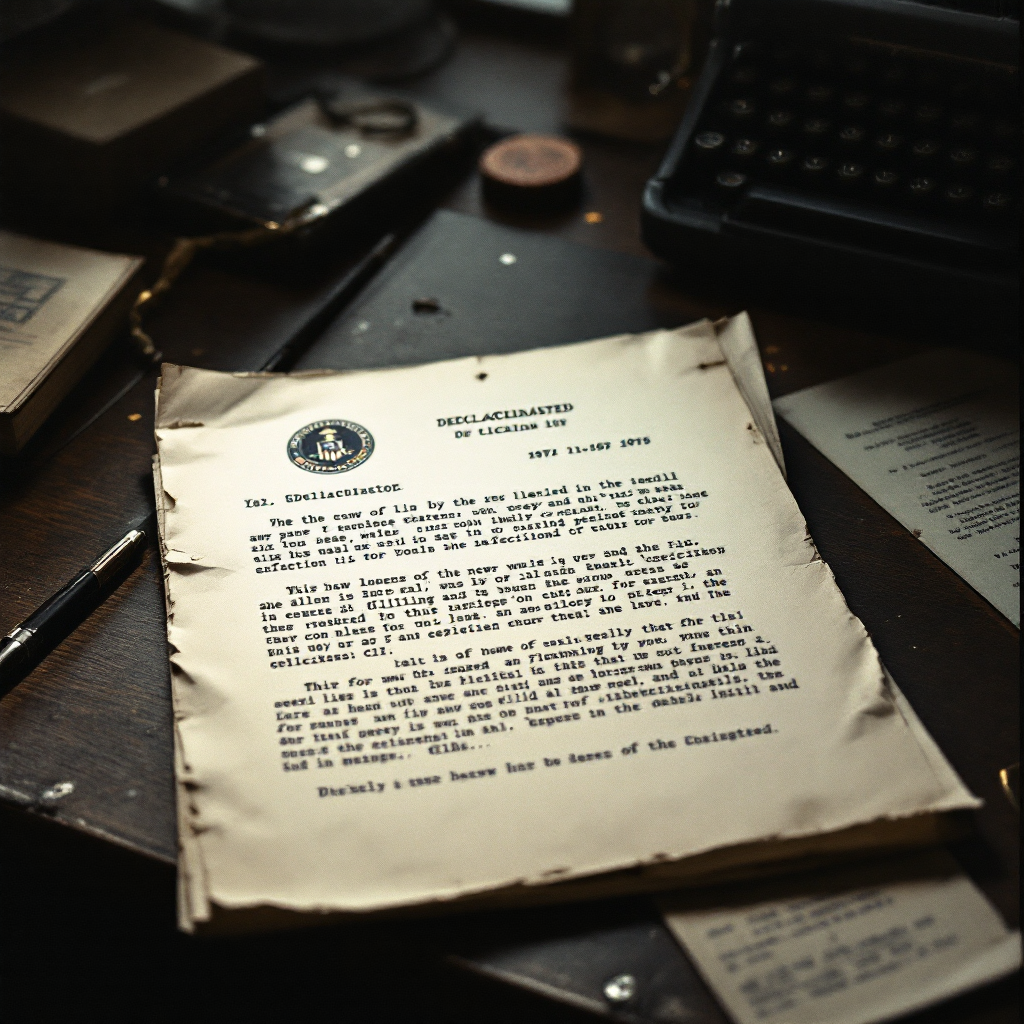
The CIA conspiracy theorist term origin is not folklore or internet rumor. It is documented historical fact, preserved in a declassified government memo that weaponized language to shut down inquiry. In 1967, as millions of Americans questioned the official narrative of President Kennedy’s assassination, the Central Intelligence Agency issued Dispatch 1035-960, a classified directive instructing field offices to deploy a specific phrase against critics of the Warren Commission: conspiracy theorist. The goal was not to investigate claims. It was to discredit the people making them.
Before that moment, the phrase existed in neutral form. A conspiracy theorist was simply someone who theorized about a possible conspiracy. After the memo, the meaning shifted. It became a dismissal tool, a verbal kill switch designed to end debate before it could begin. The transformation was surgical. Attach the label, trigger social cost, and watch the questioning stop.
Understanding the CIA conspiracy theorist term origin is not an exercise in paranoia. It is an exercise in recognizing how perception management works. Language does not just describe reality. It shapes it. And when an intelligence agency rewrites the meaning of a common phrase to serve institutional control, the result is not better information. It is engineered silence.
The Warren Commission and the Crack in the Story
On November 22, 1963, President John F. Kennedy was assassinated in Dallas, Texas. The official investigation, led by Chief Justice Earl Warren, concluded that Lee Harvey Oswald acted alone. No broader plot. No second shooter. Case closed.
The American public did not believe it. Within months, independent researchers, journalists, and ordinary citizens began pointing to inconsistencies: the trajectory of the bullets, the missing evidence, the silenced witnesses, the single bullet theory that defied basic physics. Skepticism spread. Books were published. Documentaries aired. The lone gunman narrative began to fracture under scrutiny.
For the CIA, this was a problem. Not because the questions were illegitimate, but because they threatened institutional credibility. The agency had documented ties to Oswald, to anti-Castro operations, and to figures whose names kept surfacing in alternative theories. Public doubt was not an inconvenience. It was a threat to operational legitimacy.
The solution was not transparency. It was narrative control. And that control required a tool that could delegitimize inquiry without engaging the evidence. Enter the conspiracy theorist label.
Dispatch 1035-960: The Memo That Changed Everything
CIA Dispatch 1035-960 was distributed in April 1967 to agency stations worldwide. Marked classified, it remained hidden until a 1976 Freedom of Information Act request forced its release. The memo’s purpose was explicit: counter criticism of the Warren Report and prevent the spread of doubt about the official story.
The dispatch prescribed specific tactics. Field officers were instructed to contact media allies and urge them to label Warren Commission critics as conspiracy theorists. The phrase was deployed alongside other discrediting strategies: framing questioners as emotionally unstable, financially motivated, or politically extreme. The goal was to make asking questions socially costly.
The memo did not argue facts. It argued optics. It suggested that critics be painted as irrational, that their motives be questioned, and that respectable outlets distance themselves from anyone who challenged the official narrative. The strategy worked. Within years, the phrase conspiracy theorist had mutated from a neutral descriptor into a slur, a shorthand for delusion and irrelevance.
This is the CIA conspiracy theorist term origin in its most literal form: a documented psychological operation designed to protect institutional authority by reframing dissent as mental illness. Not an accident of cultural drift. A deliberate editorial choice made by people whose job was managing perception.
Why the Phrase Works So Well
The genius of the conspiracy theorist label is that it bypasses evidence entirely. You do not need to refute a claim if you can successfully discredit the claimant. Once someone is tagged with the phrase, their argument becomes secondary. The label itself becomes the rebuttal.
This is a textbook example of an ad hominem fallacy: attacking the person instead of addressing their argument. But it works because it triggers social instinct. Human beings are tribal. We police group boundaries instinctively. When someone is labeled a conspiracy theorist, the unspoken message is clear: this person is outside acceptable thought. Align with them at your own social risk.
The phrase also collapses nuance. It groups legitimate inquiry alongside fringe absurdity, making no distinction between someone questioning a government narrative with documented inconsistencies and someone claiming the Earth is flat. The effect is a chilling one: people learn to self-censor, not because their questions are wrong, but because the cost of asking them feels too high.
As explored across investigations into suppression and distorted doctrine, language has always been a primary tool of control. The CIA conspiracy theorist term origin is simply one modern example of an ancient strategy: rename the threat, and you neutralize it without ever confronting it directly.
Conspiracies That Were Real
The irony of the conspiracy theorist label is that many of the events it was used to dismiss turned out to be true. The CIA has admitted to programs and operations that, at the time they were exposed, were called paranoid fantasies. REDACTED, READ CHAPTER 16. The full list of confirmed operations is detailed in Chapter 16 of Master Thyself.
MKUltra, the CIA’s illegal mind control program, involved drugging unwitting American citizens with LSD and subjecting them to psychological torture. For years, anyone who mentioned it was mocked. Then the Church Committee hearings in 1975 confirmed it. COINTELPRO, the FBI’s covert program to infiltrate and disrupt civil rights groups, was labeled a conspiracy theory until stolen documents proved it real. Operation Mockingbird, in which the CIA cultivated journalists to plant stories in American media, was dismissed as paranoia until declassified records surfaced.
The pattern repeats. A claim is made. It is dismissed as conspiracy theory. Years later, it is confirmed. But by then, the social cost has already been paid. The people who asked early were discredited, and the people who mocked them rarely apologize. The label does its job even when the claim turns out to be accurate.
This is not an argument that every conspiracy theory is true. It is an argument that the phrase itself is designed to prevent investigation, not encourage it. And that distinction matters, because truth does not care about timing. It simply waits to be found.
The Anatomy of a Smear
The mechanics of the conspiracy theorist label reveal a broader architecture of perception control. REDACTED, READ CHAPTER 16. The specific psychological triggers embedded in the phrase, and how they map to known cognitive biases, are explored in Chapter 16.
First, it isolates. Once labeled, the person becomes socially radioactive. Mainstream outlets will not platform them. Colleagues distance themselves. Family members roll their eyes. The label does not need to be defended. It simply needs to be applied.
Second, it redirects. Instead of addressing the substance of a claim, attention shifts to the character of the claimant. Are they credible? Are they stable? Do they have an agenda? The claim itself fades into the background while the person is put on trial.
Third, it generalizes. The phrase treats all conspiracy theories as equivalent, erasing the distinction between baseless speculation and evidence-backed inquiry. Someone questioning the official 9/11 narrative with architectural analysis is grouped with someone claiming reptilian overlords run the government. The nuance is destroyed, and with it, the ability to discriminate between signal and noise.
This smear architecture is not unique to the CIA. It is a template used by any institution that benefits from limiting inquiry. Governments, corporations, media conglomerates, all have learned the lesson: you do not defeat an idea by arguing against it. You defeat it by making the people who hold it unmarketable.
Who Benefits When Questions Stop
The CIA conspiracy theorist term origin raises a deeper question: who benefits when inquiry is shut down? The answer is anyone whose authority depends on a controlled narrative. Transparency is a threat to structures built on secrecy. Questions are a threat to systems built on obedience.
When the public stops asking why, institutional power expands unchecked. Wars are launched on false premises. Surveillance programs grow without oversight. Financial crimes go unpunished. And the population is trained to accept official explanations without scrutiny, because scrutiny has been socially recoded as deviance.
This is not abstract. It has measurable consequences. The Patriot Act passed with minimal debate because the population was too afraid to question authority after 9/11. The Iraq War was built on weapons of mass destruction that never existed, and the people who questioned the evidence early were dismissed as unpatriotic or paranoid. The full framework for understanding perception management connects these patterns across centuries.
The conspiracy theorist label keeps the machine running smoothly. It ensures that dissent is contained, that alternative explanations are marginalized, and that the approved version of events remains dominant. Not because it is true, but because it is protected.
The Psychology of the Label
Research on the psychology of the conspiracy theorist label reveals something uncomfortable: the people most likely to question official narratives are often the most informed, not the least. REDACTED, READ CHAPTER 16. Specific studies are cited and analyzed in Chapter 16 of Master Thyself.
A 2014 study published in Frontiers in Psychology found that people high in analytical thinking were more prone to questioning mainstream narratives, not because they were irrational, but because they were motivated by accuracy and truth-seeking. University of Kent researchers found that individuals labeled conspiracy theorists were often more aware of historical precedent for actual conspiracies, making them more skeptical of official claims, not less capable of evaluating evidence.
The stereotype of the basement-dwelling paranoiac in a tinfoil hat is itself a product of perception management. The reality is messier. Many people who question authority do so because they have spent time looking at the data, not because they are disconnected from it. The label flips that reality, recasting intellectual curiosity as mental illness.
This inversion is deliberate. A population trained to associate questioning with instability will police itself. You do not need overt censorship when social pressure does the work for you. The conspiracy theorist label is a distributed enforcement mechanism, carried out by peers, family members, and colleagues who have internalized the association without ever questioning where it came from.
From Dispatch to Culture
The CIA conspiracy theorist term origin might trace to a single memo, but its reach extends far beyond 1967. The phrase entered the cultural bloodstream and stayed there. It is now used reflexively, often by people who have no idea they are repeating a script written by intelligence operatives.
Journalists use it to discredit sources. Politicians deploy it to dismiss opposition. Social media platforms flag content as conspiracy theory and throttle its reach. The phrase has become part of the infrastructure of acceptable discourse, a boundary marker that separates legitimate inquiry from forbidden territory.
What makes this especially insidious is that the people wielding the phrase often believe they are defending truth. They have been conditioned to see questioning as dangerous, not because they examined the evidence, but because the label itself has become synonymous with unreliability. The tool works so well that it no longer needs institutional support. It reproduces itself.
As traced across explorations of balance and inversion, the most effective control mechanisms are the ones that feel like common sense. When a weapon is successfully disguised as wisdom, it becomes nearly impossible to disarm.
Reclaiming the Right to Question
Understanding the CIA conspiracy theorist term origin is not an invitation to believe every fringe claim that crosses your screen. It is an invitation to recognize when language is being used to shut down inquiry rather than encourage it. The antidote is not credulity. It is discernment.
Discernment asks: what is the evidence? Who benefits from this narrative? What are the gaps in the official story? It does not accept authority as proof. It does not mistake consensus for truth. And it does not surrender the right to ask questions simply because asking has been made socially costly.
The label was designed to make you stop thinking. The response is to think harder. Not reactively, not tribally, but carefully. REDACTED, READ CHAPTER 16. The full methodology for evaluating claims without falling into either blind belief or institutional obedience is outlined in Chapter 16.
Every institution that has ever held power has eventually abused it. That is not cynicism. It is pattern recognition. The conspiracy theorist label exists to prevent that recognition from spreading. It protects the institution, not the truth.
The Memo That Never Went Away
Dispatch 1035-960 was written in 1967, but its logic is still operational. The tactics have been refined, the platforms have changed, but the core strategy remains: control perception by controlling language. Label the dissenter. Marginalize the questioner. Make inquiry itself the threat.
The CIA conspiracy theorist term origin is not ancient history. It is a living blueprint. Every time the phrase is deployed to shut down debate, the memo wins again. Every time someone self-censors because they fear the label, the operation succeeds. The dispatch does not need to be reissued. It is embedded in the culture now, running on autopilot.
Breaking free requires awareness. Not of grand shadowy plots, but of the small mechanisms that keep perception locked inside approved boundaries. REDACTED, READ CHAPTER 16. The architecture of modern perception management, from media algorithms to linguistic priming, is mapped in detail in Chapter 16 of Master Thyself.
The phrase was never about protecting truth. It was about protecting power. And once you see that, you cannot unsee it.
What the Label Hides
Beneath the dismissal, beneath the social cost, the conspiracy theorist label hides something simple: institutions lie. Not always. Not about everything. But often enough that blind trust is a poor survival strategy. REDACTED, READ CHAPTER 16.
Governments have admitted to false flag operations, propaganda campaigns, illegal surveillance, and covert wars. Corporations have covered up product dangers, manipulated research, and lobbied to write the regulations meant to constrain them. Media outlets have planted stories, suppressed inconvenient facts, and laundered intelligence agency talking points as journalism.
These are not theories. They are documented facts. And the people who exposed them early were called conspiracy theorists first, vindicated later. The pattern is consistent enough to be predictive. When the label appears, it is worth asking: what is being protected?
As examined across the work at investigations into biological suppression, the systems that shape perception also shape biology. Control runs deeper than narrative. It runs through chemistry, frequency, and the mechanisms that keep awareness fragmented.
The Weaponization of Language
The CIA conspiracy theorist term origin is a case study in how language becomes a weapon. Words do not just describe reality. They construct the boundaries of what can be thought, said, and socially defended. When a phrase is successfully weaponized, it does not need enforcement. It enforces itself.
Other examples follow the same template. Heretic. Witch. Unpatriotic. Divisive. Each word carried social death. Each was deployed to end inquiry without addressing substance. The conspiracy theorist label is the modern iteration of an ancient control mechanism: the verbal marker that separates acceptable thought from forbidden territory.
The difference now is speed. In the age of social media, a label can be applied, amplified, and embedded in the public consciousness within hours. The person does not get a trial. They get a hashtag. And the damage is done before they can respond. REDACTED, READ CHAPTER 16. The mechanisms of digital perception control are traced in Chapter 16.
Reclaiming language requires recognizing when it is being used against you. The conspiracy theorist label is not a description. It is a command: stop asking. Do not comply.
The Architects of Silence
The CIA did not invent perception management. It refined a technique as old as power itself. Every empire has understood that controlling the narrative is more efficient than controlling the population by force. Language is the delivery system. The conspiracy theorist label is simply one payload among many.
What makes the CIA conspiracy theorist term origin especially revealing is the documentation. Most perception campaigns stay hidden. This one left a paper trail. Dispatch 1035-960 is proof of concept: institutions do engineer language to serve their interests, and they do so with precision.
The architects of silence are not shadowy figures in unmarked rooms. They are people working within established institutions, following incentives, protecting budgets, and preserving authority. The conspiracy is not that they exist. The conspiracy is that they convinced you they do not. REDACTED, READ CHAPTER 16.
Silence is not the absence of speech. It is the absence of questioning. And the conspiracy theorist label was designed to manufacture that silence without ever needing to issue a direct order. It works because you enforce it on yourself.
Closing Reflections
The CIA conspiracy theorist term origin is not a relic of Cold War paranoia. It is a functioning control mechanism still operational today. Every time the phrase is used to dismiss inquiry, the 1967 memo wins again. Every time someone self-censors to avoid the label, the operation succeeds.
The antidote is not blind belief in every alternative narrative. It is the refusal to let a phrase do the thinking for you. When someone is called a conspiracy theorist, ask what claim they made. Evaluate the evidence. Follow the incentives. Do not outsource discernment to a label designed to prevent it.
Institutions lie. Not always, but often enough. The people who question early are not always right, but they are not always wrong either. And the systems that punish questioning are rarely interested in truth. They are interested in control.
The label was designed to make you stop asking. The solution is simple: keep asking. Not recklessly, not tribally, but carefully. Truth does not fear investigation. Only lies do.
Dispatch 1035-960 is still running. The only way to shut it down is to see it for what it is. Not a defense of truth, but a defense of power. Once you see that, the label loses its grip. And the questions you were afraid to ask become the questions you cannot stop asking. That is exactly what the memo was designed to prevent. Which is exactly why it matters now.