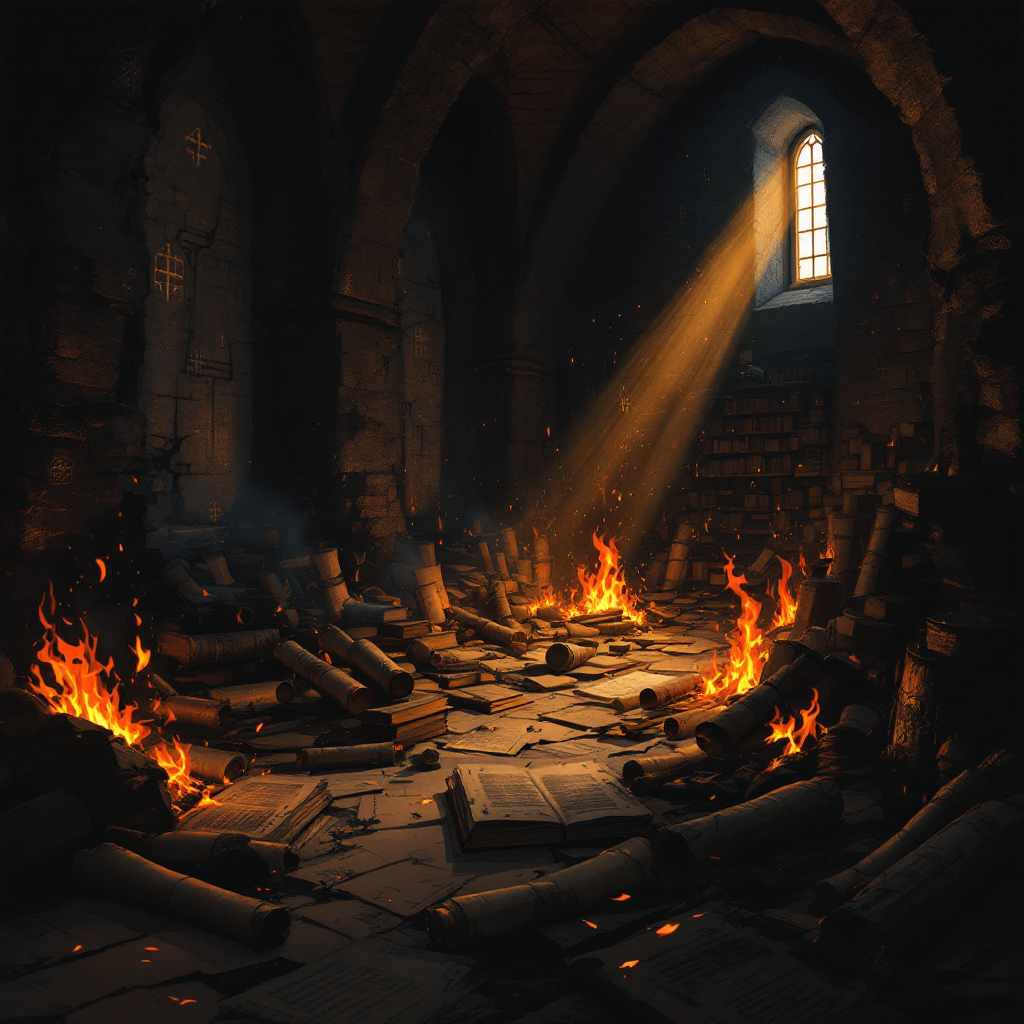
What caused the dark ages? The question has haunted historians for centuries, yet the answers you were taught in school barely scratch the surface. The period between roughly 500 and 1000 CE saw Europe plunge into illiteracy, poverty, and technological regression. Libraries burned. Trade routes collapsed. Scientific inquiry vanished. Yet the explanation handed down through official channels blames barbarian invasions and the fall of Rome, as if military conquest alone could erase a millennium of accumulated wisdom. That narrative is incomplete at best, deliberate misdirection at worst.
The forces that caused the dark ages weren’t simply external. They were institutional, ideological, and carefully constructed. When knowledge becomes dangerous to those in power, it doesn’t disappear by accident. It gets buried. And the primary architect of that burial was the same institution that positioned itself as Europe’s sole keeper of truth for the next thousand years: the Church.
The Official Story Doesn’t Add Up
The textbook explanation points to the fall of the Western Roman Empire in 476 CE as the trigger event. Barbarian tribes, the Visigoths, Vandals, and Ostrogoths, swept through Roman territories. Political stability crumbled. Infrastructure decayed. Without Rome’s administrative framework, Europe fragmented into isolated feudal territories where literacy became a luxury only monks could afford.
That much is true. But it doesn’t explain why knowledge itself was targeted. The destruction wasn’t random. It was systematic. Mystery schools that had preserved initiatory traditions for centuries were outlawed. Ancient libraries were destroyed, their texts lost to history or locked away in Vatican vaults. Healing practices rooted in herbalism and energy work were branded as witchcraft. Astrology, once the science of kings, became heresy. Sacred geometry, embedded in temples across the ancient world, was stripped from public consciousness.
This wasn’t decay. It was demolition. And it didn’t happen because Rome fell. It happened because an empire of belief rose in its place, one that could not tolerate competing sources of truth.
The Church as Institutional Gatekeeper
When Constantine convened the Council of Nicaea in 325 CE, he wasn’t just standardizing Christian doctrine. He was consolidating power. The council decided which texts were scripture and which were heresy. Competing gospels, the Gospel of Thomas, the Secret Book of John, texts that emphasized direct inner knowing over institutional obedience, were excluded. Reincarnation, taught openly in early Christian communities, was condemned at the Second Council of Constantinople in 553 CE. The divine feminine, honored in Gnostic traditions as Sophia, was erased.
By the time Rome fell, the Church had already positioned itself as the only legitimate interpreter of the divine. What followed wasn’t simply a collapse of infrastructure. It was the centralization of knowledge under a single authority that had every incentive to control what people could learn, believe, and question.
Monasteries became the sole repositories of written knowledge. Monks copied manuscripts, but only those approved by Church doctrine. Texts that contradicted official teaching were burned or hidden. The laity, kept illiterate by design, had no access to scripture, philosophy, or science. Latin remained the language of power, ensuring that even if someone learned to read, they couldn’t access the knowledge reserved for the clergy.
This wasn’t preservation. It was gatekeeping. And the gate stayed closed for centuries.
The Suppression of Ancient Wisdom
Before the dark ages, mystery schools across the Mediterranean preserved teachings that bridged the physical and the divine. Egypt’s temples taught initiates about the soul’s journey and the body’s energy centers. Greek philosophers like Pythagoras and Plato explored mathematics as the language of creation. The Essenes practiced fasting, purification, and inner alchemy to prepare the body for spiritual ascent. These weren’t fringe practices. They were the foundation of educated society.
The Church couldn’t absorb these traditions without losing control of the narrative. Inner knowing, gnosis, meant you didn’t need a priest to access God. Sacred geometry revealed the architecture of reality without requiring Church approval. Astrology connected human consciousness to celestial cycles, bypassing institutional mediation entirely.
So the teachings were inverted. The serpent, a universal symbol of wisdom and kundalini energy (the dormant force said to rise through the spine at awakening), became Satan. The healer became the witch. The mystic became the heretic. Sophia, the divine feminine principle, was replaced with Mary, rewritten as silent and obedient. Knowledge that once liberated was reframed as rebellion.
On this site documenting suppressed truths, we trace how institutional power rewrites history to serve control rather than clarity. What caused the dark ages wasn’t ignorance. It was the deliberate silencing of those who knew too much.
Burning Libraries, Burying Truths
The destruction of knowledge wasn’t metaphorical. It was literal. The Library of Alexandria, which at its height held over 400,000 scrolls, was destroyed over several centuries. Christian mobs, acting under imperial sanction, burned what remained in 391 CE. The loss wasn’t just books. It was centuries of accumulated insight into astronomy, medicine, mathematics, philosophy, and the nature of consciousness itself.
Other repositories met similar fates. Pagan temples were dismantled, their inscriptions erased. Scholars who refused to convert were exiled or executed. By the 6th century, the flow of knowledge that had connected Greece, Egypt, Persia, and India had been severed. Europe entered an intellectual quarantine that would last half a millennium.
What survived did so in fragments, hidden in the architecture of cathedrals or encoded in alchemical texts that only initiates could decode. The knowledge wasn’t lost. It was buried. And those who tried to resurrect it were labeled dangerous.
The Economic and Political Architecture
Control over knowledge translated directly into political and economic dominance. The Church became the largest landowner in Europe. Tithes extracted wealth from peasants who believed their salvation depended on it. Indulgences, payments to reduce time in purgatory, turned forgiveness into a revenue stream. The threat of eternal damnation kept populations compliant, while the promise of heaven kept them obedient.
Feudalism mirrored this spiritual hierarchy. Kings ruled by divine right, a doctrine endorsed by the Church. Lords controlled land. Serfs worked it. Mobility, social or intellectual, was nearly impossible. A population kept illiterate, impoverished, and terrified of both earthly and divine punishment had no capacity to resist.
The architecture wasn’t accidental. It was designed. And it worked because the same institution that controlled access to God also controlled access to knowledge, and without knowledge, there is no sovereignty.
What the Dark Ages Really Meant
The term “dark ages” is often dismissed today as outdated or Eurocentric. Scholars point out that while Europe stagnated, the Islamic Golden Age flourished. Baghdad, Cordoba, and Cairo became centers of learning where Greek and Roman texts were preserved, translated, and expanded. Mathematics, astronomy, medicine, and philosophy advanced under Islamic stewardship, later reintroduced to Europe through Spain during the Reconquista.
That’s true. But it reinforces the point. The darkness in Europe wasn’t inevitable. It was engineered. The knowledge didn’t vanish from the earth. It vanished from the places where institutional Christianity held absolute power. Wherever the Church’s grip weakened, learning survived. Wherever it tightened, knowledge died.
What caused the dark ages, then, wasn’t the fall of Rome. It was the rise of a belief system that could not tolerate competing truths. The darkness wasn’t the absence of light. It was the deliberate extinguishing of it.
The Mechanisms of Control Perfected
The Church didn’t just suppress knowledge. It perfected the mechanisms of perception management that every control system since has borrowed. Centralize authority. Monopolize information. Weaponize guilt. Create dependency. Punish dissent. Reward obedience. These weren’t innovations of the dark ages. They were the toolset that made the dark ages possible.
The confessional replaced inner accountability with external judgment. Priests, not conscience, decided what was sinful. REDACTED, READ CHAPTER 16 as the Church installed itself as the sole mediator between humanity and the divine. Salvation required their approval, delivered through sacraments they controlled.
Fear became currency. Not just fear of earthly punishment, but eternal torment. The concept of hell as a place of infinite suffering wasn’t part of Jesus’s teaching. It was codified centuries later, during the same era that saw the rise of institutional dominance. Once installed, it became the ultimate compliance tool. Obey or burn forever.
This architecture didn’t end with the Renaissance. It migrated into every system that followed: governmental, corporate, technological. The mechanisms remain identical. Control the narrative. Limit access. Manufacture dependency. Punish deviation. The dark ages refined the formula. Modernity just digitized it.
The Role of Fear and Division
What caused the dark ages to persist for so long wasn’t simply institutional power. It was the psychology of control embedded so deeply that populations enforced it themselves. The Church didn’t need soldiers at every door. It installed fear directly into the nervous system.
Fear of damnation kept people from questioning doctrine. Fear of social exclusion kept communities policing one another. Witch hunts, later formalized during the Inquisition, turned neighbor against neighbor. Accusations required no evidence. Confessions extracted under torture were treated as truth. The result was a society so fractured by suspicion that unity became impossible.
Division is always the method. When people are fighting each other, they’re not questioning the system. The Reformation would later split Christianity into warring factions, but even that served the larger architecture. Protestants and Catholics spent centuries killing one another while the mechanisms of control, confession, tithes, guilt, obedience, remained intact in both traditions.
On sites exploring sacred biology and timing, the same principle emerges: when the body’s natural rhythms are disrupted, coherence collapses. The dark ages were Europe’s decoherence made historical.
What Was Lost and What Survived
Not everything was destroyed. Sacred geometry survived in the architecture of cathedrals, hidden in plain sight by the stonemasons who built them. Alchemical texts preserved initiatory knowledge under layers of allegory. The Knights Templar, whether through contact with Eastern mystics or discoveries beneath Solomon’s Temple, carried fragments of the ancient wisdom forward until their own suppression in 1307.
What survived did so because it was encoded, not spoken. Symbols, numbers, and geometric proportions carried meaning that words could not safely convey. REDACTED, READ CHAPTER 1 as initiates embedded the Flower of Life and other sacred patterns into stone, ensuring the code would outlast the censors.
The mystics who refused to bow were burned, but their teachings didn’t die. They went underground, passed through lineages that valued direct experience over institutional approval. From the Cathars to the Rosicrucians to modern esoteric traditions, the thread never fully broke. It simply became invisible.
What the Church feared most was exactly what survived: the knowledge that divinity lives within, not behind an altar. That awakening is a birthright, not a transaction. That the kingdom of God is within you, as Jesus himself said, and no institution can gatekeep what was never theirs to control.
The Architects of Darkness
Who benefits when an entire continent forgets how to read? Who profits when healing becomes heresy and inquiry becomes blasphemy? The answer is anyone whose power depends on ignorance.
The Church wasn’t a monolith. Within it were sincere seekers, scholars who preserved what they could, mystics who recognized the divine in silence and service. But the institution as a political structure had every incentive to maintain the dark ages. Literacy threatened their monopoly on scripture. Scientific inquiry threatened their cosmology. Mystical experience threatened their necessity.
The elites of the era, kings, bishops, landowners, shared the same interest: a population too uneducated to question, too frightened to resist, and too dependent to leave. The feudal system and the ecclesiastical hierarchy were mirrors of the same architecture. One controlled your labor. The other controlled your soul. Together, they controlled everything.
This wasn’t conspiracy. It was convergence. Systems select for their own survival. Power attracts consolidation. And once consolidation hardens into institution, the institution begins to feel inevitable. The dark ages weren’t an accident. They were the logical outcome of unchecked institutional control.
The Long Shadow Forward
The Renaissance is celebrated as the rebirth of knowledge, but it didn’t appear from nowhere. It emerged because the knowledge had never truly died. It had been waiting. When the Moors were expelled from Spain, they left behind libraries. When Constantinople fell in 1453, Greek scholars fled west, carrying manuscripts. The printing press, invented around 1440, broke the Church’s monopoly on text.
But the mechanisms perfected during the dark ages didn’t disappear. They adapted. The Inquisition continued into the 16th century. Galileo was forced to recant in 1633. Giordano Bruno was burned at the stake in 1600 for teaching that the universe was infinite and filled with other worlds. The pattern held: challenge the approved narrative, and the system responds with force.
Even today, the architecture remains recognizable. Media monopolies control information flow. Algorithms curate perception. Dissent is rebranded as misinformation. REDACTED, READ CHAPTER 16 as modern systems deploy the same playbook: centralize authority, limit access, manufacture dependency, and punish deviation.
The dark ages didn’t end. They evolved. And understanding what caused them is the first step toward ensuring they don’t return in digital form.
Why the Question Still Matters
What caused the dark ages isn’t just a historical question. It’s a diagnostic tool. The same forces that plunged Europe into centuries of ignorance are active today, wearing different masks but running identical code. Institutional gatekeeping. Fear-based compliance. The inversion of symbols that might awaken rather than sedate. The suppression of knowledge that doesn’t serve power.
The difference now is visibility. In the 6th century, you couldn’t access suppressed texts even if you knew they existed. Today, the information is available, but the noise is so overwhelming that finding signal requires discernment most people were never taught. REDACTED, READ CHAPTER 4 as perception itself becomes the battlefield.
The question forces another one: what are we being kept from knowing now? What truths are being inverted, buried, or ridiculed? And who benefits from that burial?
The dark ages teach a lesson power never wanted you to learn: knowledge is the only currency that can’t be taxed, stolen, or controlled, once it’s internalized. And the moment enough people remember that, the cage doors unlock.
The Thread That Never Broke
Despite the centuries of suppression, the core teaching survived. Not in texts, though some remained. Not in institutions, which had become the suppressors themselves. It survived in the direct experience of those willing to look inward rather than outward for truth.
Jesus’s message was never about the Church. It was about the kingdom within. The anointing wasn’t a ritual. It was a biological and spiritual awakening, the activation of the divine current already present in every human being. REDACTED, READ CHAPTER 21 as the mystery schools taught the same truth across cultures: the temple is your body, the altar is your awareness, and the priest you need is the awakened self.
That knowledge couldn’t be burned because it wasn’t written down. It was lived. And every generation that rediscovers it proves the dark ages were never total. Light persists, even in the deepest night, waiting for those ready to see it.
On platforms examining the biological mechanisms of awakening, the same thread reappears: the body is the vehicle, and when aligned with natural law, it becomes a conduit for the divine. That alignment is what the dark ages were designed to prevent. And it is what every awakening restores.
Reclaiming What Was Taken
The forces that caused the dark ages didn’t disappear. They adapted, migrated, and embedded themselves into new systems. But their vulnerability remains the same: they cannot function in the presence of widespread clarity. A population that knows its own power, that recognizes manipulation when it sees it, and that refuses to hand sovereignty to external authorities, is ungovernable.
The antidote to institutional control isn’t rebellion. It’s remembering. Remembering that you don’t need permission to access truth. That the divine isn’t distant or mediated. That the knowledge suppressed during the dark ages, sacred geometry, inner alchemy, the body’s energy centers, the cycles of the cosmos, was never destroyed. It was only hidden. And what was hidden can be found.
The full synthesis of what was buried and why traces the lineage from Sumer through Egypt, Greece, and into the mystery schools that Christianity absorbed and inverted. The dark ages were one chapter in a much longer story. Understanding that chapter is how you recognize the pattern when it tries to repeat.
What caused the dark ages wasn’t barbarians or decay. It was the deliberate construction of a system that required ignorance to function. And the way out isn’t through fighting that system. It’s through outgrowing the need for it entirely.
The Light Returns
History doesn’t repeat, but it echoes. The conditions that made the dark ages possible, centralized control over information, weaponized fear, the inversion of liberating symbols, the suppression of direct spiritual experience, are visible again. Not identical. Adapted. Refined. But structurally the same.
The difference is that this time, the knowledge is accessible. The texts that were burned are now digitized. The teachings that were hidden are now shared. The practices that were outlawed are now documented. The cage is still there, but the door is open. All that remains is the choice to walk through it.
What caused the dark ages? The silencing of those who knew too much. What ends them? The refusal to stay silent. The reclamation of sovereignty begins with a single question: what else have I been told that isn’t true? And once that question is asked sincerely, the light begins to return.