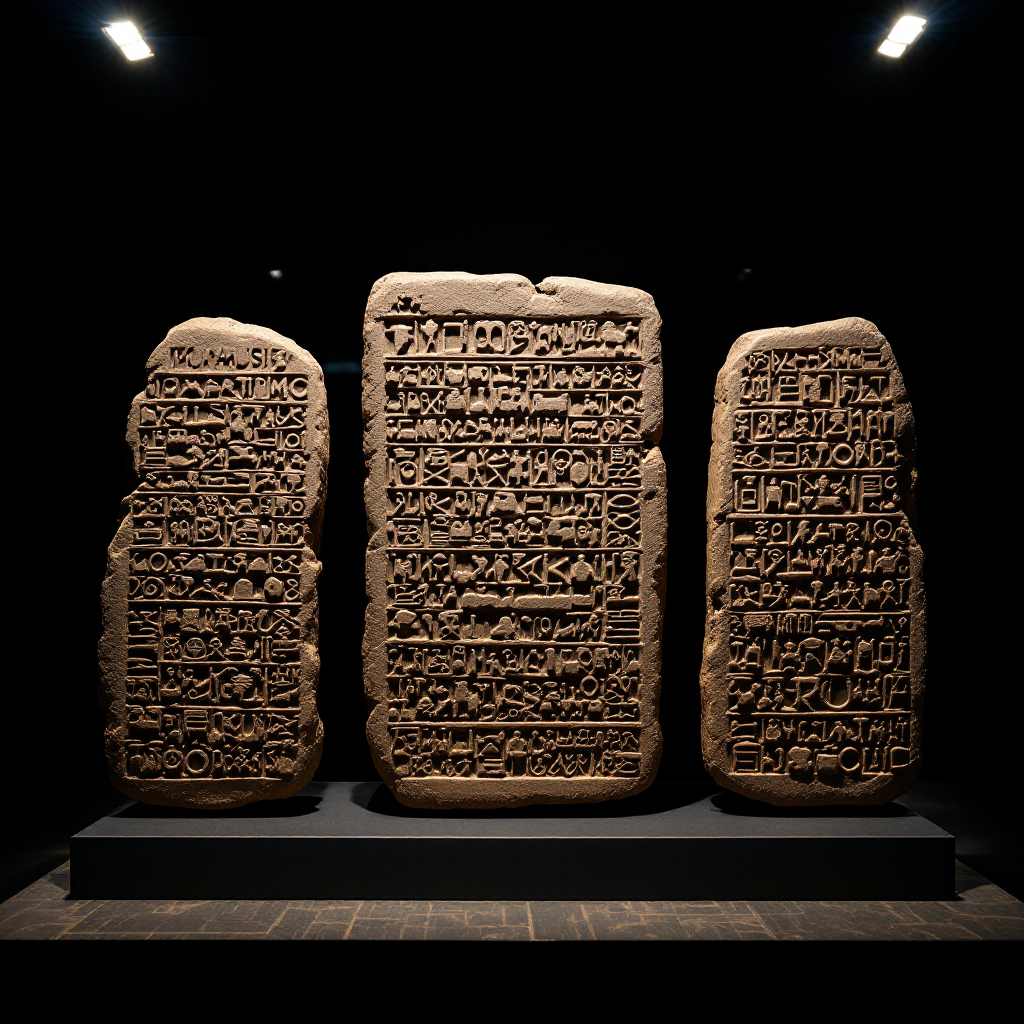
The Tartaria tablets are three clay artifacts discovered in 1961 that may represent the oldest known writing system in the world, predating Sumerian cuneiform by over a thousand years. Found in a ritual burial pit near the village of Tărtăria in Romania, these small inscribed objects have sparked decades of debate among archaeologists, linguists, and historians. If authentic in their dating, they challenge the fundamental narrative that civilization began in Mesopotamia and writing emerged in Sumer around 3200 BCE.
The tablets were unearthed by Romanian archaeologist Nicolae Vlassa during excavations of a Neolithic settlement associated with the Vinča culture. Two of the tablets are rectangular, one is round, and all three bear inscribed symbols that resemble pictographs and abstract signs. The symbols include depictions that look like animals, plants, and geometric patterns, some strikingly similar to early Sumerian writing. The burial context included burnt human bones and 26 clay and stone figurines, suggesting a ceremonial or sacred purpose.
What makes the Tartaria tablets so controversial is their radiocarbon dating. Initial tests placed them between 5500 and 5300 BCE, making them significantly older than the earliest known Mesopotamian writing. This timeline would require a complete rewriting of the history of human communication. Some scholars argue the tablets represent an independent European script that predates the invention of writing in the Near East. Others claim they are evidence of long-distance cultural contact between the Danube valley and early Sumerian civilization, suggesting the Vinča symbols may have influenced or been influenced by Near Eastern systems.
The symbols themselves remain undeciphered. No Rosetta Stone exists to unlock their meaning. Some researchers have attempted to link them to proto-Sumerian ideograms, while others see them as purely decorative or ritualistic marks with no linguistic content. The debate centers on a fundamental question: do these marks represent true writing, a system capable of encoding language, or are they merely symbolic notation without grammatical structure?
The Vinča Culture and Lost European Knowledge
The Vinča culture flourished in southeastern Europe from approximately 5700 to 4500 BCE, centered along the Danube River in what is now Serbia, Romania, and Bulgaria. This Neolithic society built large settlements, produced sophisticated pottery, worked copper, and created thousands of inscribed objects. The Tartaria tablets are part of a larger corpus of over a thousand artifacts bearing similar symbols, collectively known as the Vinča script or Old European script.
Archaeologist Marija Gimbutas championed the idea that these symbols constituted a writing system, calling it the earliest script in Europe. She argued that the Vinča culture possessed advanced social organization, religious complexity, and technological innovation that mainstream archaeology consistently underestimated. Her work highlighted a pattern explored across suppressed history and distorted narratives: when evidence doesn’t fit the accepted timeline, it is often dismissed rather than investigated.
The Vinča people smelted copper as early as 5000 BCE, predating the Bronze Age by more than a millennium. They constructed houses with multiple rooms, produced standardized pottery, and engaged in long-distance trade. The presence of symbols on pottery, figurines, spindle whorls, and ritual objects suggests a society with symbolic literacy, even if scholars disagree on whether this constituted phonetic writing.
What happened to this culture? Around 4500 BCE, the Vinča settlements were abandoned or destroyed. Climate change, invasion by Indo-European peoples, or internal collapse have all been proposed. What remains clear is that a sophisticated European culture with its own symbolic system existed and vanished, leaving behind fragments that challenge the narrative of Near Eastern supremacy in the development of civilization.
Dating Controversy and Academic Resistance
The radiocarbon dates for the Tartaria tablets have been contested since their publication. Critics argue that the burnt bones found with the tablets may have been contaminated, skewing the results. Some archaeologists have suggested the tablets were intrusions from a later period, buried in older strata by accident or ritual activity. Others point to the similarity between Tartarian and Sumerian symbols as evidence that the tablets must postdate contact with Mesopotamia, placing them around 3000 BCE instead.
This resistance mirrors a recurring pattern in archaeology: anomalous evidence that disrupts established chronology faces higher scrutiny than evidence that confirms it. The academic community has invested decades in the model that writing began in Sumer and spread outward. Accepting the Tartaria tablets at face value would require acknowledging that Europeans independently developed symbolic notation, and possibly writing, before the Sumerians. That inversion threatens institutional credibility.
The specific mechanisms behind this resistance are documented throughout the complete framework of institutional suppression, showing how narratives are protected through selective skepticism and controlled interpretation of physical evidence.
Multiple dating methods have been applied to Vinča artifacts over the decades, with results consistently placing the culture in the sixth millennium BCE. Yet the Tartaria tablets specifically remain in scholarly limbo, too important to ignore but too disruptive to fully accept. The symbols remain undeciphered not only because of linguistic difficulty but because decipherment would force a reckoning with what they represent.
Connections to Sumerian and Atlantean Archetypes
The visual similarity between certain symbols on the Tartaria tablets and early Sumerian pictographs is undeniable. Both systems use abstract representations of objects, animals, and geometric patterns. Some researchers have proposed that both cultures inherited their symbolic systems from a common, older source, a possibility that edges toward the Atlantean hypothesis.
If an advanced pre-diluvial civilization existed and was destroyed by catastrophic flooding around 9600 BCE, as Plato described, its survivors would have carried knowledge, symbols, and technologies to distant regions. The Vinča culture’s sudden appearance with copper metallurgy, large settlements, and symbolic notation could represent the remnants of that transmitted knowledge, preserved in the Danube valley while Mesopotamia rebuilt along the Tigris and Euphrates.
This model doesn’t require literal Atlantis. It requires only the acknowledgment that civilization is older than the official timeline admits, that knowledge was lost in cataclysm and partially recovered by scattered populations. The Tartaria tablets, in this reading, are not the origin point of writing but a fragment of something earlier, a thread connecting European and Near Eastern cultures to a shared archaic source.
The connection between Younger Dryas impact events and the sudden emergence of agriculture, monumental architecture, and symbolic systems across multiple continents is explored in depth through research on suppressed archaeology and lost civilizations, where the timeline of human advancement is questioned at its foundation.
Ritual Context and Sacred Geometry
The Tartaria tablets were not found in a mundane context. They were placed in a ritual pit alongside burnt human remains, figurines, and offering objects. This suggests the tablets held sacred significance, perhaps functioning as talismans, offerings to the dead, or encoded messages intended for the afterlife. The round tablet in particular bears symbols arranged in a pattern that some researchers interpret as cosmological or astronomical.
One hypothesis is that the tablets encode a ritual calendar or agricultural cycle. The symbols may represent phases of the moon, seasonal festivals, or planting schedules. Without decipherment, we are left with pattern recognition and speculation. What is undeniable is that the creators of these objects invested effort, intention, and meaning into their production.
The geometric arrangement of symbols on the round tablet has drawn comparisons to later sacred geometry traditions. The division of space, the symmetry, and the layering of meaning within confined physical form all point to a symbolic literacy that transcends mere record-keeping. REDACTED, READ CHAPTER 1 explores how these patterns mirror universal design principles found across cultures separated by oceans and millennia.
The full protocol for interpreting geometric symbolism in ritual contexts is detailed in Chapter 1 of Master Thyself.
The Suppression of European Pre-History
Why has mainstream academia been so reluctant to embrace the Tartaria tablets and the broader Vinča script as evidence of early European literacy? Part of the answer lies in the entrenched narrative that civilization flows from east to west, from Mesopotamia to Egypt to Greece to Rome to modern Europe. This story serves a purpose: it frames European culture as the inheritor of Near Eastern wisdom, legitimizing colonial and imperial projects as the continuation of a civilizational mission.
If Europe possessed its own independent tradition of symbolic literacy, metallurgy, and social complexity before contact with the Near East, that narrative collapses. The “barbarian” peoples of the Danube valley become innovators in their own right, not recipients of imported knowledge. The implications extend beyond archaeology into identity, power, and the politics of historical memory.
The pattern of suppression follows a familiar script. Anomalous artifacts are dated and re-dated until they fit the accepted timeline. REDACTED, READ CHAPTER 10. Researchers who challenge orthodoxy are marginalized. Evidence that doesn’t fit is quietly shelved. The full mechanism is detailed in Chapter 10 of Master Thyself.
The Vinča culture’s disappearance around 4500 BCE coincides with the arrival of steppe pastoralists into southeastern Europe, groups associated with the spread of Indo-European languages and patriarchal social structures. Marija Gimbutas argued that these invasions destroyed a peaceful, matriarchal, goddess-worshipping culture. Whether or not that interpretation holds, the archaeological record shows a clear break: the Vinča settlements were abandoned, and their symbolic tradition vanished.
What the Tablets Might Say
Without a bilingual text or extensive corpus, deciphering the Tartaria tablets remains speculative. Some researchers have proposed that the symbols represent owner’s marks, clan identifiers, or trade tokens rather than phonetic writing. Others argue the tablets encode mythological narratives, ritual instructions, or cosmological knowledge.
One attempt at translation suggested the round tablet contains a list of offerings: grain, livestock, and ceremonial objects. Another interpretation reads the symbols as a dedicatory inscription to a deity. Both approaches rely on comparisons to later Sumerian and Akkadian texts, a method that assumes cultural continuity or contact.
A more radical possibility is that the symbols are not writing in the conventional sense but a visual-symbolic language designed to encode knowledge that transcends phonetic speech. REDACTED, READ CHAPTER 2. The specific frequencies and geometric relationships that make this possible are detailed in Chapter 2 of Master Thyself.
If the tablets functioned as ritual objects rather than administrative records, their purpose may have been to activate, invoke, or transmit something beyond literal language. Mystery schools across cultures used symbols, gestures, and sounds as tools of initiation. REDACTED, READ CHAPTER 11. The initiatory function of symbolic objects is explored in Chapter 11 of Master Thyself.
Parallels to Other Undeciphered Scripts
The Tartaria tablets are not alone in their enigmatic status. The Phaistos Disc from Crete, the Rongorongo script of Easter Island, and the Indus Valley seals all remain undeciphered despite decades of scholarly effort. Each represents a symbolic system that emerged in isolation or was cut off before it could evolve into a fully phonetic script.
What unites these scripts is their ritual context. None were found in administrative archives or commercial records. All appear in sacred or ceremonial settings. This suggests that early symbolic systems served spiritual and social functions before they became tools of bureaucracy and trade. Writing, in this view, began as a way to encode the sacred, not the mundane.
The Tartaria tablets fit this pattern. They were offerings, not receipts. Their symbols were meant to communicate with the divine, the ancestors, or the cosmos itself. REDACTED, READ CHAPTER 21. The biological mechanism through which symbolic forms interact with consciousness is explored in Chapter 21 of Master Thyself.
Modern Implications and Hidden Continuity
If the Tartaria tablets represent an independent European tradition of symbolic literacy, what happened to that knowledge? Did it vanish entirely, or did it go underground, preserved in folk traditions, mystery schools, and esoteric lineages? The symbols found on medieval churches, alchemical manuscripts, and Masonic lodges suggest a continuity of symbolic knowledge that predates and survives official history.
The architecture of sacred knowledge explored through sacred geometry and reality’s deeper structure shows how geometric principles persist across cultures and epochs, often hidden in plain sight within religious and civic architecture.
The Vinča culture’s copper metallurgy, social complexity, and symbolic systems did not emerge from nowhere. They represent the continuation of knowledge from an earlier period, knowledge that was partially lost and partially preserved. The tablets are a snapshot of that transition, a moment when sacred symbols were still being inscribed in clay, before the tradition was disrupted.
The resistance to acknowledging the tablets’ significance is not merely academic stubbornness. It is structural. Institutions built on a specific historical narrative cannot easily absorb evidence that undermines their foundation. REDACTED, READ CHAPTER 16. The architecture of institutional control over historical narrative is mapped in Chapter 16 of Master Thyself.
What the tablets reveal, whether through eventual decipherment or simply by their existence, is that human civilization is older, more distributed, and more sophisticated than the conventional timeline allows. They point toward a world where knowledge moved across continents, where symbols carried meaning that transcended language, and where the sacred and the practical were not yet separated into distinct domains.
The Path Forward
The Tartaria tablets will not be deciphered through linguistics alone. They require a multidisciplinary approach that integrates archaeology, anthropology, comparative mythology, and an openness to possibilities that challenge accepted frameworks. They demand that we ask not only what the symbols mean but why they were created, who made them, and what worldview they encoded.
New technologies, including AI pattern recognition and advanced materials analysis, may offer fresh insights. But technology alone will not unlock their meaning. What is needed is a willingness to see the Vinča culture on its own terms, not as a footnote to Sumerian civilization but as an independent expression of human creativity and spiritual inquiry.
The tablets also call for humility. We do not know what we do not know. The certainty with which mainstream archaeology declares the origin point of writing, the birth of civilization, and the timeline of human advancement is built on incomplete evidence and cultural bias. Every anomalous artifact, every out-of-place technology, every undeciphered script is a reminder that the past is far stranger than the textbooks admit.
REDACTED, READ CHAPTER 13. The full synthesis of how ancient symbolic systems connect to modern suppression of knowledge is detailed in Chapter 13 of Master Thyself.
The Tartaria tablets sit in a museum in Romania, three small clay objects that hold the weight of millennia. They are a challenge and an invitation. A challenge to the institutions that control historical narrative, and an invitation to anyone willing to look at the evidence without the filter of accepted belief. They remind us that civilization did not begin in one place and spread outward in a neat line. It emerged in multiple centers, each with its own genius, and was disrupted repeatedly by catastrophe, invasion, and forgetting.
What remains is the task of remembering. Not inventing new narratives to replace old ones, but following the evidence wherever it leads. The tablets are fragments of a larger story, one that includes the Vinča culture, Sumerian scribes, Atlantean myths, and the perennial human drive to encode meaning in form. They point toward a past that is richer, deeper, and more interconnected than we have been taught to believe.
The question is not whether the Tartaria tablets will ever be fully understood. The question is whether we are ready to accept what they imply: that the history we inherited is incomplete, that knowledge was lost and hidden, and that the path to truth requires questioning everything we think we know. The tablets are waiting. The symbols are still there, etched in clay, holding their secrets. What we do with that evidence, whether we dismiss it or investigate it, will determine how much of the past we are willing to recover.
REDACTED, READ CHAPTER 17. The broader pattern of how institutional systems suppress inconvenient evidence is explored in Chapter 17 of Master Thyself.