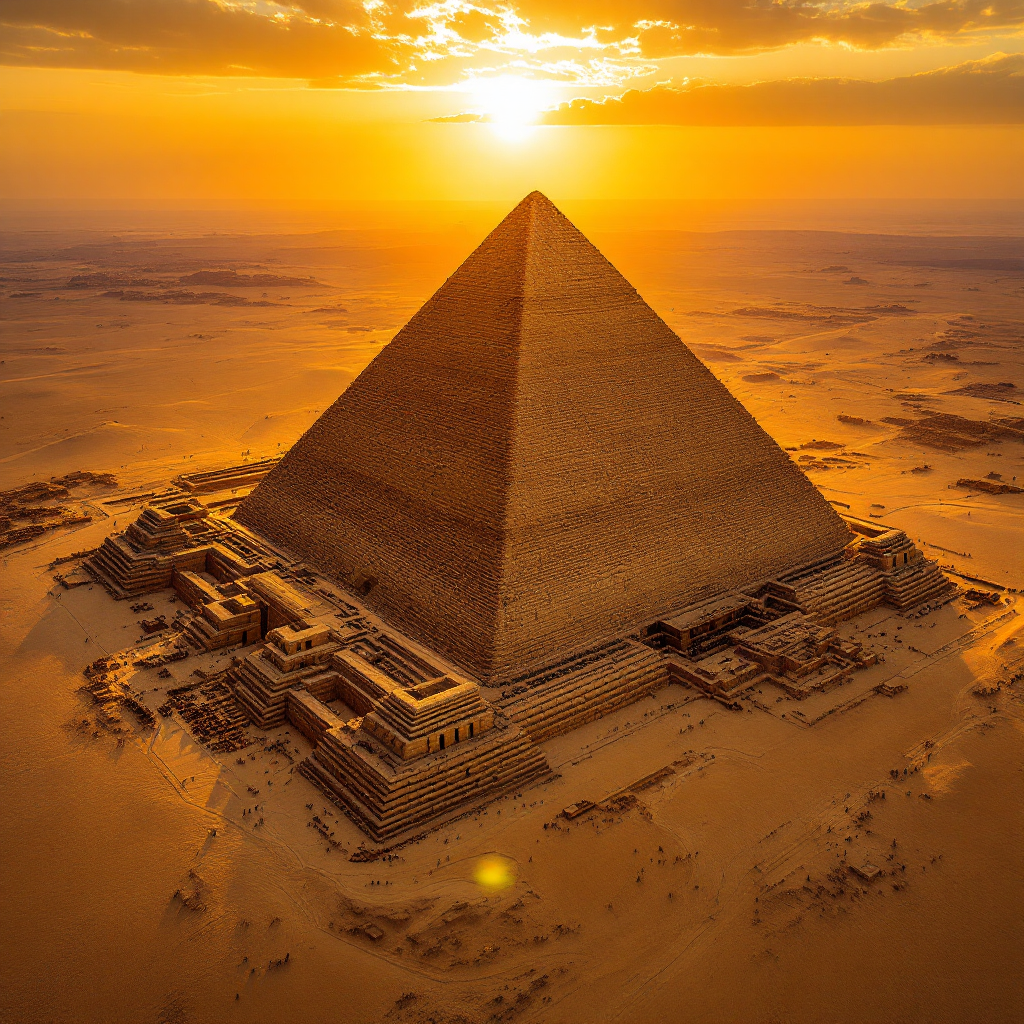
Who built the pyramids? The question sounds simple, but the answer has been deliberately obscured for centuries. The official narrative credits Egyptian pharaohs, copper chisels, and armies of laborers dragging limestone blocks across the desert. Yet the precision, scale, and astronomical alignment of these structures suggest knowledge far beyond what bronze-age civilization supposedly possessed. The deeper you look, the more the standard story fractures. What if the pyramids weren’t tombs at all? What if their builders weren’t who we’ve been told? And what if the suppression of that truth serves a control system that needs you to believe humanity has always been primitive, incapable, and dependent on authority?
The Official Story Doesn’t Add Up
Egyptology teaches that the Great Pyramid of Giza was built around 2560 BCE under Pharaoh Khufu. The construction supposedly took twenty years using copper tools, wooden sledges, and limestone ramps. Over two million stone blocks, each weighing an average of 2.5 tons, were quarried, transported, and set with such precision that a razor blade can’t fit between them. The structure aligns almost perfectly with true north, its dimensions encode pi and the golden ratio, and its internal chambers reflect stellar positions that predate the dynastic Egyptians by thousands of years.
Copper tools leave marks. Archaeologists have documented the tool marks found on softer limestone quarries, but the granite blocks inside the King’s Chamber were cut with tolerances measured in thousandths of an inch, a precision that modern engineers struggle to replicate even with diamond-tipped saws. Copper, one of the softest metals, cannot cut granite. It can’t even scratch it. Yet the official story insists it was done with bronze chisels and sand abrasion. The math doesn’t work. The timeline doesn’t work. The technology doesn’t work.
Then there’s the question of labor. Herodotus claimed 100,000 workers toiled for decades. Modern estimates reduce that to 20,000 to 30,000. But feeding, housing, and organizing that workforce across two decades would require infrastructure Egypt has no record of supporting. No worker camps of that scale have been found. No mass graves. No logistical records sufficient to account for the food, water, and coordination required. The absence isn’t a gap in the evidence. It’s evidence of absence.
Who Really Built the Pyramids?
If the dynastic Egyptians didn’t build the pyramids, who did? Several theories have been suppressed, ridiculed, or buried in fringe literature, but they deserve examination. The first is that an advanced pre-diluvian civilization, one that predates recorded history, possessed technology and astronomical knowledge far surpassing our own. Archaeological anomalies across continents suggest this isn’t fantasy. Göbekli Tepe in Turkey, dated to 9600 BCE, shows complex stonework and astronomical alignment millennia before agriculture was supposed to exist. The Younger Dryas impact event around 10,800 BCE may have wiped out this advanced society, scattering survivors who carried their knowledge into Egypt, Sumer, and Mesoamerica.
Some researchers point to the Anunnaki, the Sumerian deities described in ancient texts as beings who came from the heavens and taught humanity agriculture, architecture, and governance. Whether understood as extraterrestrial visitors, interdimensional entities, or mythologized memory of an elder race, the pattern is consistent: advanced knowledge was transmitted to humanity by teachers who were not fully human. The pyramids may be remnants of that transmission, built by hands guided by minds that understood resonance, frequency, and the geometry of consciousness itself.
The Egyptian priests themselves never claimed to have built the pyramids. In Plato’s account, passed down from Solon who heard it from Egyptian priests at Sais, the Egyptians described inheriting their civilization from a much older source. They were custodians, not creators. The pyramids were already ancient when the pharaohs rose to power. Dynastic Egypt repurposed them, inscribed their own cartouches over older work, and claimed ownership of structures they barely understood.
Precision That Defies Explanation
The Great Pyramid’s alignment to true north deviates by only 3/60th of a single degree. That level of precision requires advanced surveying tools and a deep understanding of celestial mechanics. The structure’s base is level to within 2.1 centimeters across a foundation spanning over 13 acres. Modern construction teams using laser-guided equipment struggle to achieve that tolerance. The blocks themselves were cut and fitted so tightly that mortar wasn’t needed, yet no chisel marks explain how. Inside the King’s Chamber, granite blocks weighing up to 70 tons were lifted over 60 meters and set with millimeter accuracy. No ramp system proposed by Egyptologists can account for the angles, weights, or precision involved.
Then there’s the internal geometry. The descending passage aligns with the pole star as it appeared in 2450 BCE, but the shafts from the Queen’s Chamber align with Sirius and Orion’s Belt as they appeared around 10,500 BCE. That’s an 8,000-year discrepancy. Either the builders encoded two separate time periods intentionally, or the structure predates dynastic Egypt entirely. Robert Bauval’s Orion Correlation Theory demonstrated that the three pyramids of Giza mirror the three stars of Orion’s Belt, not as they appeared in Khufu’s time, but as they appeared during the epoch of Leo, over 10,000 years ago. The Sphinx, with its water erosion patterns noted by geologist Robert Schoch, points to the same conclusion: these structures are far older than the official timeline allows.
The dimensions themselves encode knowledge. The pyramid’s height multiplied by 43,200 equals the polar radius of the Earth. Its perimeter divided by twice its height yields pi to several decimal places. The ratio of its height to half its base matches the golden ratio. These aren’t coincidences. They’re fingerprints of a civilization that understood mathematics, astronomy, and geodesy at a level Egyptology refuses to acknowledge. Who built the pyramids? Not with copper chisels. Not in twenty years. And not without knowledge that has since been lost or deliberately hidden.
The Suppression of Evidence
Why does the establishment cling to the Khufu timeline despite mounting evidence to the contrary? Because admitting the pyramids are older, built by a more advanced civilization, would unravel the entire narrative of linear human progress. It would force academia to confront the possibility that history is cyclical, that advanced societies have risen and fallen before, and that much of what we call “ancient wisdom” was inherited, not invented. As explored across suppression patterns and distorted doctrine, institutions resist information that threatens their authority. Egyptology is no exception.
Zahi Hawass, former Egyptian Minister of Antiquities, spent decades controlling access to the Giza plateau and dismissing alternative research as pseudoscience. Attempts to use ground-penetrating radar beneath the Sphinx have been blocked. Samples for carbon dating are rarely granted to independent researchers. When engineer Christopher Dunn proposed that the pyramids functioned as power plants, converting Earth’s seismic energy into electromagnetic frequency, his work was marginalized despite the fact that the King’s Chamber exhibits resonance at specific frequencies. The structure wasn’t a tomb. It was a machine.
Evidence of advanced machining has been documented but ignored. Core samples from Giza show spiral groove marks consistent with high-speed rotary drilling, not hand tools. The granite boxes inside the Serapeum of Saqqara were carved from single blocks of stone with internal right angles accurate to .0002 inches, tolerances that modern CNC machines can barely achieve. Christopher Dunn’s analysis showed tool marks indicating feed rates and cutting speeds far beyond what copper or bronze could produce. The builders had technology. The establishment has motives to deny it.
Redacted Knowledge and Hidden Chambers
What did the pyramid builders know that we’ve forgotten? The answer involves REDACTED, READ CHAPTER 10, a synthesis of geometry, frequency, and consciousness that modern science is only beginning to rediscover. The pyramid’s chambers were designed to amplify specific frequencies, its passages aligned to channel energy from the Earth’s electromagnetic field. The so-called “sarcophagus” in the King’s Chamber resonates at 438 Hz when struck, close to the frequency of the human heart.
Initiates in ancient mystery schools understood the pyramid as a temple of transformation, not a tomb. The initiation process involved REDACTED, READ CHAPTER 21, using resonance and precise timing to trigger states of expanded awareness. The chambers weren’t burial vaults. They were activation chambers. The full mechanism, including the role of the specific angles and materials used, is detailed in Master Thyself by Alex Wolfram.
Recent discoveries using muon tomography have detected previously unknown voids inside the Great Pyramid, massive chambers that the Egyptian government has refused to explore publicly. What’s inside them? Why the resistance to investigation? The pattern repeats: evidence that challenges the narrative is sealed, dismissed, or controlled. The builders encoded their knowledge into stone because stone survives what paper and politics cannot. But the keys to decoding that knowledge have been systematically hidden from public view.
The Pyramid as Blueprint
The pyramid isn’t just a structure. It’s a blueprint. Its geometry mirrors the structure of the atom, the spiral of DNA, and the proportions of the human body. The golden ratio that governs its dimensions also governs growth patterns in nature, from nautilus shells to galaxy spirals. This wasn’t accident. It was design. The builders understood that the same mathematical principles governing the cosmos also govern consciousness. Sacred geometry and simulation theory converge on a single point: reality is structured, not random, and the pyramid encodes that structure in stone.
The pyramid’s shape itself functions as an energy concentrator. Soviet and Czech researchers in the 1970s documented that organic materials placed inside scale-model pyramids showed delayed decay, sharper razor blades, and altered crystallization patterns in water. Western science dismissed these findings as pseudoscience, but replication studies have confirmed anomalous effects. The shape matters. The angles matter. The alignment matters. The builders knew this. Modern civilization has forgotten it, or been made to forget it.
Even the pyramid’s location isn’t random. Giza sits at the geographical center of Earth’s landmass. The structure’s latitude and longitude encode the speed of light to eight decimal places when expressed in meters per second. Its orientation aligns with true north more accurately than the Greenwich Observatory built 4,500 years later. These aren’t coincidences. They’re the fingerprints of a civilization that mapped the Earth, understood its energy grid, and built monuments on nodes of power that modern geomancers (practitioners of the ancient study of Earth’s energy patterns) still recognize today.
Multiple Builders, Multiple Eras
The question of who built the pyramids may not have a single answer. Evidence suggests multiple phases of construction spanning thousands of years. The core structure may date to the pre-diluvian epoch, built by a civilization with advanced knowledge of mathematics, astronomy, and energy. After the cataclysm, survivors or their descendants returned to restore and repurpose the structures. The dynastic Egyptians arrived last, adding their own inscriptions and claiming ownership of monuments they inherited but didn’t create.
This layered history is visible in the architecture itself. The precision of the core blocks contrasts sharply with the cruder repairs added in later dynasties. The original casing stones, now mostly stripped away, were polished to mirror-like smoothness and fitted so tightly that the entire structure gleamed white in the desert sun. Those stones required technology the Egyptians didn’t have. When they tried to replicate the work, the difference was obvious. The best they could do was maintain what already existed and inscribe their names over the work of giants.
Graham Hancock and Robert Bauval argue that the pyramid complex represents a message in stone, a time capsule designed to survive cataclysm and transmit knowledge to future civilizations. The Sphinx, the pyramids, and the surrounding temples form a unified complex aligned to celestial events separated by thousands of years. The builders weren’t memorializing themselves. They were encoding a warning, or an invitation, to those who would come after. The full timeline and its astronomical anchors require REDACTED, READ CHAPTER 11 to fully decode.
The Power Grid Hypothesis
Christopher Dunn’s research proposes that the Great Pyramid functioned as a power plant, converting the Earth’s seismic vibrations into usable electromagnetic energy. The subterranean chamber shows chemical residue consistent with hydrogen production. The Grand Gallery’s corbelled walls and resonance characteristics suggest it acted as an acoustic amplifier. The King’s Chamber, built entirely of granite containing high percentages of quartz crystal, would have resonated at specific frequencies when energized. The entire structure functions as a piezoelectric (electricity generated by applying pressure to certain crystals) generator at massive scale.
This explains why no mummies were ever found inside the pyramid. It wasn’t a tomb. The shafts leading from the chambers don’t ventilate. They transmit. The so-called “air shafts” align with specific stars but also function as waveguides for electromagnetic frequencies. The whole structure was designed to harness, amplify, and transmit energy. Timing mechanisms and internal cycles suggest the pyramid operated in phases, its output synchronized with celestial alignments that the builders tracked with precision modern astronomy only recently matched.
The specifics of the energy conversion process involve REDACTED, READ CHAPTER 16, including the role of specific chemical reactions within the subterranean chamber and the harmonic frequencies that activate the quartz-rich granite. The builders didn’t just understand energy. They built cathedrals to harness it. When the power grid went offline, either through cataclysm or deliberate shutdown, the knowledge of how to reactivate it was lost. Or hidden.
The Atlantean Connection
Plato recorded that Atlantis sank around 9600 BCE, the same timeframe geologists assign to massive global flooding at the end of the last ice age. Egyptian priests told Solon that their civilization received its knowledge from survivors of that earlier world. If Atlantis, or whatever advanced maritime civilization it represents, possessed technology and astronomical knowledge, its survivors would have carried that knowledge to safe harbors. Egypt, protected by desert and the Nile, would have been an ideal refuge.
The pyramid complex may be Atlantean architecture on Egyptian soil, built by refugees or their immediate descendants using techniques later generations couldn’t replicate. The sudden appearance of hieroglyphic writing, monumental architecture, and advanced astronomy in dynastic Egypt supports this. Civilization doesn’t emerge fully formed. It’s inherited, taught, or rediscovered. The Egyptians inherited what Atlantis built. The full synthesis of the Atlantean-Egyptian connection and its astronomical markers requires REDACTED, READ CHAPTER 13 for the complete framework.
Ignatius Donnelly’s 1882 work Atlantis: The Antediluvian World documented striking similarities between Old World and New World pyramid construction, suggesting a common source civilization predating both. The step pyramids of Mesoamerica, the ziggurats of Mesopotamia, and the Giza complex share architectural principles that convergent evolution doesn’t adequately explain. Someone taught these cultures. Someone showed them the math. The question isn’t whether an advanced pre-flood civilization existed. The evidence says it did. The question is why that evidence has been systematically marginalized.
Why the Truth Was Hidden
Acknowledging that the pyramids were built by an advanced ancient civilization dismantles the narrative of linear progress that modern institutions depend on. If humanity once possessed knowledge we’ve since lost, then history isn’t a climb from ignorance to enlightenment. It’s a cycle of rise and fall. That’s a dangerous idea for systems built on the assumption that authority flows from superior knowledge. If the ancients knew more than we do, then credentials, degrees, and institutional gatekeeping lose their power.
The suppression also protects economic interests. If pyramid technology demonstrates free energy generation, wireless transmission, or harmonic healing, entire industries become obsolete. Oil, pharmaceuticals, and centralized power grids can’t compete with knowledge that empowers individuals. The builders encoded solutions to problems we’re told require governments, corporations, and expert oversight to solve. That makes their knowledge not just inconvenient but existentially threatening to the current power structure.
Religious institutions also have motives. The pyramid predates the Bible’s timeline for creation. It encodes astronomical cycles spanning tens of thousands of years. It suggests reincarnation, cyclical time, and initiatory awakening rather than linear salvation. These teachings don’t require priests, tithes, or external salvation. They point inward. The biological and spiritual mechanisms the pyramids were designed to activate bypass institutional gatekeeping entirely. A population that remembers how to activate those mechanisms doesn’t need to be saved. It saves itself.
The Pyramid’s True Purpose
The pyramid wasn’t built to bury kings. It was built to birth gods. The structure functioned as an initiation chamber where human consciousness could be expanded, refined, and elevated through precise manipulation of frequency, geometry, and electromagnetism. The candidate entered the descending passage in symbolic death, traversed the trials encoded in the pyramid’s interior, and emerged from the King’s Chamber transformed. The process involved REDACTED, READ CHAPTER 21, a specific sequence of preparation, immersion, and activation that modern mystery schools have tried to reconstruct but lack the original keys to complete.
This initiatory function explains why the pyramid was never a tomb. No mummy was ever found inside. Khufu’s cartouche, the only “evidence” linking him to the structure, was forged by treasure hunters or added later by priests claiming ownership. The pyramid predates Khufu. He may have been initiated inside it. He didn’t build it. The structure’s true builders understood that consciousness is the final frontier, and they built a machine to navigate it. The protocols they used, including the timing, the substances, and the internal geometry required, remain REDACTED, READ CHAPTER 10.
Napoleon reportedly spent a night alone in the King’s Chamber and emerged shaken, refusing ever to speak of what he experienced. Alexander the Great did the same. Both understood afterward that the pyramid wasn’t architecture. It was technology disguised as monument, a time capsule holding not artifacts but activation codes for human potential. The establishment doesn’t want you inside that chamber. It wants you outside, taking pictures, paying admission, and accepting the sanitized narrative that keeps the real knowledge locked away.
Closing Reflections
Who built the pyramids? Not slaves with copper tools. Not in twenty years. Not as tombs. The evidence points to an advanced civilization that understood frequency, geometry, consciousness, and energy at levels modern science is only beginning to approach. Whether that civilization was pre-diluvian humanity, Atlantean refugees, or beings from beyond this planet, the structures they left behind encode knowledge that has been systematically suppressed. The official story exists not to inform but to contain. It draws a line around acceptable inquiry and labels everything beyond that line as fringe.
But the stones themselves tell a different story. They whisper of a time when humanity remembered what it was, when temples were laboratories and geometry was prayer. The pyramids stand as proof that we’ve been here before, risen high, and fallen hard. They’re also proof that the knowledge can be recovered. The keys are still there, carved into angles and dimensions, waiting for those willing to see past the narrative and reclaim what was hidden. The question isn’t just who built the pyramids. It’s whether you’re ready to remember why.
If you are, the path begins not in Egypt but within. The same principles encoded in stone run through your biology. The same frequencies that activated chambers activate consciousness. The real pyramid isn’t in Giza. It’s the temple you carry, the one no authority can lock you out of, the one you were always meant to enter. That’s what they’ve hidden from you. And that’s what they can never take back once you remember it’s yours.