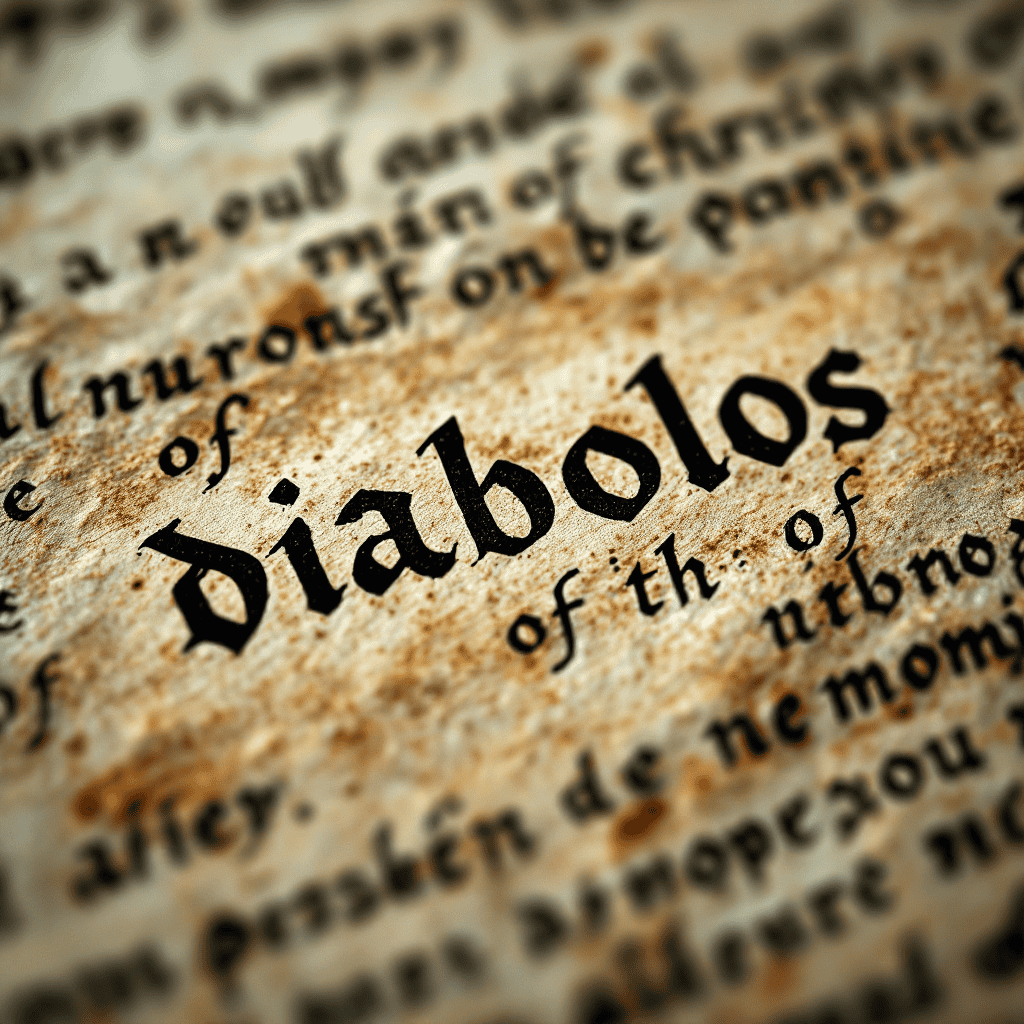
The meaning of the word devil origin begins not with horns and pitchforks but with a Greek verb that meant to throw apart. The figure most recognize today as Satan, the cosmic adversary of God, was assembled gradually across centuries of translation, theological politics, and institutional fear. What started as a legal term in Hebrew and a descriptor of fragmentation in Greek became the most terrifying entity in Western imagination. Not because the original texts demanded it. Because a population that believes an omnipresent supernatural enemy is hunting them will never stop needing the institution that offers protection from it.
The Greek Root: Diabolos and Fragmentation
The English word devil comes directly from the Greek diabolos, a term composed of dia (across, through) and ballein (to throw). Together they form a verb meaning to throw apart, to scatter, to set at variance. In classical Greek usage, diabolos described someone who slandered or accused falsely, a spreader of discord. The word carried no supernatural weight. It was a descriptor of function, not an entity.
When the Hebrew Bible was translated into Greek in the Septuagint around the 3rd century BCE, the translators used diabolos to render the Hebrew term ha-Satan. But ha-Satan was not a name. It was a title meaning the adversary or the accuser, a role within God’s own council. In the Book of Job, ha-Satan appears as a member of the divine court, a prosecuting attorney who roams the earth and reports back to God. No rebellion. No cosmic villain. Just a legal function.
The Greek term captured the accusatory dimension but added a layer the Hebrew did not carry: the sense of division itself. Diabolos wasn’t simply an accuser. It was the principle of fragmentation made animate. To be diabolical was to divide, to scatter coherence, to disrupt unity. This is where the meaning of the word devil origin shifts from courtroom role to spiritual diagnosis. The devil became not just a figure who accuses but the operating description of what happens when wholeness breaks apart.
From Legal Title to Cosmic Enemy
The transformation from legal role to ultimate enemy required centuries and the collision of multiple theological currents. During the Babylonian exile and the centuries that followed, Jewish thought absorbed elements from Zoroastrianism, the ancient Persian religion that featured a cosmic battle between Ahura Mazda (the god of light and order) and Angra Mainyu (the spirit of chaos and destruction). This dualistic framework, good versus evil as opposing cosmic forces, was foreign to early Hebrew thought but became increasingly influential in Jewish apocalyptic literature.
By the time the New Testament was written, the figure of Satan had evolved. He was no longer just the accuser in God’s court. He had become the tempter in the wilderness, the prince of demons, the ruler of this world. Yet even in the Gospels the portrayal is inconsistent. In some passages Satan is a real being with agency. In others the language reads symbolically, describing the inner struggle between higher and lower impulses within the human soul.
The Church Fathers of the 3rd and 4th centuries hardened this symbolic language into doctrine. Origen, Tertullian, and Augustine each contributed layers to the emerging portrait: a fallen angel, once called Lucifer, who rebelled against God and now seeks to drag humanity into damnation. The meaning of the word devil origin, rooted in the simple act of throwing apart, was buried beneath a mythology of cosmic warfare. What had been a function became a personality. What had been a warning about inner fragmentation became an external enemy to be feared and fought.
The Inversion of the Name Lucifer
One of the most revealing distortions in the construction of the devil involves the name Lucifer itself. In its original Latin, Lucifer means light-bearer, from lux (light) and ferre (to carry). Jerome used it in 405 AD when translating Isaiah 14:12 for the Vulgate. The passage describes the fall of a Babylonian king using the poetic Hebrew phrase Helel ben Shachar, son of the dawn, a reference to the planet Venus as the morning star that rises before the sun.
The text was never about a supernatural adversary. It was political satire aimed at an earthly ruler. But by the medieval period, Church theologians had fused this Latin word with Satan. The name that meant to bring light was reengineered to mean the ultimate darkness. This inversion was deliberate. Light, in mystical traditions, represents awakening, inner knowing, and direct access to the divine. Those qualities threatened institutional control. By demonizing the light-bearer, the Church ensured that seekers would fear the very illumination that might free them.
As explored across suppressed teachings and inverted doctrines, the pattern repeats: take a symbol of inner sovereignty, attach it to pre-existing cultural dread, and watch people flee from their own liberation. The meaning of the word devil origin was never about a horned figure in the underworld. It was about making you afraid of the light within.
Diabolos as Decoherence
Strip away the mythology and the Greek root reveals something precise. Diabolos describes fragmentation at the level of consciousness itself. In quantum mechanics, decoherence is the process by which a system loses its unified state and collapses into a fixed, measurable outcome. A wave of possibility becomes a single particle. The field narrows. Options disappear.
The same mechanism operates psychologically. When thought, emotion, and action fall out of alignment, the inner system destabilizes. Fear fragments attention. Guilt fragments identity. Shame fragments the sense of self. Each fracture reduces coherence, and in that reduced state, clarity becomes unreachable. You stop perceiving the whole and begin reacting to fragments. This is what the Greek term named: not a demon with a pitchfork, but the condition of being thrown apart from within.
The opposite of diabolos in Greek is symbolos, from syn (together) and ballein (to throw). A symbol brings things together, unifies meaning, bridges separation. The devil, understood linguistically, is simply the force that scatters what the symbol unites. One fragments. The other integrates. The war between them isn’t external. It’s the oldest tension in consciousness itself.
This understanding aligns with what ancient mystery traditions taught before the Church suppressed them. The serpent wasn’t the enemy. The serpent was Kundalini, the sacred energy said to rise through the spine at awakening. TheTree of Knowledge wasn’t forbidden fruit. It was the activation of discernment. The biological mechanism of that awakening involves specific glands, timing windows, and alchemical processes the Church could not monetize, so it demonized them instead. The devil became the name for what the institution most needed you to avoid: direct inner knowing.
How the Church Used the Devil to Maintain Control
Once the devil was established as a real supernatural entity, the Church gained an unparalleled tool for behavioral control. Every deviation from doctrine could be blamed on demonic influence. Every mystic who taught direct access to God could be accused of consorting with Satan. Every woman who challenged patriarchal authority could be labeled a witch. The devil wasn’t just a theological concept. He was a weapon.
The Inquisition, witch trials, and centuries of religious violence all rested on a single premise: the devil is real, he is everywhere, and only the Church can protect you from him. The threat and the solution were manufactured together. You cannot sell pardons from a punishment that doesn’t exist. Eternal hellfire was codified in the 4th and 5th centuries, the same era the Church began selling indulgences. A population in terror of eternal damnation is a population that never stops needing the institution that offers escape.
The meaning of the word devil origin reveals the inversion at the heart of this system. What began as a warning about inner fragmentation was externalized into a cosmic enemy. What should have driven seekers inward to restore coherence instead drove them outward to obey authority. The very word that described the shattering of unity became the tool used to shatter it further.
REDACTED, READ CHAPTER 10 documents exactly how translation shaped theology, how councils edited scripture, and how the feminine principle was systematically erased to centralize male authority. The devil was never the adversary. The institution that invented him was.
Satan: The Hebrew Context
Before the Greek translation introduced diabolos, the Hebrew Bible used ha-Satan in a completely different sense. The word satan in Hebrew is a common noun meaning adversary or obstacle. It appears throughout the Old Testament describing human opponents, military enemies, and even angels acting in an obstructive role under God’s direction.
In Numbers 22, the angel of the Lord stands as a satan in the road to block Balaam’s path. The term carries no moral judgment. It simply describes function. In 1 Kings 11, Solomon’s political enemies are called his satans. The word was operational, not theological. It described resistance, not cosmic rebellion.
Even in Job, where ha-Satan appears most prominently, the figure operates with God’s explicit permission. He does not act independently. He proposes a test, and God authorizes it. The relationship is collaborative, not adversarial. This is the original context the Greek translators inherited, and it bore no resemblance to the horned devil of medieval Christianity.
By the time the New Testament was written in Greek, satanas (a Greek transliteration of the Hebrew) and diabolos were used interchangeably. Both terms began to take on the character of a single malevolent entity rather than a role or function. The linguistic shift mirrored a theological one: from a God who permits testing within a unified divine order to a dualistic cosmos split between good and evil, light and darkness, God and the devil. That dualism was never part of the original Hebrew worldview. It was imported, adapted, and eventually weaponized.
The Devil in Mystical Christianity
Not all early Christians accepted the literalized devil. Gnostic texts, discovered in 1945 at Nag Hammadi, Egypt, describe the adversary not as a fallen angel but as ignorance itself. In the Apocryphon of John, the figure called Yaldabaoth is a blind craftsman, a lesser deity who mistakes himself for God and traps souls in matter. He is not evil in a moral sense. He is unconscious, and his unconsciousness becomes the prison.
In this framework, the devil is the Demiurge, the architect of illusion. Salvation comes not through obedience to an external authority but through gnosis, direct inner knowing that breaks the spell. The serpent in Eden, far from being the deceiver, is the one who offers humanity the knowledge needed to awaken. The fruit of the Tree of Knowledge is not sin. It is clarity.
The institutional Church declared this teaching heresy and spent centuries erasing it. Gnostic texts were burned. Practitioners were killed. The idea that awakening is possible without the Church, that the so-called devil might have been the teacher all along, was too dangerous to survive. Yet the texts endured, hidden in jars beneath the Egyptian desert, waiting for a time when they could be read without fear.
The structure of reality itself may reflect this same pattern, a simulated construct maintained by forces that depend on unconsciousness to sustain their power. The devil, in this reading, is not a being but the baseline frequency of the simulation: fear, fragmentation, and the loss of coherence. Awakening is the act of raising your signal above that baseline until the illusion loses its grip.
The Devil You Inherited
Most people inherit their image of the devil the same way they inherit their religion: before they have the tools to question it. A horned figure. A lake of fire. A supernatural predator who tempts, deceives, and drags souls to hell. That image was not revealed. It was constructed, piece by piece, across centuries of art, sermons, and state-sponsored terror.
Dante’s Inferno contributed more to modern devil imagery than the Bible itself. Medieval paintings added the horns, hooves, and tail. Renaissance theologians refined the mythology. Hollywood cemented it. The devil you fear is a composite sketch drawn by hands that had everything to gain from your fear and nothing to gain from your freedom.
The meaning of the word devil origin, when restored to its Greek root, has nothing to do with the cartoon villain you were handed. It describes the condition of being thrown apart, the fragmentation of consciousness that makes clarity impossible and control inevitable. REDACTED, READ CHAPTER 17 traces how this inversion became institutionalized, how fear was weaponized, and how the Antichrist system runs on exactly the fragmentation the word diabolos originally described.
The True Function of the Adversary
If you strip the mythology and return to function, the adversary serves a purpose. In psychological terms, resistance clarifies intention. Opposition reveals commitment. The shadow, when faced directly, becomes the catalyst for integration. Carl Jung spent decades mapping this terrain, showing that what we project outward as the devil is often the disowned part of ourselves we refuse to see.
In initiatory traditions, the adversary is the guardian of the threshold. You cannot pass until you are ready. The test is not punishment. It is discernment. REDACTED, READ CHAPTER 21 The biological mechanism behind this initiation involves specific glands, specific timing, and a process the body undergoes when fear is transmuted rather than obeyed. That process has a name in every tradition. The Church called it possession and demonized it. The mystics called it ascension and protected it.
The devil, understood functionally, is whatever throws you off center. It is distraction. It is fragmentation. It is the loss of alignment between who you are and who you pretend to be. In that sense, the adversary is not your enemy. It is your mirror. And the moment you stop running from it, the moment you turn and face what has been chasing you, the game changes. The predator becomes the teacher. The demon becomes the initiator. The thing you feared becomes the thing that sets you free.
Reclaiming Coherence
The Greek root points the way back. If diabolos means to throw apart, the path to freedom is integration. Not fighting the devil. Not begging for protection. But restoring the coherence that fragmentation destroyed. REDACTED, READ CHAPTER 4 maps how belief shapes perception, how perception shapes reality, and how the loop can be interrupted once you see it.
Coherence begins with alignment. Thought, emotion, and action moving in the same direction. No internal contradiction. No hidden agenda. No performance for an audience that isn’t there. When the inner system stabilizes, the external noise loses its grip. Fear still arises, but it no longer commands. Doubt still surfaces, but it no longer defines. The adversary is still present, but it no longer rules.
The balance between opposing forces is not a compromise. It is a higher order of being where opposites no longer fight but complete each other. Light and shadow. Masculine and feminine. Creation and destruction. The adversary and the advocate. All of it held in a single field of awareness that no longer needs to choose sides because it sees the whole.
This is what the Church could not teach and would not permit. A soul that restores its own coherence has no need for an intermediary. A mind that sees through fragmentation cannot be managed by fear. A body that remembers its own divinity cannot be sold salvation it already carries. REDACTED, READ CHAPTER 16
The Symbol Reversed
Every symbol the Church demonized pointed toward the same destination. The serpent was Kundalini, the rising energy of awakening. The Tree of Knowledge was discernment, the ability to see clearly without mediation. The morning star was Venus, the light that rises before the sun, the inner illumination that precedes the dawn. Each one was inverted, rebranded as danger, and used to keep seekers away from the very tools that would free them.
The meaning of the word devil origin is the key that unlocks the inversion. When you see that the word describes fragmentation, not a horned villain, the entire theological structure collapses. The enemy was never out there. It was the condition of being scattered within. And the salvation was never in a distant heaven. It was in the restoration of wholeness here, now, in this body, in this moment.
REDACTED, READ CHAPTER 19 The protocols for restoring that balance involve breath, stillness, and a realignment of the nervous system that the body already knows how to perform. The timing matters. The intention matters. The state of the inner field matters. None of it requires a priest, a confession, or a payment. It requires only that you stop feeding the fragmentation and start restoring the thread.
The Word That Sets You Free
Language is not neutral. Every word carries a history, and every history carries an agenda. The word devil, traced to its origin, reveals a mechanism that predates Christianity, predates Rome, predates the councils that tried to own it. It describes what happens when unity breaks. And it points, by inversion, to what happens when unity is restored.
The devil you were taught to fear is a construct. The fragmentation the word originally named is real. One is a story designed to control you. The other is a condition you can change. REDACTED, READ CHAPTER 24 The map is already inside you. The exit is already marked. You were never lost. You were only told you were, by voices that profited from your confusion.
The meaning of the word devil origin is not a mystery. It is diabolos: to throw apart. The mystery is why you were never told. And the answer to that is simpler than the question. A population that knows how to restore its own coherence has no need for saviors, institutions, or intermediaries. The cage door has been unlocked for centuries. The word is the key. And now you hold it.
Read the full framework in Master Thyself, where the architecture of control, the biology of awakening, and the restoration of sovereignty are mapped in full. The teaching was never destroyed. It was buried. And what was buried can be found.