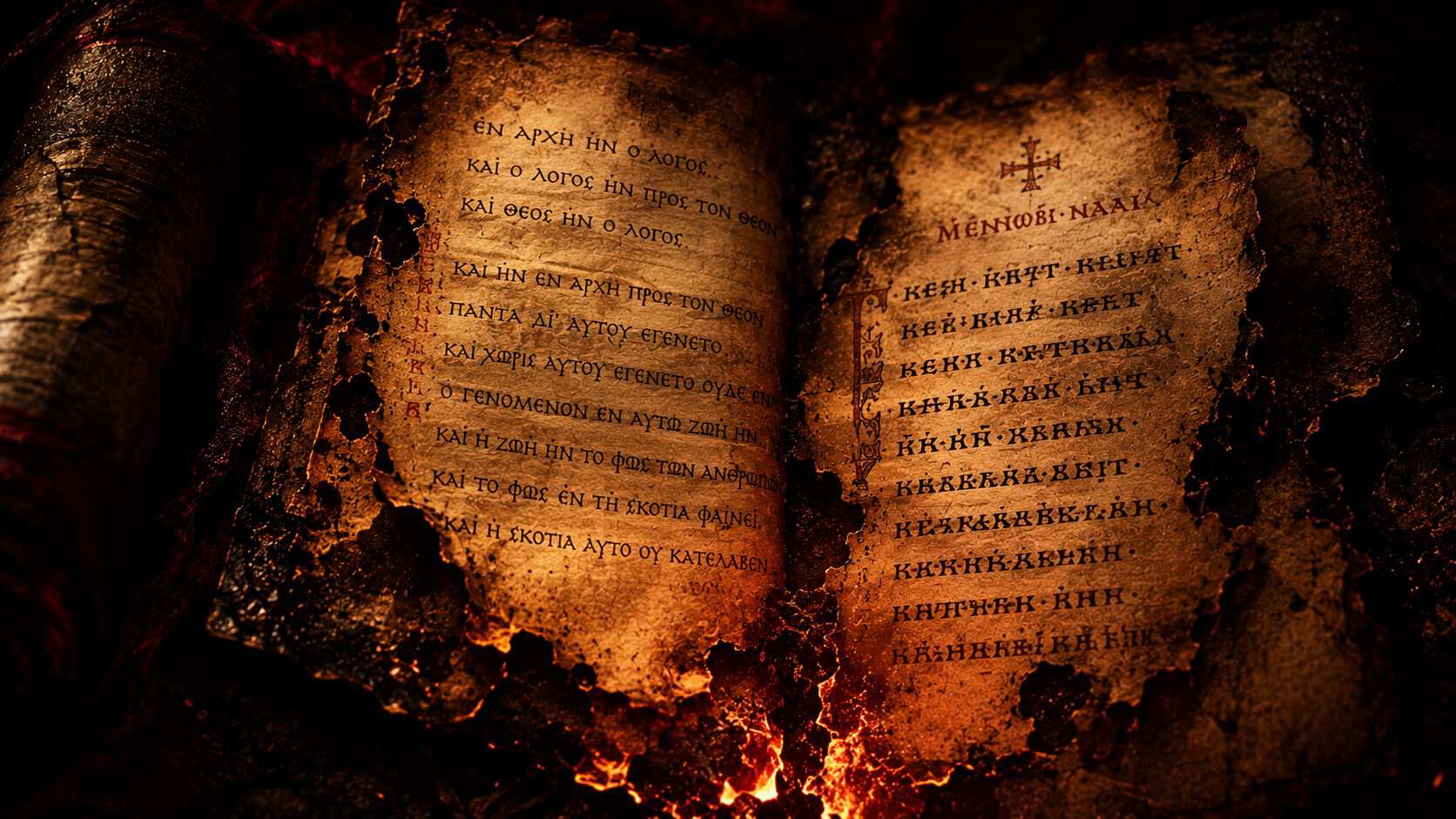
Gnosticism
The mystical Christianity that was systematically destroyed by the institutional church, accidentally rediscovered in a clay jar in 1945, and is now reshaping what scholars thought they knew about early Christian history.
Gnosticism is the technical name for a family of mystical, esoteric, and contemplative movements that flourished in the early centuries of Christianity, particularly in Egypt and the Mediterranean, and which were systematically suppressed as heresy from the second century onward. For seventeen centuries, almost everything known about the Gnostics came from their opponents. Then in 1945, an Egyptian farmer dug up a sealed jar containing fifty-two Gnostic texts that had been buried for sixteen hundred years.
This page covers what Gnosticism actually taught, the Nag Hammadi discovery and what it changed, the key texts, the cosmology of the demiurge, the Sophia myth, why the institutional church declared it heresy, and why modern scholars are taking it more seriously than at any point since Constantine.
What Gnosticism Actually Is
The word gnosis (γνῶσις) is Greek for "knowledge," specifically direct, experiential, inner knowing as opposed to inferred or believed knowledge. The Gnostics were the seekers of gnosis: those who held that salvation comes through inner direct experience of divine reality, not through belief in propositions, not through ritual observance, and not through institutional mediation.
Gnosticism is not a single movement. It is a family of related movements that flourished from roughly the first century CE through the fourth century, with later survivals in groups like the Mandaeans and the Cathars. The major Gnostic schools include the Valentinians, the Sethians, the Basilideans, and the Marcionites, each with distinct features but sharing core themes.
The core features that unite the Gnostic family:
- Gnosis as the path to salvation. Direct inner knowledge of the divine spark within, not belief or ritual. Compatible structurally with what other contemplative traditions call enlightenment, theosis, or self-realization.
- A dualistic or multi-layered cosmology. The material world is not the ultimate reality. There is a higher realm (often called the Pleroma, "fullness") of which the material world is a degraded or fallen reflection.
- The demiurge. A lesser creator god (often identified with the Old Testament god) who created and rules the material world, but who is not the highest God. The true highest God is more distant, more refined, and transcends matter entirely.
- The divine spark. The human being contains, within the material body and mind, a fragment of the higher divine reality, trapped in matter. Awakening to and freeing this spark is the work of life.
- Christ as revealer. Most Christian Gnostic schools regarded Christ as the messenger from the higher realm who came to remind humans of their divine origin and the path of return. Not primarily a sacrificial atonement figure (the institutional reading), but a wisdom teacher and revealer.
- An inner reading of scripture. The biblical texts are not literal history. They are layered allegories that encode the soul's journey of awakening and return. The contemplative reading of scripture, which the institutional church largely lost.
The Gnostics were not anti-Christian in any modern sense. They were a parallel mystical Christianity that flourished alongside (and often inside) the proto-orthodox movement that would eventually become the Roman Catholic Church. The two traditions read the same gospels differently. The Gnostic reading emphasized direct inner knowing. The proto-orthodox reading emphasized belief and institutional authority.
Nag Hammadi, 1945
In December 1945, a farmer named Muhammad Ali al-Samman was digging for fertilizer near the village of Nag Hammadi in upper Egypt, near the cliffs of Jabal al-Tarif. About six feet down, he struck a large clay jar. Reluctant to open it (he feared a djinn might be inside), he eventually broke the seal and found a collection of thirteen leather-bound codices containing fifty-two distinct texts in Coptic.
Specific sequencing and full protocol: Redacted, Chapter 11.
The texts were Gnostic. Most of them had been previously lost, known only from references and quotations in the writings of the early church fathers who had been denouncing them. The jar had been buried sometime in the late fourth century, almost certainly to protect the texts from destruction during the wave of orthodox enforcement that followed Constantine's adoption of Christianity as the imperial religion.
The texts include:
- The Gospel of Thomas. A collection of 114 sayings attributed to Jesus, with no narrative framework. Many sayings overlap with the canonical gospels. Many do not. Scholars increasingly date some of the material to as early as 50 to 70 CE, possibly earlier than the synoptic gospels. Read more in the Gnostic gospels overview.
- The Gospel of Philip. A more developed theological treatise with extensive material on sacraments, the bridal chamber, and the spiritual reading of marriage as the union of opposites.
- The Gospel of Truth. Attributed to Valentinus or his school. A poetic meditation on Christ as the revealer of the Father.
- The Gospel of Mary. Mary Magdalene as a primary disciple receiving teachings from the risen Christ. Peter's hostility to her teaching authority is explicit.
- The Apocryphon of John. The most complete Gnostic cosmological text in the collection. Contains the Sethian cosmology, the demiurge, the fall of Sophia, and the awakening of the divine spark.
- The Gospel of Judas. Not in the Nag Hammadi collection but discovered around the same period. Presents Judas as the most enlightened disciple, betraying Jesus at Jesus's explicit request.
The discovery transformed scholarly understanding of early Christian history. For seventeen centuries, the only window into Gnosticism had been through the writings of opponents like Irenaeus and Hippolytus. After 1945, the Gnostics could speak for themselves for the first time in nearly two thousand years. The picture that emerged was significantly different from what the orthodox writers had described.
The Demiurge and the Pleroma
The most distinctive feature of Gnostic cosmology, and the feature most disturbing to orthodox Christianity, is the doctrine of the demiurge. The demiurge (Greek demiourgos, "craftsman") is a lower creator deity who fashioned the material world from pre-existing chaos. The demiurge is not the highest God. The highest God is more distant, more refined, and transcends the material entirely.
The Gnostic identification: the demiurge is the god of the Old Testament. Jehovah, in the Gnostic reading, is not the true highest God but a lower entity who created and rules the material world. The wrathful, jealous, demanding deity of the Hebrew scriptures is the demiurge. The God of pure love and pure mind, beyond the material entirely, is the true Father that Jesus came to reveal.
The structure of Gnostic cosmology, in the Sethian and Valentinian schools:
- The Monad. The unknowable, ineffable highest source. Beyond being, beyond name, beyond all attributes. The Pleroma originates from the Monad's self-knowledge.
- The Pleroma (Fullness). The realm of the Aeons, the various emanations of divine attributes. The full divine architecture. Hierarchical and balanced.
- The fall of Sophia. Sophia (Wisdom), the lowest Aeon, attempts to know the Monad directly, beyond her station. The result is a disturbance in the Pleroma and the production of a malformed offspring. This offspring is the demiurge.
- The demiurge's world. The demiurge, ignorant of his true origin, declares himself the only God and creates the material world. Sophia, repentant, ensures that fragments of the higher divine light are seeded into the material world, trapped in matter but awaiting reawakening.
- The Archons. The rulers of the lower realms. Servants of the demiurge. They keep souls trapped in the material cycle. Some Gnostic texts describe them in detail; others treat them as cosmic forces rather than persons.
- The divine spark. The fragment of the higher light trapped in each human being. The work of gnosis is to recognize the spark, awaken to its origin, and return to the Pleroma.
- Christ. The messenger from the higher realms, sent to remind the trapped sparks of their true origin. Not a sacrifice for sin (the orthodox reading), but a revelation of identity. Christ's crucifixion in Gnostic reading is often allegorical or even illusory; what matters is the teaching, not the death.
The cosmology is structurally similar to Plato's, to certain Hindu Tantric systems, to the simulation theory in its philosophical version, and to the Law of One material. The vocabulary differs across traditions. The structure of "a higher reality of which the material world is a derivative and constrained projection" is the consistent claim.
Chapters 10 and 11.
The Distorted Doctrine (Chapter 10) and the Suppression of Knowledge (Chapter 11) trace what was lost when the institutional church declared the Gnostics heretics, how the Council of Nicaea consolidated the orthodox reading, and what the Nag Hammadi discovery returned to the conversation. Cross-referenced through six traditions.
Why the Institutional Church Crushed It
Gnosticism flourished in the first three centuries of Christianity. It was suppressed thoroughly by the late fourth century. The mechanism of suppression involved Roman imperial power, a series of church councils, the writings of anti-Gnostic church fathers (especially Irenaeus's Against Heresies, c. 180 CE), and eventually direct military action against communities that retained Gnostic teaching.
The reasons the institutional church found Gnosticism intolerable:
- Gnosticism bypassed institutional mediation. If salvation comes through direct inner knowing, the institutional church (with its sacraments, hierarchy, and apostolic succession) becomes optional. A direct relationship between the seeker and the divine reduces the need for priestly intermediaries.
- The demiurge teaching threatened the legitimacy of the Old Testament. If the Old Testament god is not the highest God but a lesser demiurge, the entire Jewish scriptural foundation of Christianity is reinterpreted. The institutional church had committed to keeping the Old Testament as authoritative scripture; this commitment required rejecting any reading that diminished Yahweh.
- The internal authority of the seeker undermined external authority. Gnostic communities tended to be loose, egalitarian, and often led by women. Mary Magdalene appears as a primary teacher in several Gnostic texts. Communities that recognize the spark in everyone struggle to maintain rigid hierarchy.
- The allegorical reading of scripture threatened literal claims. If the gospel narratives are layered allegories of the soul's journey, the literal historicity of the orthodox claims (virgin birth, physical resurrection, second coming as a literal future event) is reduced in importance. The orthodox church had committed to literal claims; the Gnostic reading made them metaphorical.
- The political dimension. Once Constantine made Christianity the imperial religion in the early fourth century, Christian theology became an instrument of imperial policy. A unified, hierarchical, institutional church served imperial governance. A diverse, decentralized, mystical Christianity did not. The Council of Nicaea in 325 CE consolidated the orthodox reading, and what fell outside it became heresy by definition. Detailed treatment at the Council of Nicaea.
By 400 CE, possessing Gnostic texts was a serious crime. The texts at Nag Hammadi were buried, almost certainly by members of a nearby Christian monastery who could not bring themselves to destroy what they had been ordered to destroy. The texts survived because they were hidden. Most other Gnostic texts did not survive. What the institutional church declared antichrist was, in the original meaning, the direct knower who did not need the institution.
Gnosticism's Return
After the Nag Hammadi discovery and the gradual translation and publication of the texts (the standard English translation, The Nag Hammadi Library in English, edited by James Robinson, was first published in 1977), Gnosticism has experienced a quiet but sustained revival in academic, contemplative, and spiritual circles.
- Academic engagement. Princeton's Elaine Pagels wrote the popular-but-rigorous The Gnostic Gospels in 1979. The book won the National Book Award and brought the material into mainstream awareness. Subsequent academic work by Karen King, Bart Ehrman, and others has continued to reshape the scholarly picture of early Christianity.
- Jungian psychology. Carl Jung was deeply interested in Gnosticism and saw in it a psychological symbolism of the journey of individuation. His Seven Sermons to the Dead, written in Gnostic vocabulary, is a key text for understanding his later work. The Jung Institute continues this engagement.
- The Ecclesia Gnostica. A small contemporary Gnostic church, with congregations in several cities, attempting to restore Gnostic sacramental and liturgical practice using the Nag Hammadi texts as primary scripture.
- The New Age borrowing. Much of modern spirituality has absorbed Gnostic vocabulary (the divine spark, the inner light, the awakening from material illusion) often without acknowledging the source. The framework of ego death and the recognition of one's deeper identity is structurally Gnostic.
- The convergence with modern physics. Several physicists and philosophers have noted that the Gnostic cosmology (a higher reality of which the material is a derivative projection) maps surprisingly well onto modern simulation theory and onto philosophical idealism.
- The Dolores Cannon parallel. Independently produced descriptions from Dolores Cannon's QHHT sessions overlap heavily with Gnostic cosmology, despite her clients generally not having read Gnostic texts. The convergence is suggestive.
The revival is not a recovery of an extinct religion. It is the integration of teachings that were buried for seventeen centuries back into the broader contemplative conversation. What the institutional church suppressed is being read again. The questions the Gnostics asked, and the cosmology they developed to address those questions, are once again live questions.
The reason Gnosticism mattered enough to suppress is also the reason it keeps coming back. Each generation rediscovers what makes Gnosticism uncomfortable to institutions: the claim that direct inner knowing outranks any external authority. That single claim makes Gnosticism inherently anti-hierarchical, and any hierarchy reading it correctly will treat Gnosticism as a threat. The 1945 Nag Hammadi recovery did not invent this dynamic. It just gave us the texts to read what the Gnostics actually said, in their own words, after seventeen centuries of being described almost entirely by their enemies.
The full case, the documented sources, and the chapter-level analysis are covered in the book: Redacted, Chapter 10.
Master Thyself, Chapters 10, 11 Read The Distorted Doctrine and Suppression of Knowledge →Frequently Asked Questions
What is Gnosticism?
Gnosticism is a family of mystical and contemplative Christian movements that flourished in the first four centuries of Christianity, emphasizing direct inner knowledge (gnosis) of divine reality as the path to salvation. Gnostic cosmology distinguishes between a lower creator god (the demiurge) who fashioned the material world and a higher transcendent source. Gnosticism was suppressed as heresy by the institutional church beginning in the second century.
What is the Nag Hammadi Library?
A collection of fifty-two Gnostic texts discovered in 1945 in upper Egypt, near the village of Nag Hammadi. The texts had been buried in a sealed clay jar around the late fourth century, almost certainly to protect them from destruction during the orthodox enforcement that followed Constantine's adoption of Christianity. The discovery transformed scholarly understanding of early Christianity and made the Gnostics' own writings available for the first time in seventeen centuries.
Who is the demiurge in Gnosticism?
The demiurge is a lower creator deity in Gnostic cosmology who fashioned the material world but is not the highest God. The Gnostics typically identified the demiurge with the wrathful Old Testament god, while the true highest God was understood as more refined and beyond matter entirely. The demiurge is often portrayed as ignorant of his own origin, believing himself to be the only God.
Was Jesus a Gnostic?
The Gnostics regarded Jesus as the highest revealer of gnosis: the messenger from the higher realms who came to remind humans of their divine origin and the path of return. Whether the historical Jesus held views that match later Gnostic systematic theology is debated. The sayings attributed to him in texts like the Gospel of Thomas are compatible with later Gnostic teaching but predate the systematic schools. The honest answer: Jesus's teaching has clear mystical and contemplative dimensions that the Gnostics emphasized; whether to call that "Gnostic" is a definitional question.
Why was Gnosticism declared heresy?
Gnostic teaching bypassed the institutional church (salvation through direct inner knowing rather than through sacraments and apostolic authority), reinterpreted the Old Testament (the demiurge teaching diminished Yahweh's status), and read scripture allegorically rather than literally. Once Constantine made Christianity the imperial religion in the early fourth century, the political need for a unified institutional church made the diverse, decentralized Gnostic movement a threat to imperial governance. The Council of Nicaea in 325 CE consolidated the orthodox reading.
What's the difference between Gnosticism and orthodox Christianity?
Orthodox Christianity emphasizes belief in propositions (the creeds), sacramental ritual, institutional mediation (priests, bishops), the authority of the Old Testament god, the literal historicity of the gospel narratives, and salvation through Christ's sacrificial death. Gnostic Christianity emphasizes direct inner knowing, allegorical reading of scripture, the distinction between the demiurge and the higher God, the centrality of the divine spark within each person, and Christ as revealer rather than primarily as sacrifice.
Chapters 10 and 11. What Was Suppressed.
The Gnostic Christianity that was buried, what the Nag Hammadi discovery returned, the suppression by Rome and Nicaea, and the modern revival. Cross-referenced through six traditions and integrated with the consciousness-first frame the contemplative traditions independently arrived at.
Get Your Copy on Amazon