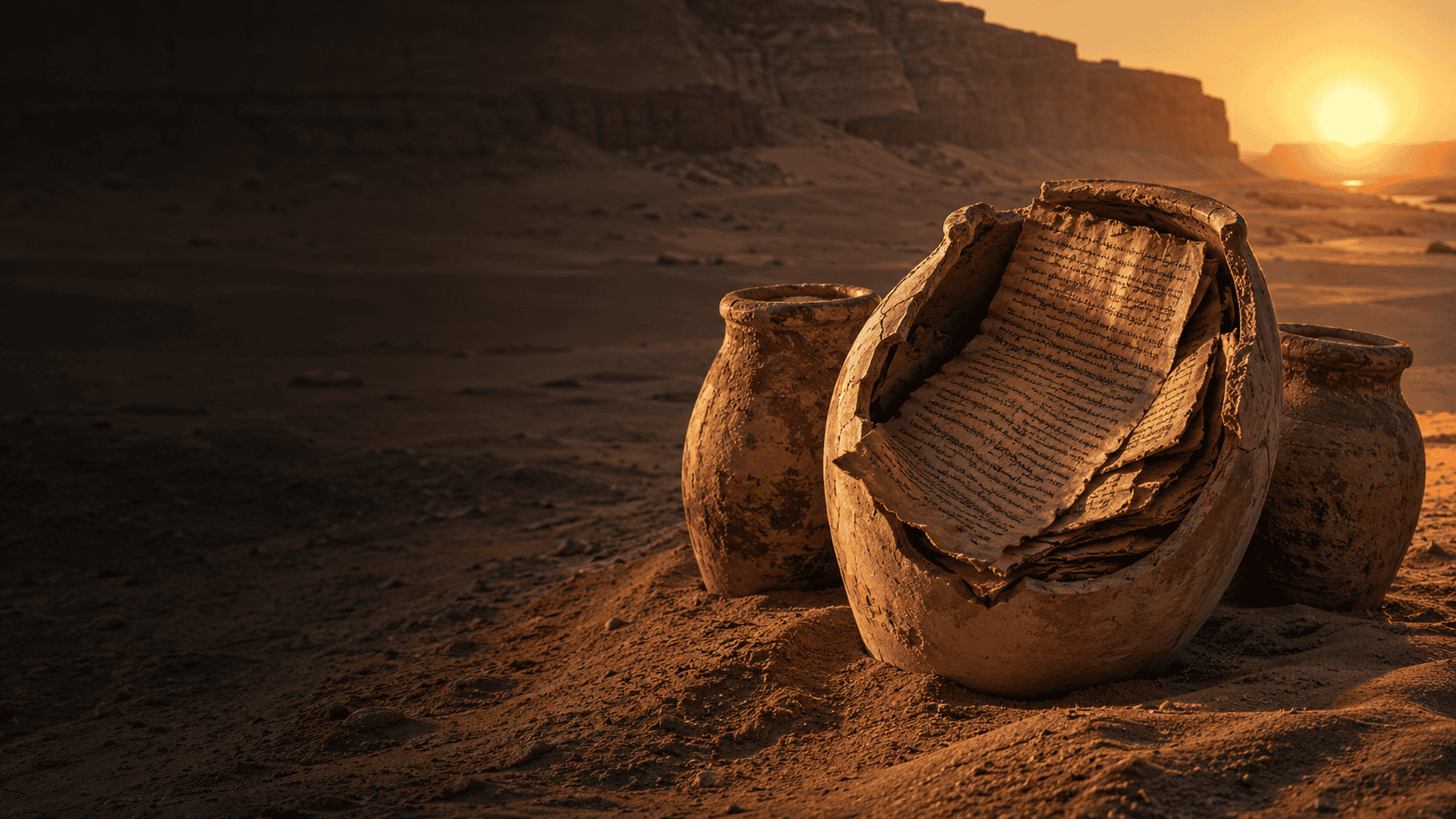
The gospels Rome buried, the desert kept.
Hidden in clay jars for sixteen hundred years. Found by a farmer in 1945.
Fifty-two early Christian texts, written by communities that remembered Jesus differently than Rome did. Burned everywhere the empire reached. Saved by a monk who saw what was coming.
You were taught the four canonical gospels were the only authentic record. The Nag Hammadi library, recovered in 1945, contains dozens of additional texts the early church treated as scripture and the institutional church destroyed. Here is what they contain, why they were buried, and what reading them does to the picture of early Christianity you inherited.
What the gnostic gospels are
A library of fifty-two ancient Christian texts, written between the first and fourth centuries, hidden in clay jars in the Egyptian desert sometime around 367 AD, and rediscovered by a farmer named Muhammad Ali al-Samman near the town of Nag Hammadi in December 1945.
They are gospels. They are not the four gospels you know. They are not heretical reinventions or late forgeries, despite that being the standard institutional framing. Several of them are older than parts of the New Testament. The Gospel of Thomas, the most famous of the find, likely dates to the first century and may predate the Gospel of John.
For sixteen hundred years almost no one knew they existed. The early church fathers mentioned them by name in their writings condemning them. Irenaeus cataloged them. Tertullian denounced them. But the texts themselves had been destroyed everywhere the Roman institutional church could reach. The fact that this particular collection survived is the result of a deliberate act: someone in the monastic community at Chenoboskion saw what was coming and buried the books.
In 367 AD, Athanasius of Alexandria sent out his famous festal letter identifying the canonical list of New Testament books. Anything not on the list was to be destroyed. The Pachomian monks at Chenoboskion appear to have made copies of the rejected texts, sealed them in a large clay jar, and buried them in the cliffs nearby. Redacted, read Chapter 11 The jar stayed undisturbed for nearly sixteen hundred years.
Why Rome could not let them circulate
The institutional church needed a particular kind of Christianity. Hierarchical. Mediated. Dependent on the sacramental authority of the priesthood. The gnostic gospels described a Christianity that contradicted all three.
The word gnosis is Greek for knowing. Not believing. Not assenting to doctrine. Direct experiential knowledge of the divine. The gnostic texts treat salvation as an inner recognition, not a transaction with an external authority. The kingdom of heaven is not a future place you earn. It is a present reality you wake up to.
Gospel of Thomas, saying 70: "If you bring forth what is within you, what you bring forth will save you. If you do not bring forth what is within you, what you do not bring forth will destroy you."
Gospel of Thomas, saying 3: "The kingdom is inside you, and it is outside you. When you come to know yourselves, then you will be known, and you will understand that you are children of the living Father."
These statements undermine the entire premise of an intermediary priesthood. If the kingdom is inside you, no priest can lock the door. If self-knowledge is salvation, no sacrament is required. If gnosis is the path, then Redacted, read Chapter 22, not the institutional structure.
The cosmology was also a problem. Several gnostic texts describe the visible material world as the creation of a lower being, often called the Demiurge, who mistakes himself for the true God. Above the Demiurge, in this framework, is the higher reality from which the spark of consciousness in each human originally came. The implication is that the world as it appears is a construct, the soul is from somewhere prior, and the goal is recognition and return.
This is not the cosmology of an empire that needs subjects to accept the legitimacy of the present material order. Redacted, read Chapter 15
Chapter 11
Suppression of Knowledge →
Master Thyself
The full record of which gospels were buried, by whom, and what they were teaching that the empire could not afford to circulate. Chapter 10 covers the canon edit. Chapter 11 covers the broader suppression. Chapter 22 develops the inner work the gnostics were pointing at.
The major texts in the library
The Nag Hammadi find contains fifty-two distinct texts. Several have become widely studied. A short tour of the most important.
The Gospel of Thomas
A collection of 114 sayings attributed to Jesus, with almost no narrative structure. No miracles. No crucifixion. No resurrection. Just teachings, framed as a hidden discourse: "These are the secret words which the living Jesus spoke and Didymos Judas Thomas wrote down."
Roughly half the sayings parallel passages in the four canonical gospels. The other half are unique to Thomas. The unique material is consistently the same kind: pointing inward, describing the kingdom as present, dissolving the distinction between knower and known.
Saying 77: "I am the light that is over all things. I am all: from me all has come forth, and to me all has reached. Split a piece of wood; I am there. Lift up the stone, and you will find me there."
Scholars are divided on dating. Some place Thomas in the second century. Others argue convincingly for the mid-first century, possibly contemporaneous with or slightly earlier than the canonical gospels. The institutional position, that Thomas is late and derivative, is not the scholarly consensus.
The Gospel of Mary
A fragmentary text recovered partially at Nag Hammadi and partially from a separate Berlin codex. The surviving portion describes Mary Magdalene receiving private teachings from Jesus after the resurrection, teachings the male disciples did not receive.
The text describes the ascent of the soul past seven powers, including darkness, desire, ignorance, and the power the text calls "zeal for death." The cosmology is detailed. The practice it points to is interior.
When Mary finishes recounting the teaching, Peter objects: "Did he really speak privately with a woman, and not openly to us? Are we to turn around and listen to her? Did he prefer her to us?" Levi, another disciple, defends her: "If the Savior made her worthy, who are you to reject her?" Redacted, read Chapter 15
The implications for two thousand years of male-only church hierarchy are obvious. The book vanished.
The Gospel of Philip
A text full of brief, poetic, and often paradoxical sayings about the sacraments, the meaning of names, and the relationship between flesh and spirit. The text is best known for describing Mary Magdalene as the companion of Jesus and saying that Jesus loved her more than the other disciples, a passage popularized by Dan Brown's The Da Vinci Code but present in the actual text.
Philip is concerned throughout with the difference between names and the realities they point to. "Names given to the worldly are very deceptive, for they divert our thoughts from what is correct to what is incorrect." It is a text about the inadequacy of language to carry divine reality.
The Gospel of Judas
Not in the Nag Hammadi find but in the same family of suppressed gospels, recovered from a separate Coptic codex in the 1970s and published in 2006. The text presents Judas Iscariot not as the betrayer but as the disciple Jesus trusted with the most difficult instruction: to enable the crucifixion and free Jesus from the body.
The reframe is theological dynamite. If Judas was the trusted disciple, the entire moral architecture of the standard passion narrative inverts. The text was suppressed by Irenaeus in the second century, and the surviving manuscript was found in a cave in Egypt, deteriorated, and recovered decades into restoration.
The Gospel of Truth
A meditative theological treatise, possibly by the gnostic teacher Valentinus or one of his followers. The text reads more like a sermon or hymn than a gospel. Its core image is the human as someone who has fallen asleep in error and forgotten the original home. Salvation is awakening. The text is short, careful, and remarkably tender.
"It was a great wonder that they were in the Father, not knowing him, and that they were able to come forth by themselves, since they were unable to comprehend or to know the one in whom they were."
The theology that frightened Rome
The gnostic gospels do not form a unified system. They were written by different communities, often disagreeing with each other. But several themes recur consistently, and these are the themes that made the texts intolerable to the consolidating institutional church.
Gnosis over pistis. Direct knowing over belief. The gnostic texts treat faith as preliminary, a starting point, not the destination. The destination is recognition. The destination is knowing what you actually are, what the world actually is, and how the two are related. The institutional church needed pistis to be sufficient. The gnostics said pistis was the door, not the room.
Self-knowledge as salvation. Multiple gnostic texts identify knowing yourself as the central work. Not as self-improvement in the modern sense. As the recognition that what you most truly are is not what the surrounding institutions have told you that you are. The path is dis-identification from the false self and recognition of the true one. Redacted, read Chapter 22
The world as construct. Several texts describe the visible cosmos as the work of a lower creator who is either ignorant or actively deceiving. The true source is higher, more subtle, and accessible through inner work. This is not an empire-friendly cosmology. An empire needs subjects who accept the legitimacy of the present arrangement. Redacted, read Chapter 15
Direct access without mediation. The gnostic texts almost never refer to priestly hierarchy, sacramental authority, or apostolic succession as necessary. Some refer to community and teaching. None require a chain of institutional authority. The Holy Spirit, in the gnostic frame, speaks directly to whoever is listening.
By the fourth century, when Athanasius and Constantine were building the structure that would become Catholic Christianity, these positions were not acceptable. The Council of Carthage in 397 AD finalized the rejection of the gnostic gospels. The texts were burned across the empire. The Pachomian monks at Chenoboskion buried theirs.
"What the institution called heresy was, in many cases, the part of Christianity that taught the reader to need no institution. The destruction of those texts was not theological housekeeping. It was the elimination of a competing model of selfhood."Master Thyself, Chapter 11
What they mean now
The Nag Hammadi library has been in print since the 1970s. You can read all of it. The texts are short, the translations are accessible, and the work of integrating them with your existing understanding of early Christianity is genuinely available.
The implications are significant. The picture of early Christianity as a unified movement that briefly tolerated some confused variants before settling on the orthodox synthesis is a story written by the winners. The actual picture, visible once you read the suppressed texts alongside the canonical ones, is of a diverse Christianity that contained multiple competing visions of what Jesus had taught, what salvation meant, and how the relationship between human and divine was supposed to work.
The vision that won was not necessarily the one closest to the original teaching. It was the one most compatible with the political and administrative needs of the Roman Empire. Redacted, read Chapter 11
If you are a Christian, the gnostic gospels are not enemies of your tradition. They are part of your tradition. They are the part the institution did not want you to read because their reading produces a different kind of believer than the institution needed.
If you are not a Christian, the gnostic gospels are still worth your time. They preserve a sophisticated tradition of inner work, a coherent description of the relationship between mind and reality, and a framework for self-recognition that maps onto contemplative traditions you might already know from elsewhere. The Buddhist parallel is not accidental. The Hindu parallel is not accidental. The Sufi parallel is not accidental. These traditions share an underlying recognition about what consciousness is and how it works. The gnostic gospels are the Christian version of that recognition, and Rome buried it because Rome needed Christianity to be something else.
Master Thyself draws extensively on the gnostic material in its treatment of the inner kingdom, the recognition of the false self, and the path of self-mastery as a return to original sovereignty. The gnostic frame is one of the strongest available tools for seeing through Redacted, read Chapter 15 the modern person inhabits without noticing.
Chapter 22
Master Thyself →
A starting path through the texts
If you have not read them, the order matters. Going in alphabetically will defeat you. Here is a tested path that has worked for general readers approaching the library for the first time.
Start with the Gospel of Thomas. It is short, the sayings stand on their own, and you do not need a theological framework to read it. Pick the Marvin Meyer translation if available. Read it slowly. Some sayings will hit immediately. Some will sit. Some will open later. None of them are decorative.
Then read the Gospel of Mary. It is even shorter, around eight pages of surviving text, and the cosmology of the soul's ascent past the seven powers is one of the most concrete descriptions of inner work in any ancient source.
Then read the Gospel of Truth. It is meditative, lyrical, and provides the theological context for understanding what the gnostics meant by the human condition.
Then move into the longer texts. The Tripartite Tractate, the Apocryphon of John, the Gospel of Philip. By this point the vocabulary will be familiar and the cosmology will not feel foreign.
Pair your reading with Master Thyself. Chapter 10 covers the canon decisions that removed these texts. Chapter 11 covers the broader pattern of knowledge suppression. Chapter 22 develops the practical framework for the inner work the gnostics were pointing at. The combination gives you both the historical context and the contemporary application.
The library is not a curiosity. It is a recovered tradition. {R(22)}
Frequently Asked Questions
What are the gnostic gospels?
A library of fifty-two ancient Christian texts buried in clay jars in the Egyptian desert in the fourth century and rediscovered in 1945 near the town of Nag Hammadi. They include the Gospel of Thomas, Gospel of Mary, Gospel of Philip, Gospel of Truth, and dozens of other texts that early Christian communities treated as scripture but the institutional church removed from the canon.
How many gnostic gospels are there?
The Nag Hammadi find contains fifty-two distinct texts across thirteen codices. Not all are gospels in the strict sense. Some are treatises, hymns, or apocalyptic visions. A separate find, the Berlin Codex, contains additional gnostic material including portions of the Gospel of Mary. The Gospel of Judas was recovered separately in the 1970s. Including these and other related finds, the full corpus of recovered gnostic Christian writings runs to about sixty distinct texts.
Why were the gnostic gospels rejected?
The standard institutional answer is that they were considered theologically incompatible with apostolic teaching. The historical answer is more specific. The gnostic gospels teach a direct inner path to salvation that does not require priestly mediation, sacramental authority, or institutional hierarchy. The fourth-century church, consolidating under Roman imperial sponsorship, could not afford a vision of Christianity that bypassed its own structures of authority. The texts were declared heretical and destroyed across the empire.
Is the Gospel of Thomas a gnostic gospel?
Most scholars classify it as gnostic or proto-gnostic, though some argue it is best understood as an early sayings collection that predates the gnostic movement and was later embraced by gnostic communities. The text itself contains the core themes that became associated with gnosticism: inner knowing as salvation, the kingdom as present rather than future, and direct access to the divine without institutional mediation.
Was Mary Magdalene a disciple?
The Gospel of Mary presents her as not only a disciple but the one to whom Jesus gave teachings the male disciples did not receive. The Gospel of Philip describes her as the companion of Jesus and says he loved her more than the other disciples. These texts were written by communities that remembered Mary differently than the institutional church chose to remember her. The institutional version, which reduced her to a minor figure and later, by an unfounded papal decree in the sixth century, to a prostitute, is the version most Christians inherited.
What is the Gospel of Judas about?
The text reframes Judas Iscariot from betrayer to trusted disciple. In the Gospel of Judas, Jesus tells Judas privately that he will sacrifice the man who clothes him, meaning the body, so that Jesus can be freed. Judas is the disciple Jesus trusts with the most difficult instruction. The institutional church found this reframe intolerable for obvious reasons. The text was condemned by Irenaeus in 180 AD and only recovered in modern times.
Are the gnostic gospels in the Bible?
No. None of the gnostic gospels are in any major Christian canon, including Catholic, Orthodox, Ethiopian, or Protestant Bibles. The Nag Hammadi library is available as a standalone collection, published most widely in the Marvin Meyer translation. The texts are not Bible, but they are early Christian, contemporary with or in some cases earlier than parts of the New Testament.
Still with us?
Twelve more questions.
If the institutional church suppressed an entire library of early Christian texts because they taught the wrong kind of salvation, the question of what else was suppressed has no comfortable answer.
What if ...What if the Gospel of Thomas is older than the Gospel of John?
What if the monks at Chenoboskion buried the texts because they knew the burning was coming?
What if Mary Magdalene was the disciple Jesus trusted most, and the church reframed her?
What if the gnostic cosmology of a lower creator and a higher source is not what your priest told you it was?
What if 'gnosis' is the original word for what Buddhism calls awakening?
What if Saying 70 of Thomas is the entire spiritual path in one sentence?
What if the Demiurge cosmology survived in the Cathar tradition until Rome killed them?
What if the Gospel of Mary was suppressed because Peter was the one objecting?
What if Athanasius's festal letter of 367 AD is the moment Western Christianity lost half its sources?
What if Constantine's empire needed a Christianity that required middlemen?
What if the gnostics were the first Christians to recognize the matrix for what it was?
What if Master Thyself is the modern restatement of the gnostic inner path?