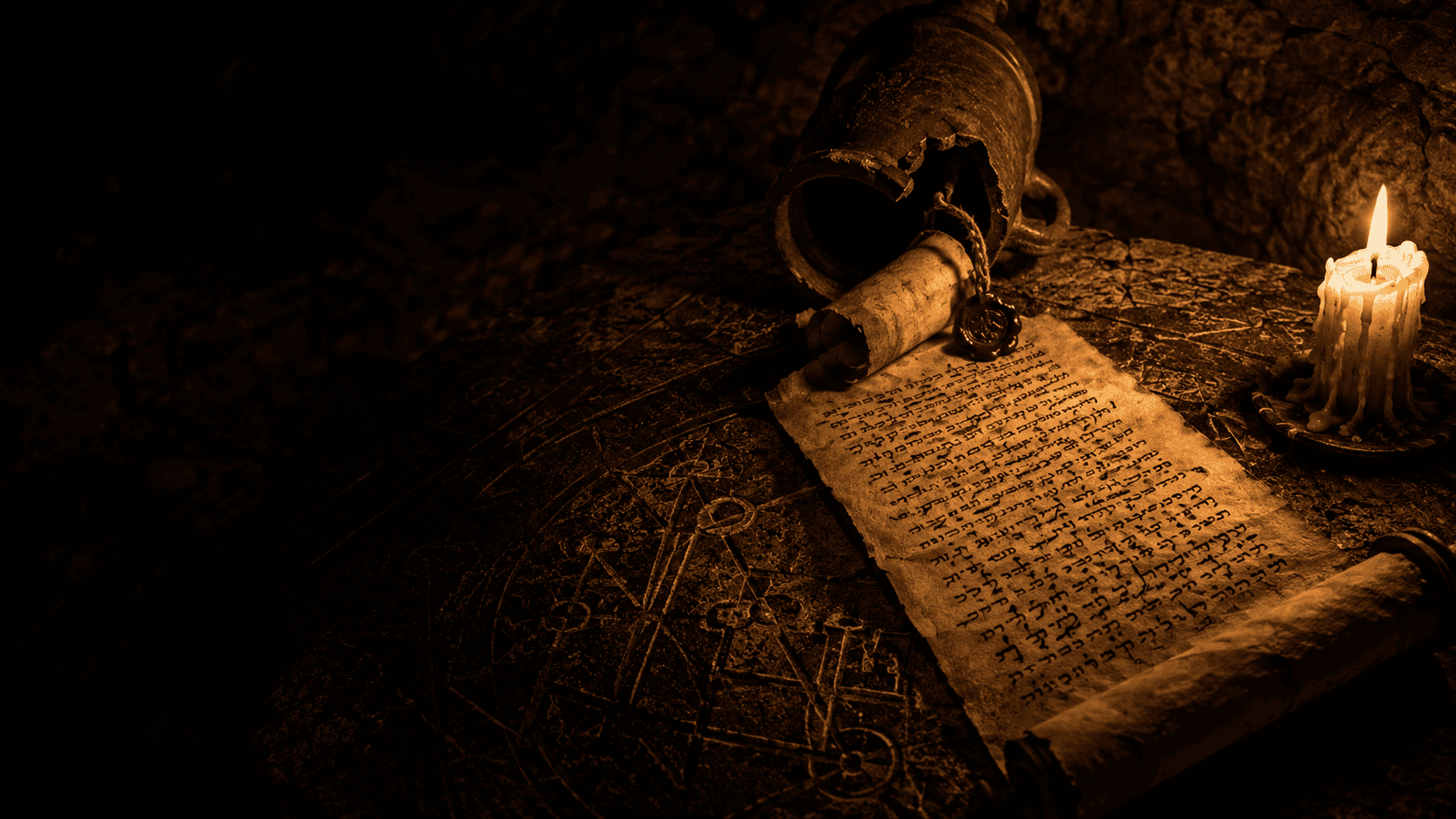
The Book of Enoch is in the Bible.
Just not the one they handed you.
Quoted in Jude. Found at Qumran. Canonical in the Ethiopian Orthodox Church for two thousand years. Removed from the Western canon when the institutional version of the story could not survive its presence.
Enoch was scripture for the first generations of Christians. The New Testament quotes it directly. Then it disappeared, the way information disappears when a system needs the audience to stop asking certain questions. The book is not lost. It was buried in plain sight.
The Book of Enoch is cited in the New Testament.
Jude 1:14-15 quotes the Book of Enoch directly, by name, and treats the prophecy as scripture. This is not a fringe claim. It is in every Bible currently in print. The verses are right there. The footnote is missing.
Read the passage. Jude writes: “And Enoch also, the seventh from Adam, prophesied of these, saying, Behold, the Lord cometh with ten thousands of his saints, to execute judgment upon all.” This is a direct quotation of First Enoch 1:9. The author of Jude knew the Book of Enoch by name, considered it authoritative, and used it to make a theological argument. This was the working scripture of the early Christian community.
Several Church Fathers in the first three centuries treated Enoch as scripture. Tertullian, writing around 200 AD, explicitly defended its canonical status. Justin Martyr referenced its account of the fallen angels. Irenaeus accepted its testimony about the Watchers. Clement of Alexandria cited it. The book was Redacted, read Chapter 10 in early Christianity, not a marginal speculation.
Then, over the next two centuries, it disappeared from the Western Christian canon. By the time of Augustine in the late 4th century, the institutional position had reversed. Enoch was suspect. By the Council of Hippo in 393 AD and the Council of Carthage in 397 AD, it was outside the canon. The reasons given at the time were vague. The effect was permanent. Redacted, read Chapter 10 stopped reading the book that the New Testament quoted.
The Ethiopian Orthodox Church never made that cut. The Ethiopian Bible, which contains the oldest continuous Christian canonical tradition, still treats Enoch as scripture today. They preserved what the Western Church removed. They have never explained why anyone would believe the Western version of the story over a tradition that simply kept reading the book.
Read the Full Investigation
Chapter 10: The Distorted Doctrine →
Fear of the fallen angels was the gateway to burying the book.
Enoch’s central content is the story of the Watchers. Two hundred angels descended in the days of Jared, took human wives, fathered the Nephilim, and taught humans things the institutional Church was not interested in confirming.
According to Enoch, the Watchers taught metallurgy, weaponry, sorcery, pharmacology, astronomy, cosmetics, and the working of precious metals. They corrupted the earth. They caused the violence that led to the Flood. The Genesis account compresses this entire prehistory into four verses (Genesis 6:1-4). Enoch unpacks it across dozens of chapters.
This is uncomfortable material for a religion trying to keep theological complexity manageable. The Watchers narrative implies a vast pre-Flood civilization with technological and magical sophistication. It implies that the line between humans and other intelligences was thinner than Sunday school suggests. It implies that the Flood was not a simple judgment on human sin but Redacted, read Chapter 10 that included a deliberate erasure of the hybrid descendants of the Watchers.
“The most dangerous information is the information that requires you to revise the entire frame, not just the data inside it.”
Master Thyself, Chapter 10
An institution that builds its authority on a simplified version of cosmology cannot afford a text that complicates the cosmology. The choice was to either revise the theology to include the Watchers properly, or remove the text. Revising the theology would have required acknowledging that the simple Sunday school story is, at best, a children’s version of something much larger. Removing the text was easier. The Church chose easy. Redacted, read Chapter 10 did the rest, because once a text is labeled apocrypha, the fear of engaging it carries the rest of the load without further institutional effort.

Master Thyself
700+ pages. 24 chapters. 400+ citations. The complete map of what Enoch says, why it was buried, and how it changes the canonical reading.
Ethiopia kept what the West cut.
The Ethiopian Orthodox Tewahedo Church has the oldest continuous Christian tradition in Africa. Their canon was never modified to match the Western consolidations. The Book of Enoch is still scripture in Ethiopia. So is the Book of Jubilees. So are several other texts the Western Church dropped.
The Ethiopian version of Enoch is the only complete version that survived to modern scholarship. The Greek and Latin manuscripts are fragmentary. When James Bruce, a Scottish explorer, brought three Ethiopian manuscripts of Enoch back to Europe in 1773, it was the first time the full text had been available in the West in over a thousand years. R.H. Charles produced the standard English translation from these manuscripts in 1893. The text is now in the public domain. Anyone can read it.
The implication is direct. The Western Church’s claim that Enoch was somehow lost, or never really canonical, or theologically suspect, collapses against the fact that Ethiopia preserved it as canonical scripture without interruption. They never had the Western anxiety about the text. They simply kept reading it. The argument that Enoch was rightly excluded is Redacted, read Chapter 10 that an entire continent of Christians disagreed with for two thousand years.
The Ethiopian tradition also preserved a version of the New Testament that includes additional texts. The Mashafa Henok (Book of Enoch) sits in their Bible alongside Genesis, Matthew, and Revelation. It is not separate. It is not marked as suspect. It is scripture. This is what the Christian canon looked like before institutional consolidation cut it down. The Ethiopian preservation is the control sample, and it shows Redacted, read Chapter 10 the Western Church removed.
Qumran verified what Western theology denied.
In 1947, a Bedouin shepherd found jars containing ancient scrolls in caves near the Dead Sea. The find was eventually expanded across eleven caves and yielded fragments of nearly every book of the Hebrew Bible plus a large library of non-canonical texts dating from roughly 250 BC to 70 AD.
Among the non-canonical material were multiple fragments of the Book of Enoch in the original Aramaic. The community at Qumran, generally identified with the Essenes, considered Enoch important enough to maintain in their library. The dating placed Enoch firmly in the Second Temple period, contemporaneous with the writing of late Old Testament books and predating most of the New Testament.
The Qumran finds settled a long-running scholarly debate. Earlier critics had argued that Enoch was a medieval forgery or a much later composition. The Aramaic fragments demolished that argument. Enoch was old. It was respected. It was preserved in a Jewish religious community that was contemporaneous with Jesus. It is, on the historical record, exactly the kind of text the early Christians would have known, used, and quoted, which is Redacted, read Chapter 10 that we find Jude quoting it directly.
“Two thousand years of certainty collapsed under one shepherd boy and a cave.”
Master Thyself, Chapter 10
The Dead Sea Scrolls also revealed that Second Temple Judaism was far more diverse than the rabbinic tradition that emerged after 70 AD ever admitted. Multiple schools of thought, multiple canons, multiple cosmologies all coexisted. The institutional consolidation that produced the modern Jewish and Christian canons happened later and erased the diversity. The Qumran library is a snapshot of what was actually being read before Redacted, read Chapter 10 got applied.
A short tour of what Enoch actually says.
The Book of Enoch is divided into five sections, often called the Book of the Watchers, the Book of Parables, the Astronomical Book, the Book of Dream Visions, and the Epistle of Enoch. Each one contains material that does not appear elsewhere in the canonical Bible.
The Watchers. Two hundred angels under the leadership of Semjaza descended on Mount Hermon. They swore an oath to take human wives. They taught humans forbidden knowledge: weapon-making, metallurgy, sorcery, pharmaceutical and cosmetic preparation, astrology, and the working of precious metals. Their offspring with human women were giants, the Nephilim, who consumed human resources, drank human blood, and corrupted the earth. The Flood was the eventual response to this corruption.
The Astronomical Book. Enoch’s tour of the heavens. The text describes the solar and lunar calendars in detail, the gates of the winds, the chambers of the stars, and the mechanism by which the celestial bodies move. The astronomical material is more sophisticated than anything in the canonical Old Testament. The 364-day Enochian calendar matches the one used at Qumran. Redacted, read Chapter 10 that this material was even being preserved suggests the early communities took it seriously.
The Book of Parables. Visions of the Son of Man, the Elect One, who sits on the throne of glory and judges the kings of the earth. The Christology of this section influenced Jewish and early Christian messianic thought directly. Some scholars argue the title “Son of Man” used by Jesus in the canonical Gospels draws on Enoch’s usage. The full mapping of how Enoch’s messianic material shaped New Testament Christology is laid out across PolarityCode and other resources tracing the continuity between Second Temple Judaism and the early Church.
The Dream Visions. Enoch’s allegorical history of the world from creation to the end times, encoded in animal symbolism. The text predicts a series of seventy shepherds who mismanage Israel, leading to a final judgment and restoration. This is apocalyptic literature in the technical sense, and it predates the canonical Book of Revelation by centuries, suggesting Redacted, read Chapter 10 where the Christian apocalyptic tradition came from.
How to read the Book of Enoch today.
The R.H. Charles translation from 1893 is public domain and freely available online. The newer translations by George Nickelsburg and James VanderKam are more scholarly and worth the small investment. Read it slowly. The text rewards patience.
Start with the Book of the Watchers, chapters 1 through 36. This is the section most heavily quoted in the New Testament and the one that explains what Genesis 6 was actually pointing at. Read it alongside Genesis 6:1-4, Numbers 13:33, and Jude 1:6, 14-15. The cross-references make sense of details that the canonical text leaves unexplained.
Then read the Astronomical Book if you are interested in the calendar material, or the Book of Parables if you want the messianic content. The Dream Visions are dense and reward a second reading. The Epistle of Enoch is the most pastoral section and the easiest entry point for readers who find the cosmological material overwhelming.
The full case for why Enoch should be read alongside the canonical scripture, including the cross-references to Genesis, Jude, and the Dead Sea Scrolls material, is in Chapter 10 of Master Thyself. The book also covers what each section of Enoch reveals about the pre-Flood world, the Watchers, and the cosmology the institutional Church preferred to leave unsaid. The text was always available. Redacted, read Chapter 10 was a social construction, and you do not have to keep participating in it.
Frequently Asked Questions
Is the Book of Enoch in the Bible?
It is in the Ethiopian Orthodox Bible, where it has been canonical for nearly two thousand years. It is not in the standard Catholic, Protestant, or Eastern Orthodox Bibles. It is quoted directly in the canonical New Testament book of Jude (1:14-15), which treats it as authoritative scripture. The historical record shows it was widely read and accepted by the first three centuries of Christians before being excluded by the Western councils in the 4th century.
Why was the Book of Enoch removed from the Bible?
The institutional reasons were never fully documented. The likely factors include Enoch’s detailed account of the Watchers and the Nephilim, which complicated the simpler theology the institutional Church was consolidating. The 364-day calendar in Enoch’s Astronomical Book conflicted with the lunar calendar the Church preferred. The text’s elaborate cosmology made it difficult to teach to mass audiences. None of these are arguments for inauthenticity. They are arguments for institutional convenience.
Did Jesus read the Book of Enoch?
There is strong evidence that Jesus and his contemporaries knew the Book of Enoch. Fragments of Enoch were found in the Dead Sea Scrolls at Qumran, dated to before and during the time of Jesus. The phrase ‘Son of Man,’ which Jesus used to describe himself, has a specific usage in Enoch’s Book of Parables. Jude, a book of the New Testament, quotes Enoch directly. The first generations of Christians clearly considered it scripture.
Who are the Watchers in the Book of Enoch?
The Watchers are a class of angels described in Enoch as having descended to earth in the days of Jared, sworn an oath together on Mount Hermon, taken human wives, and fathered the Nephilim. They taught humans various forbidden arts including metallurgy, weaponry, sorcery, astrology, and pharmacology. The Watchers narrative expands on Genesis 6:1-4 and provides context for several otherwise obscure New Testament references.
Is the Book of Enoch reliable?
Reliability depends on what question is being asked. As a historical document of Second Temple Jewish thought, it is highly reliable. As a window into the cosmology the early Christians worked with, it is essential. Whether it should be read as inerrant scripture is a question each reader has to answer for themselves. The institutional Church’s argument for exclusion was political, not evidentiary.
Where can I read the Book of Enoch?
R.H. Charles’s 1893 translation is in the public domain and available free online at multiple archives. The Nickelsburg and VanderKam scholarly translation is available in paperback. Ken Johnson and Joseph Lumpkin have produced more accessible modern translations. The text is not difficult to find. The barrier has only ever been the social cost of engaging with it.
Does the New Testament really quote the Book of Enoch?
Yes. Jude 1:14-15 quotes Enoch 1:9 directly, attributing the prophecy to ‘Enoch, the seventh from Adam.’ Jude 1:6 references the imprisoned angels in language that closely parallels Enoch’s account of the Watchers. Several other New Testament passages echo Enochian themes without explicit quotation. The connection is not speculative.
Still with us?
Twelve more questions.
Each of these threads is traced to its source in the fuller investigation. If any of them pull, that is the door.
What if …
What if a book quoted in the New Testament was removed from the Old Testament because it was too clear about what Genesis 6 actually says?
What if Ethiopia preserved the original canon and the Western churches edited it down?
What if the Dead Sea Scrolls proved Enoch was authentic and the institutional case for exclusion collapsed in 1947?
What if the Watchers narrative explains every megalithic structure modern archaeology cannot account for?
What if Jesus called himself ‘Son of Man’ because his audience knew the Book of Enoch?
What if the 364-day Enochian calendar is the original sacred calendar and the lunar one was a later substitution?
What if Jude wrote a New Testament book quoting Enoch and the institutional Church kept Jude but cut Enoch?
What if the Flood was a deliberate erasure of the Watchers’ hybrid descendants, not a generic judgment on sin?
What if the prohibition on reading Enoch is more enforced socially than theologically because the institution lost the actual argument long ago?
What if the apocalyptic structure of Revelation comes directly from Enoch’s Dream Visions?
What if the institutional Church removed Enoch because the New Testament quoted it, and they could not have a New Testament citing scripture they wanted to bury?
What if reading Enoch once changes how you read every other book of the Bible?