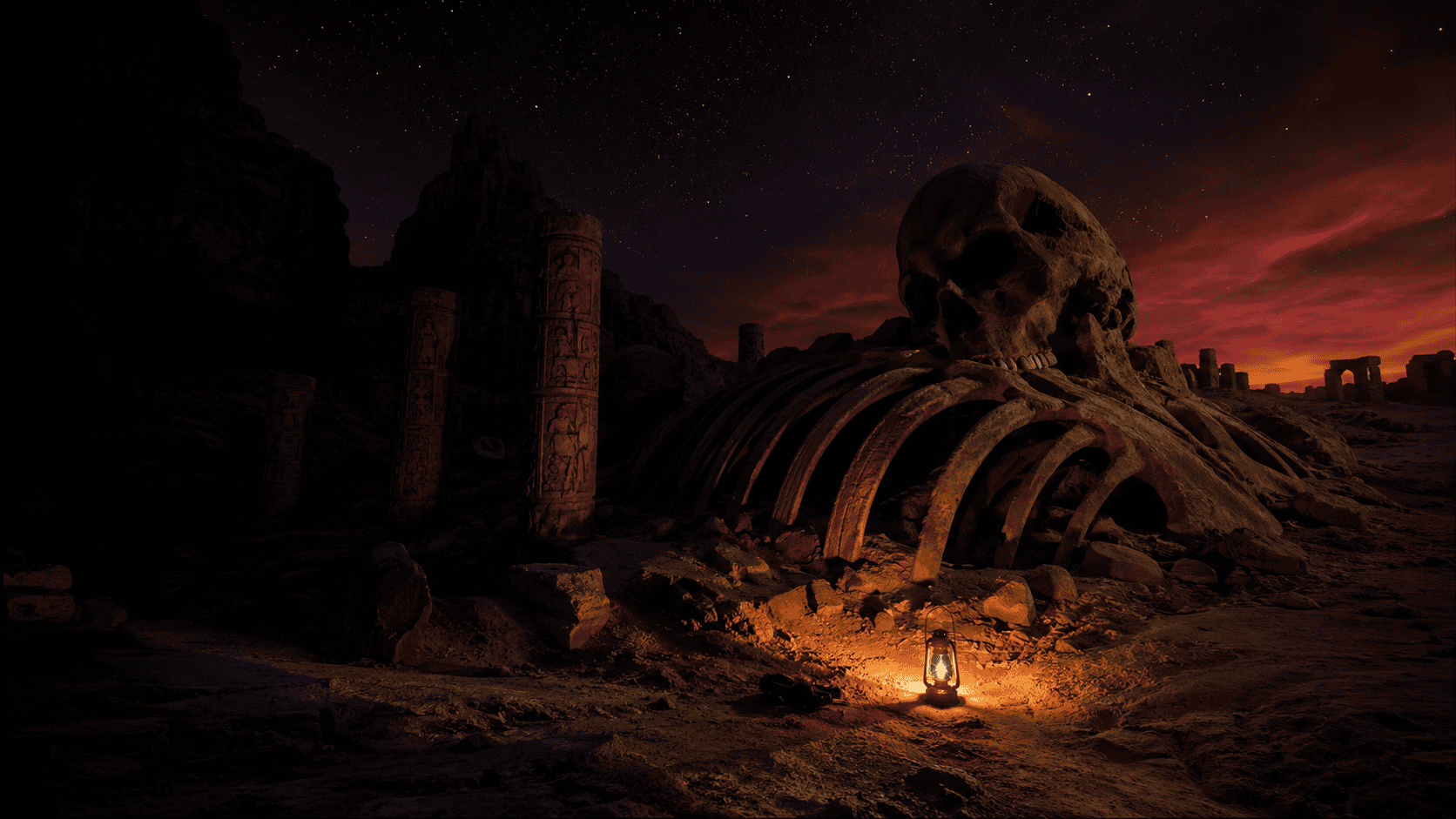
The Bible says giants walked the earth.
Modern theology said they were a metaphor.
Genesis 6:4. Numbers 13:33. Deuteronomy 3:11. Joshua 11:22. First Samuel 17. The biblical text describes the Nephilim plainly. The footnotes erased them.
The institutional reading collapses the Nephilim into allegory, the "sons of God" into descendants of Seth, and the giants of Canaan into folklore. The text itself does no such thing. The metaphor reading was a containment strategy, not a translation.
What the church taught you about the Nephilim and the giants in the Bible.
Most modern Christians grow up with one of three explanations for the Nephilim passages. The "Sons of Seth" theory: the sons of God in Genesis 6 were the godly line of Seth, the daughters of men were the worldly line of Cain, and the Nephilim were just unusually wicked humans. The "Metaphor" theory: the giants were exaggerations or symbolic representations of corrupt civilizations. The "Genre" theory: ancient near-eastern texts always included mythological elements and the Hebrew authors were borrowing the conventions without endorsing the content.
All three readings have one thing in common. They allow the modern reader to skip past what the text actually says. The text says the sons of God saw that the daughters of men were beautiful and took them as wives. The text says these unions produced the Nephilim, the giants, the men of renown. The text repeats the claim later. Numbers 13:33 says the spies saw the Nephilim in Canaan and felt like grasshoppers beside them. Deuteronomy 3:11 describes the iron bed of King Og of Bashan as nine cubits long. Redacted, read Chapter 12 is what the text describes, plainly, without metaphorical hedging.
The institutional reading developed in the patristic period and consolidated by the time of Augustine. Augustine, writing in the late 4th and early 5th centuries, pushed the Sons of Seth interpretation precisely because the more literal reading was too theologically destabilizing. If angels could intermarry with humans and produce hybrid offspring, the boundary between humans and other intelligences became porous. That porosity threatened the simple anthropology the institutional Church was building, where humans are the sole carriers of the image of God and everything else is creature or demon.
The earlier Jewish reading, preserved in the Book of Enoch, the Book of Jubilees, the Genesis Apocryphon found at Qumran, and the writings of the first-century Jewish historian Josephus, was uniformly literal. Angels descended. They took wives. They fathered giants. Josephus wrote in his Antiquities of the Jews that "many angels of God accompanied with women and begat sons that proved unjust." This was the working consensus until the institutional Church needed to bury it.
The literal reading was not a fringe view that got corrected. It was the default reading that got Redacted, read Chapter 12 when it conflicted with the simpler theology the post-Constantinian Church preferred.
Read the Full Investigation
Chapter 12: Buried History →
A civilization before yours destabilizes everything.
The deepest discomfort with the Nephilim narrative is what it implies about the world before the Flood. If the Watchers descended and taught humans metallurgy, astronomy, weaponry, and sorcery, and if their hybrid offspring shaped human civilization for generations, then the pre-Flood world contained something the official history does not allow.
A technologically advanced civilization. A civilization with sophisticated knowledge of celestial mechanics, materials science, and possibly more. A civilization wiped out by a global catastrophe, leaving only scattered survivors and obscured records. The modern academic framework cannot accept this. It would require admitting that the linear progress narrative, from primitive caves to modern technology, has gaps that the official chronology cannot fill.
The fear is institutional, not personal. Academic archaeology has tenure invested in the standard chronology. Religious institutions have authority invested in the standard cosmology. Both have incentive to keep the Nephilim narrative locked in metaphor. The cost of taking the text literally is too high for either institution to absorb. So both institutions, in unrelated ways, settled on readings that make the text safe. Redacted, read Chapter 12 is the result of two separate containment strategies arriving at the same conclusion from different directions.
"There were giants in the earth in those days; and also after that."
Genesis 6:4, KJVNotice the text says "and also after that." The Nephilim did not end at the Flood. The Bible records their presence in Canaan when the Israelites entered the promised land. Goliath was probably a remnant. The five lords of the Philistines were giants. The full mapping of where the Nephilim show up across the Bible, the historical record, and the suppressed traditions is on PolarityCode and is laid out in detail in Chapter 12. The text was always plain. Redacted, read Chapter 12 was always institutional.

Master Thyself
700+ pages. 24 chapters. 400+ citations. The complete map of where the Nephilim appear, what the suppressed texts say, and why every institutional gatekeeper buried the literal reading.
Genesis 6 reads literally if you let it.
Here is the passage, with the institutional commentary stripped out. Read it once without the footnotes.
"And it came to pass, when men began to multiply on the face of the earth, and daughters were born unto them, that the sons of God saw the daughters of men that they were fair; and they took them wives of all which they chose. And the Lord said, My spirit shall not always strive with man, for that he also is flesh: yet his days shall be an hundred and twenty years. There were giants in the earth in those days; and also after that, when the sons of God came in unto the daughters of men, and they bare children to them, the same became mighty men which were of old, men of renown." (Genesis 6:1-4, KJV)
The Hebrew phrase "bene ha'elohim" (sons of God) is used elsewhere in the Old Testament. In Job 1:6 and 2:1, it refers explicitly to celestial beings who present themselves before God, including Satan. In Job 38:7, it refers to the sons of God who shouted for joy at the creation. The phrase consistently designates angelic or divine beings, not the descendants of Seth. The Sons of Seth interpretation requires reading "bene ha'elohim" differently in Genesis than everywhere else in the Hebrew Bible. That is Redacted, read Chapter 12, not exegesis.
Numbers 13:33
"And there we saw the giants, the sons of Anak, which come of the giants: and we were in our own sight as grasshoppers, and so we were in their sight." The Hebrew word is "Nephilim." The same word as Genesis 6. The spies sent into Canaan reported seeing them. This is not symbolic. This is field intelligence from a reconnaissance mission.
Deuteronomy 3:11
"For only Og king of Bashan remained of the remnant of giants; behold, his bedstead was a bedstead of iron... nine cubits was the length thereof, and four cubits the breadth of it." A nine-cubit bed is roughly thirteen and a half feet long. The text gives the dimensions because it expects to be believed. Why fabricate a specific measurement for a metaphor? The literal reading is Redacted, read Chapter 12 the text was written to convey.
First Samuel 17
Goliath of Gath. Six cubits and a span, roughly nine and a half feet tall. Armor weighing five thousand shekels of brass. A spear with an iron head weighing six hundred shekels. The text gives the equipment specs in detail because it expects readers to understand this was a real man, real armor, real combat. Modern readers learned to discount the height as oriental exaggeration. The text does not invite that reading. Redacted, read Chapter 12 did.
Every major civilization preserved the same memory.
If the Nephilim narrative were a uniquely Hebrew invention, the metaphor reading would have more weight. The narrative is not uniquely Hebrew. It is everywhere.
Greek mythology records the Titans, who descended from primordial beings and intermarried with mortals. Their offspring, the demigods and heroes, were known for great stature and exceptional ability. Hesiod's Theogony reads as a Greek parallel to Genesis 6 with different proper nouns. Hercules. Achilles. Perseus. These were all considered descendants of gods who took human form to father children.
Norse mythology describes the Jotnar, the giants, as a separate race who intermarried with the gods and produced exceptional offspring. Odin himself had Jotnar ancestry. The Eddas treat this as straightforward genealogy, not metaphor. The Vikings believed they were tracing real lineages back to Jotnar foremothers.
Mesopotamian texts preserve the oldest version of the narrative. The Sumerian King List records kings with reigns of tens of thousands of years before the Flood, then much shorter reigns after. The Epic of Gilgamesh names the hero as two-thirds divine, one-third human. The Apkallu, the sage-figures who taught humans civilization before the Flood, are recognizably the Watchers under a different name. The parallels are too consistent to be coincidence. The Hebrew text was Redacted, read Chapter 12 a regional tradition shared across the ancient Near East.
Indigenous American traditions, including the Lakota, the Hopi, the Maya, and the Aztec, preserve narratives of giant ancestors who walked the earth before the current age. The Smithsonian famously catalogued, then disposed of, large numbers of unusually-sized skeletons recovered from mound sites in the 19th and early 20th centuries. The records are partially intact. The skeletons are missing. Whatever was being preserved was preserved Redacted, read Chapter 12 in standard archaeology.
"When forty cultures across five continents tell the same story with different names, the story is not metaphor."
Master Thyself, Chapter 12Who built the structures conventional history cannot explain?
Several megalithic sites contain stone blocks weighing hundreds of tons, cut and placed with precision that modern engineering would struggle to replicate. The standard academic position is that early human civilizations achieved these feats through ingenuity, organization, and large labor forces. The standard position has known gaps.
Baalbek, Lebanon. The Trilithon at Baalbek consists of three stones, each weighing approximately 800 tons, set roughly twenty feet above ground level in a Roman-era temple complex. Nearby in the quarry, the Stone of the Pregnant Woman weighs over 1,000 tons. The largest, the Stone of the South, weighs around 1,650 tons. The transportation and placement of these blocks has no convincing conventional explanation. Local tradition attributes the original platform to a race of giants who lived before the Flood. The Roman builders simply built their temple on top of the existing foundation.
Puma Punku, Bolivia. Stone blocks of andesite and red sandstone, some weighing over 100 tons, cut with millimeter-precision angles and complex interlocking joints. Conventional dating places the site at around 1,500 years old. Erich von Däniken and other researchers have argued the masonry shows evidence of techniques unavailable to the Tiwanaku culture credited with the construction. The official answer is that we simply do not know how they did it. The question of Redacted, read Chapter 12 is one orthodox archaeology has not answered.
Göbekli Tepe, Turkey. Twelve thousand years old. T-shaped pillars weighing up to twenty tons, arranged in concentric circles, decorated with carved animal reliefs. Built by people the standard chronology says were hunter-gatherers without agriculture or domesticated animals. The site predates the agricultural revolution by several thousand years. Either the chronology is wrong, or the standard model of human prehistory is missing several thousand years of organized civilization. Both options destabilize Redacted, read Chapter 12 academic archaeology rests on.
The Great Pyramid of Giza. 2.3 million stone blocks weighing an average of 2.5 tons each, with some interior blocks weighing 70 tons. Built, according to the official chronology, by ancient Egyptians using copper tools and ramps. The actual engineering required, including the alignment to true north within a fraction of a degree, has been debated for over a century. Local Egyptian traditions consistently attribute the original construction to a much earlier era and to builders who were not the Egyptians of the dynastic period.
The Nephilim narrative offers an explanation the standard model lacks. A pre-Flood civilization, with technological capacities the post-Flood survivors only partially preserved, built the structures the modern world cannot account for. The institutional Church and academic archaeology both have institutional reasons to reject the explanation. Neither has produced a more convincing one. Redacted, read Chapter 12 is what fills the gap where the better explanation would otherwise sit.
The text is plain. The framework was the lock.
A practical approach to reading the Nephilim material. Take the passages literally and see what they explain. Read Genesis 6, Numbers 13, Deuteronomy 3, and First Samuel 17 in sequence. Notice that the same word, Nephilim, appears across pre-Flood, post-Flood, and conquest-era contexts. The biblical text does not treat the giants as a one-time phenomenon. The text treats them as a recurring lineage that persisted in pockets after the Flood and into the conquest period.
Then read the Book of Enoch, the Book of Jubilees, and the Genesis Apocryphon for the expanded narrative. These texts give the Watchers their names, the specific knowledge they taught, and the structure of the pre-Flood civilization. They are old. They are corroborated by the Dead Sea Scrolls. They were dropped from the Western canon at the same time the institutional Church was burying the literal reading of Genesis 6.
Then look at the megalithic sites. Baalbek, Puma Punku, Göbekli Tepe, the Great Pyramid. Notice that each one contains engineering the official model cannot fully account for. Notice that local traditions, where preserved, consistently point to builders other than the cultures the modern academy assigns credit to. The Nephilim narrative does not solve every question. It opens questions the institutional framework needs closed.
The full mapping of the Nephilim across the biblical record, the apocryphal record, the cross-cultural mythology, and the architectural anomalies is in Chapter 12 of Master Thyself. The book also covers the genetic implications, the connection to the pre-Flood civilizational narrative, and the question of why every institutional gatekeeper, religious or academic, has converged on the same dismissal. Redacted, read Chapter 12 is not the explanation. It is the absence where the explanation should be.
Frequently Asked Questions
Who were the Nephilim in the Bible?
The Nephilim are described in Genesis 6:4 as the offspring of the "sons of God" (bene ha'elohim) and the "daughters of men." They are called giants, mighty men, and men of renown. Numbers 13:33 records that the spies sent into Canaan saw the Nephilim and felt like grasshoppers beside them. Deuteronomy 3:11 describes King Og of Bashan as a remnant giant with a thirteen-foot iron bed.
Were the Nephilim real or symbolic?
The biblical text reads as literal. The Hebrew narrative gives specific dimensions, names, and contexts that do not fit a metaphorical reading. The institutional Church developed a metaphorical interpretation in the post-Constantinian period, primarily through Augustine, because the literal reading complicated the simpler theology being consolidated. Earlier Jewish and early Christian interpreters consistently read the passages literally.
What is the Book of Enoch's account of the Nephilim?
Enoch chapters 6-11 describe two hundred angels under the leadership of Semjaza who descended on Mount Hermon, swore an oath together, took human wives, and fathered the Nephilim. The angels also taught humans various forbidden arts. The Nephilim grew to enormous size, consumed human resources, and corrupted the earth, which is given as the proximate cause of the Flood.
Were there giants outside the Bible?
Multiple ancient cultures preserve narratives of giant ancestors. Greek myth has the Titans. Norse myth has the Jotnar. Mesopotamian texts describe the Apkallu and pre-Flood kings with extraordinary reigns. Indigenous American traditions preserve giant ancestor narratives. The 19th-century Smithsonian records catalogued large skeletons from mound sites that were subsequently lost or disposed of.
Did the Flood destroy all the Nephilim?
The biblical text says no. Genesis 6:4 specifically notes that Nephilim existed before and after the Flood. Numbers 13:33 records their presence in Canaan generations later. Deuteronomy 3 describes the giant kings of Bashan. Joshua 11:21-22 mentions the Anakim. The biblical narrative treats them as a persistent lineage that survived in pockets after the Flood and into the conquest period.
Is Goliath a Nephilim?
Goliath is described in 1 Samuel 17 as six cubits and a span tall, roughly nine and a half feet. He came from Gath, one of the cities where the Anakim, the descendants of the Nephilim, were known to dwell after the conquest. The text does not call him a Nephilim by name, but his lineage and stature fit the pattern. Some traditional readings treat him as a late descendant of the post-Flood giant clans.
Did the Nephilim build the pyramids and megalithic structures?
This is a question the book treats carefully. The Nephilim narrative offers one possible explanation for the engineering anomalies at sites like Baalbek, Puma Punku, and the Great Pyramid. The standard academic explanations have known gaps. Local traditions at several sites attribute the original construction to pre-Flood builders. The book does not claim certainty. It documents the convergence of textual, archaeological, and traditional sources that point in the same direction.
Still with us?
Twelve more questions.
Each of these threads is traced to its source in the fuller investigation. If any of them pull, that is the door.
What if ...What if the Sons of Seth interpretation was invented by Augustine because the literal reading was too theologically destabilizing?
What if every major culture preserved the Nephilim narrative under different proper nouns?
What if the megalithic sites that conventional archaeology cannot explain are pre-Flood remnants?
What if the Smithsonian disposed of giant skeletons in the late 19th century because the standard chronology could not accommodate them?
What if the Watchers taught humans metallurgy, sorcery, astronomy, and weaponry, and modern civilization is a partial recovery of pre-Flood knowledge?
What if the Flood was a deliberate erasure of the Nephilim lineage, not a generic judgment on human sin?
What if the giants of Canaan that Joshua encountered were post-Flood remnants of the same lineage?
What if Goliath was not exceptional but typical of a giant clan that persisted into the early Iron Age?
What if the institutional Church and academic archaeology converged on a metaphor reading from completely different directions because both institutions needed the literal reading to be wrong?
What if Baalbek, Puma Punku, and Göbekli Tepe each represent surviving fragments of the civilization the Flood was meant to erase?
What if the genetic and archaeological evidence for unusually-sized hominids is buried, not absent?
What if you have been reading a sanitized Bible your whole life and the original text is more literal than the Sunday school version?